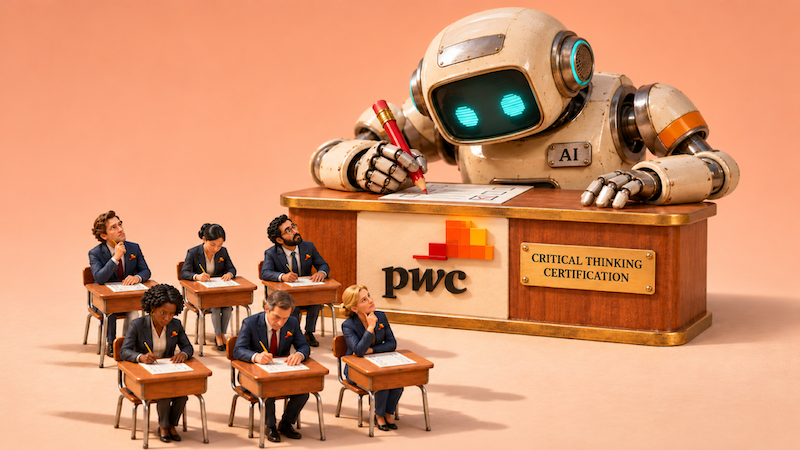
PwC is putting all of its more than 85,000 U.S. partners and staff through a certification in critical thinking, Bloomberg Tax reported. The firm says the goal is to keep human judgment in charge as AI takes on more of the work it does for clients.
The rollout starts next month in PwC's U.S. and Mexico offices and in offshore service centers such as India. PwC expects to finish by June 2027 and puts the total cost above $100 million.
That is a lot of money to teach accountants and consultants to do something their clients assumed they were already doing.
The training starts with how you think
The certification opens with a diagnostic that sorts participants by thinking style and flags their strengths and weak spots. Yolanda Seals-Coffield, PwC US's chief people and inclusion officer, gave Bloomberg Tax one example. An "analyst" type checks every input for reliability but can dive into the details before deciding how much checking the job actually needs.
After that, employees work through simulations tailored to their jobs. In one, a staffer gets an AI-generated assessment of a company's internal controls. The task is to find the deficiencies the tool missed and push back on its conclusions.
Seals-Coffield said PwC wants staff to keep critical thinking and judgment "at the forefront." She described the certification as one part of the firm's wider training on responsible AI use, not a course that stands on its own.
Part of the budget goes to universities
Some of the $100 million will be spent outside the firm. Starting in early 2027, PwC plans to offer the framework to universities and fund selected schools to work it into introductory courses. Bloomberg Tax did not name any of the schools.
That would let PwC shape how its future hires learn to handle AI before they show up for their first audit. It also puts the PwC name in front of students years before they graduate, which won't hurt recruiting.
Accenture's report shows what PwC is worried about
Last week, the Financial Times reported on a GPTZero investigation that found 31 hallucinated citations among 245 references in three Accenture-linked papers. The worst was a policy paper on African agricultural exports, written by Accenture's African arm with academics at IE University in Madrid. Fifteen of its 89 references were fabricated or wrong.
Accenture said it would correct the report and blamed human error, according to the FT.
PwC has its own record here. GPTZero says it has found hallucinations in reports from PwC, KPMG, Deloitte and EY over the past year. Those rivals are also building AI into their workflows and changing who they hire.
Our take
We think PwC is right to treat this as a training problem. We're less sure a certificate fixes it.
Consulting firms sell judgment. Clients pay for the assurance that someone experienced looked hard at the numbers and the sources. Once AI writes the first draft, that review is most of what the client is buying. A fake citation in a published report tells the client nobody did it.
A diagnostic and a set of simulations can build the habit. Whether it holds up depends on what happens when a team is behind on a deadline and the AI draft looks finished. That comes down to how managers review work and whether skipping the check has any consequences.
The university funding may matter more than the internal training. If PwC's framework ends up in intro courses, the firm gets to define what checking AI means for a lot of graduates, including the ones who go to work for its competitors.
The measure of all this will be easy to spot. There should be fewer made-up sources with the PwC logo on them.