Screenshots shared by e-commerce analyst Juozas Kaziukėnas show a "Claim your business in ChatGPT" feature with daily charts of impressions and clicks. OpenAI hasn't commented, and there's no launch date.
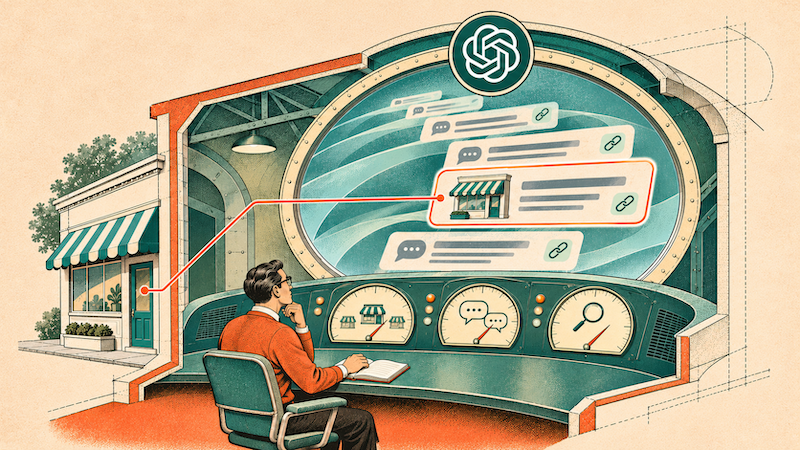
OpenAI looks to be building its own version of Google Search Console for ChatGPT. Businesses would claim a profile, then see how often ChatGPT mentioned them in answers and how many people clicked through to their site. Marketers have spent two years paying outside vendors to estimate those numbers, so this would be the first count to come from OpenAI itself.
Kaziukėnas found the feature and posted screenshots on LinkedIn. A banner in them reads "Claim your business in ChatGPT." SEO consultant Lily Ray shared it on X Friday morning, and her post passed 11,000 impressions and 200 likes in under two hours. Barry Schwartz wrote it up for Search Engine Roundtable soon after.
According to Kaziukėnas, the tool tracks two numbers. Impressions count how many times a business appeared in a ChatGPT response, and clicks count visits to the business's website from links in those responses. Both are logged daily and shown as a chart. The banner also says businesses will be able to keep their products and company details current, and to set up a "business agent" that answers customer questions using context the business controls.
Kaziukėnas said he first saw early pieces of it in August and thinks a launch is close. It appears to sit inside a larger Business Hub, and access is limited to businesses that verify ownership, for instance by connecting a Shopify store. OpenAI hasn't said anything about it publicly.
At State of AI, we think the most telling part is what's missing. OpenAI knows which questions put a brand in front of its users, and nothing in the screenshots suggests it plans to tell the brand. Without that, a marketing team gets a number to report upward and very little to act on.
OpenAI is keeping the prompts
Kaziukėnas was clear that the dashboard doesn't show prompt data, user data, or any ranking against competitors. A brand would watch its mentions go up or down with nothing inside the tool to explain the change.
The prompt is what a marketer would actually act on. In Google Search Console, the query report is the reason most people log in. Knowing a page got 40,000 impressions matters less than knowing which searches produced them. Kaziukėnas's own advice is to pair OpenAI's numbers with the outside tools that already sample prompts, so the first-party data can confirm whether a GEO or AEO strategy is working.
Those outside tools have become a crowded category. Profound, Peec AI and Similarweb are among the vendors selling prompt tracking, share-of-voice reports and competitor comparisons across ChatGPT and other assistants. They work by running sample prompts at scale and logging the answers, so their numbers are estimates. OpenAI has the real logs, which should make its figures more accurate but far less detailed. Most brands already paying for a tracker will probably keep it.
Most brands will see impressions without traffic
The clicks chart may be hard reading for a lot of brands. Last November, MarTech reported on a leaked OpenAI file covering publisher links in ChatGPT. The best-performing page in it had 610,775 impressions and 4,238 clicks, a rate of about 0.69%, and most pages came in below 0.1%.
If those rates hold for businesses, many will see big impression counts sitting on very little traffic. That makes ChatGPT harder to justify as a referral channel and easier to describe as brand awareness, where a buyer sees the name in an answer and turns up weeks later through Google or a sales call.
Referral clicks aren't entirely new. OpenAI adds utm_source=chatgpt.com to links clicked in ChatGPT search, so referral traffic has shown up in analytics for some time. What brands haven't had is any record from OpenAI of the times ChatGPT named them and nobody clicked.
The tool lands right next to ChatGPT's ad business
Search Engine Roundtable notes the tool appears to cover ordinary ChatGPT answers, not ads. It still arrives beside a growing ad operation. OpenAI sells ads in ChatGPT and gives eligible ChatGPT Business workspaces up to $50 a month in ad credits, according to its help center. Third parties like CallRail already sell attribution for ChatGPT ad campaigns.
Google has run Search Console and its ad business side by side for years, and Search Console stayed useful anyway. Nobody knows yet whether OpenAI will keep the two as far apart. A free dashboard that shows a brand slipping in organic answers, a click away from where it can buy ads, is a very convenient arrangement for OpenAI. Brands should keep that in mind before anyone pitches them on it.
Our take
Brands should sign up when it opens. First-party impression data from OpenAI is better than anything the market has now, and verifying ownership is how a company gets control over the product and business details ChatGPT will use when it talks about them.
The problem is what OpenAI left out. With no prompts and no competitor data, a marketing team could see its mentions fell last week and have no way to learn from OpenAI what changed.
Leaders planning for this should do a few things.
Claim the profile early. Verification decides who sets the product and company information the business agent will draw on, and that shouldn't be left to whoever gets there first.
Keep paying for prompt tracking. OpenAI's dashboard can confirm that visibility is moving, but an outside tool is still the only way to see which questions moved it and who picked up the mentions you lost.
Report impressions and clicks separately. If click rates resemble last year's leak, referral traffic will badly understate what ChatGPT does for a brand. Impression totals can mislead in the other direction, so put both in front of the CMO.
Watch where the dashboard ends up. If it lands inside the same console as ChatGPT ads, treat any nudge to buy back lost visibility the way you would on any other ad platform.
OpenAI wants businesses to treat ChatGPT as a channel worth managing. That would be easier to take seriously if it showed them the questions.