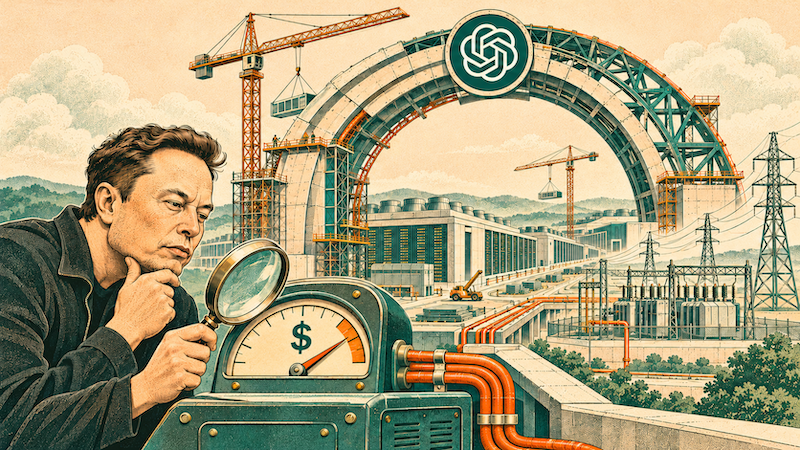
On Friday, Elon Musk posted seven words about the company bankrolling OpenAI's Stargate: "SoftBank is defaulting on their turbine orders."
He didn't name a supplier, an order, or a source. SoftBank hasn't responded, and no turbine maker has confirmed anything. For a Musk post about a rival, it was almost restrained.
It landed anyway. SoftBank shares fell close to 11% on the day. The cost of insuring its debt against default reached 466 basis points, its highest since October 2022, according to Reuters. Chip stocks had their worst session since 2020.
Musk was replying to Katie Miller, the conservative podcaster and his former adviser, who had brought back his January 2025 claim that Stargate's backers never had the money. The thread underneath was about something more concrete. An anonymous seller was trying to auction roughly $500 million in data center loans at once, days after the midterms. One was a $25 million slice of financing for a Stargate site in New Mexico. Oracle had reportedly sent that site's developer a force majeure notice, the letter a company sends when it argues events outside its control excuse it from what it promised.
"I have that on good authority"
The fight is almost two years old. On January 21, 2025, OpenAI announced Stargate at the White House: $500 billion over four years, $100 billion of it deployed "immediately." SoftBank would carry the financial responsibility and OpenAI the operations, with Masayoshi Son as chairman.
Musk answered OpenAI's post within hours. "They don't actually have the money," he wrote, then followed up that SoftBank had well under $10 billion secured. Altman told him he was wrong and invited him to visit the first site. Satya Nadella, asked about it, said only that he was good for his $80 billion.
Musk was right about the wrong thing. SoftBank never planned to have the money. Weeks later its CFO, Yoshimitsu Goto, said lenders and outside equity investors would cover most of the cost, with founding members putting in something like 10% to 20%. Stargate was a financing structure from the start. So the useful question was never how much cash SoftBank had in January 2025. It was whether the lenders would keep coming back.
What OpenAI has been selling since
OpenAI's own account of Stargate has been all momentum. In April it said it had already passed its goal of securing 10 gigawatts of US capacity by 2029, adding more than 3 gigawatts in the previous 90 days. GPT-5.5, it said, was trained at the flagship site in Abilene, Texas. At the Michigan groundbreaking in June, Altman told CNBC he was "very confident" the site would pay off for partners. Last November he put OpenAI's total commitments at about $1.4 trillion over eight years.
The word doing the work there is "secured." A secured gigawatt is a signed deal. A built one has turbines, transformers and a bill that someone has paid. By TechRadar's count this week, Stargate is a little under halfway to actually adding its 10 gigawatts. The same week, Axios reported that OpenAI may start calling its data centers "AI compute campuses." A new name doesn't change what the buildings cost or who has to finance them.
Why turbines are where it would show
Power has been the accepted bottleneck since 2024. Several Stargate sites plan to make their own electricity with on-site gas plants so they don't have to wait in grid queues. SB Energy, SoftBank's energy subsidiary, holds turbine orders for a gas facility of roughly 9.2 gigawatts in Ohio, meant to power OpenAI data centers from 2028. SoftBank has said it reserved turbines from makers including GE Vernova.
The wait for a new gas turbine now runs as long as seven years, according to S&P Global. That makes a turbine reservation the earliest bet in the whole build. You put down money years before there's a building, a chip or a customer. It's also the cheapest commitment to walk away from, which is why a sponsor that's getting cautious would let it go first.
And a slot you give up doesn't wait for you. Someone else takes it, and the Ohio timeline moves back by years, not quarters. If Musk is right, this is the first public sign that a Stargate sponsor is giving up long-lead power equipment. If he's wrong, the turbines are fine and the New Mexico loan is still for sale.
Consider who's talking
Musk runs xAI, which is racing to build its own data center capacity, and he's suing OpenAI. Miller, according to The Washington Post, holds a stake in xAI worth more than $1 million. None of that makes the claim false. It does mean nobody should take it at face value. The last time Musk put a number on SoftBank, Altman disputed it and SoftBank's CFO explained why it didn't matter.
The documented part of this week doesn't need Musk at all. A loan tied to a Stargate site is being sold off. A Stargate partner has reportedly sent that site a force majeure notice. Insuring SoftBank's debt costs more than it has in four years. Those are the questions for SoftBank, Oracle and OpenAI, and the answers won't come from X.
SoftBank could rebut Musk in a single sentence, and it may yet. The loan market will take longer to answer.