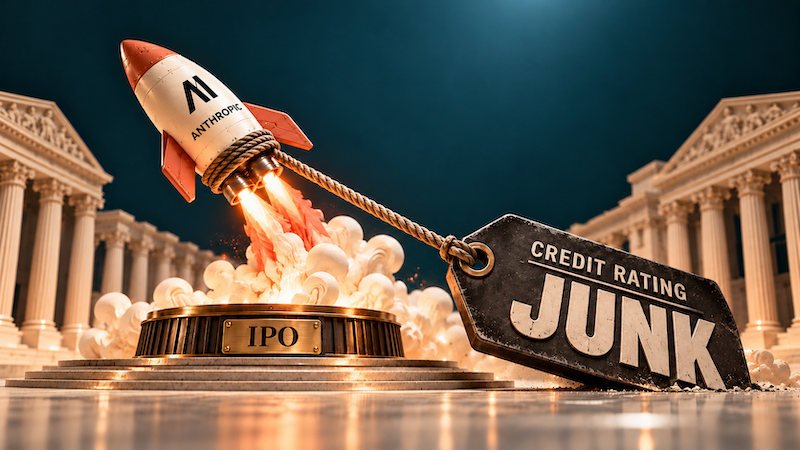
Anthropic's biggest private lender now expects a double-B rating once the company lists. That keeps the cheapest debt out of reach for a compute plan the FT puts at more than $800 billion.
Blackstone now expects Anthropic to land in the double-B range after its IPO, months after telling investors it would reach investment grade by year-end.
The junior debt that rests on Anthropic's own credit already pays more than 10%, up from about 8.5% in June.
Anthropic is about to raise as much as $100 billion from public investors. Its lenders have just been told not to expect that to make its debt much cheaper.
Blackstone has told investors in Project North Star, the $63 billion financing behind Anthropic's next batch of chips, that the company will likely get a high junk rating from the major agencies after its IPO, the Financial Times reported Friday, citing people familiar with the matter. For months, Blackstone had told the same partners Anthropic would reach investment grade before the end of the year. It changed its view after feedback from the agencies themselves, the people said.
None of the three big agencies has published anything yet, so Blackstone's call is a forecast. But it comes from the firm holding the riskiest piece of Anthropic's debt.
Broadcom's Rating Is Carrying the Deal
North Star works because Anthropic doesn't have to stand behind most of it. A new special purpose vehicle buys Broadcom chips and networking gear and leases them to Anthropic, with Bank of America, Citigroup, Morgan Stanley and Blackstone putting up the money, Bloomberg reported when the firms announced the deal on Monday.
About $42 billion of it is senior debt guaranteed by Broadcom, which already has an investment-grade rating. Lenders in that tranche are mostly betting on Broadcom. The other $18 billion is junior debt with no Broadcom guarantee, paid back from Anthropic's lease payments and nothing else. Blackstone's funds are putting $9 billion into that slice at a coupon above 10%, the FT reported earlier this month. Similarly rated companies pay about 7% in the public bond market.
The first deal in the series was built the same way. Big Sky, a $35 billion package led by Apollo in June, got an investment-grade rating because Broadcom backed most of it. Its junior slice, about $4.4 billion with direct exposure to Anthropic, was rated BB+ by Kroll Bond Rating Agency and sold at roughly 8.5%, according to documents seen by the FT.
In June, Anthropic's own credit cost about 8.5%. Four months and one IPO filing later, it costs more than 10%.
SpaceX Asked for Investment Grade. Anthropic Didn't.
SpaceX set the template this year. Its IPO filing said it aimed to keep an investment-grade rating, and Moody's, S&P and Fitch all gave it one within days of its June listing.
Anthropic's S-1, filed October 26, said little about a path to investment grade and warned that the company may need to raise more money sooner than it had planned, Bloomberg reported. The rating still matters to its existing debt. One of Anthropic's credit agreements drops its guarantees and security once two of the three big agencies rate the company investment grade, and its borrowing margin falls with each notch, from 1.25 points over the benchmark at BBB- to 0.75 at A.
Anthropic's bankers have been working the agencies anyway. Advisers to Anthropic and OpenAI have lobbied Moody's, S&P and Fitch to grant investment grade after each company lists, arguing the IPO cash will change their balance sheets. The agencies have said they'll wait to see how the IPOs go. Blackstone, which talks to the same agencies, now thinks it knows the answer.
Junk Shuts Out the Patient Money
The higher coupon is the smaller problem. Many pension funds and insurers can't hold junk debt, or can hold very little of it, and they're the buyers who fund long, cheap infrastructure loans. Anthropic's prospectus lays out more than $800 billion of computing spending between now and 2045, according to the FT. That's the kind of bill those buyers usually pay for.
Without them, Anthropic keeps borrowing the way it has all year, through special purpose vehicles that lean on Broadcom and Google. Under the North Star lease alone, Anthropic has committed $125.2 billion, and the $42 billion senior loan covers about a third of it, the FT reported.
Anthropic isn't short of cash. It holds more than $112 billion, and the IPO could bring in about $100 billion more. That covers the next few years. It doesn't come close to covering the next twenty.
What It Means for Claude Customers
Nothing about this changes what an enterprise pays for Claude next quarter. Over a longer stretch, though, the cost of financing compute has to land somewhere, in Anthropic's margins, in its prices or in how quickly new capacity comes online. A lab paying 10% for its chips has less room to move than one paying investment-grade rates.
There's a more practical change coming too. Once Moody's, S&P and Fitch publish, procurement and risk teams will be able to put a frontier lab's public credit rating into a vendor review for the first time. If the agencies land where Blackstone expects, that rating will say double-B.
What Comes Next
Anthropic is expected to list on Nasdaq under the ticker ANT before the end of November. The agencies will rule after that. OpenAI, which is preparing its own listing, will be reading the result closely.
Stock investors are lining up for Anthropic's IPO. Its lenders, for now, still want 10%.