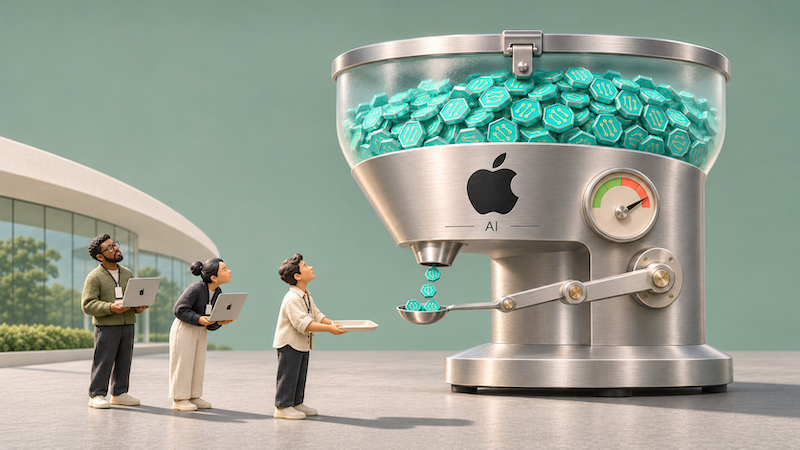
Apple has lowered daily AI spending caps for some engineers from $300 to $200 and plans further cuts to $100, with some non-engineering teams possibly going to $25. The cuts come under new CEO John Ternus, as Apple's research spending climbs and staff worry about layoffs.
Apple cut the daily amount some of its engineers can spend on AI models from $300 to $200 last month, and it plans to take certain engineering teams down to $100, Bloomberg's Mark Gurman reported Wednesday. Many teams outside engineering already have a $100 daily cap, and Apple has considered lowering that to $25 for some of them.
The budgets cover the input and output tokens employees use on outside models, which include Anthropic's Claude, OpenAI's ChatGPT and Google's Gemini, according to MacRumors. Apple is also asking some teams to switch to cheaper models or to AI that runs on the device. Employees whose work needs more can ask senior executives for an exception.
Apple wants its staff using AI more. It's also giving them less money to do it with.
The old cap was generous, and few people used all of it
At $300 a day, an engineer who hit the cap on each of roughly 250 working days could run up about $75,000 a year in model costs. At $100, that falls to about $25,000. A $25 cap works out to around $6,250.
Some employees told Bloomberg that few people were spending anywhere near $300 a day, so it isn't clear how much Apple will actually save. The first cut may have mostly trimmed headroom nobody was using. The planned drop to $100 is more likely to change how people work, because the engineers who come closest to the limits are the ones running coding agents through long sessions.
Engineers get the biggest budgets because coding work goes through tokens faster than most other uses. They're also the employees Apple most needs on these tools, since coding is where companies say they're seeing the clearest gains from AI.
Ternus is cutting costs across Apple
John Ternus became CEO on September 1, taking over from Tim Cook, who is now executive chairman. Bloomberg reported in September that Ternus wants fewer layers of management and faster product releases, and Apple has since dismissed a number of engineering program managers, including about half a dozen directors. Over the summer, Apple drew up a plan to replace about 5,000 AppleCare support workers with AI agents, then put it on hold.
Apple has also brought in outside productivity consultants for some divisions, MacRumors reported, and together with the AI cuts that has employees worried about restructuring. Techmeme's summary of the Bloomberg story was blunter, saying the cost cutting has staff afraid of layoffs.
The caps also run against the push Apple made under Cook, who had encouraged employees to use AI more in their work. And they come while Apple's overall spending keeps rising. Research and development costs rose 32% to a record $45.77 billion in fiscal 2026, much of it on AI and infrastructure. Employee AI budgets are a small line inside a much larger number that's still going up.
Other companies have set limits of their own
Apple isn't the first big company to put a number on employee AI use. Tesla has set weekly limits of around $200, and Uber caps individual developers at $1,500 a month on AI coding tools, MacDailyNews noted. Accenture funds $29 a month of Claude for each employee, slightly more than Apple's lowest proposed tier allows in a single day.
Some have gone the other way. Cisco's president gave one engineer unlimited AI tokens to rewrite the company's legacy code. Amazon, after employees ran agents on pointless tasks to climb an internal leaderboard, now tells its engineers that token counts are a poor way to measure AI adoption. Goldman Sachs took coding agents away from its traders and bankers last month and kept them for engineers.
Our take
At State of AI, we think Apple is right to put limits on AI spending and is doing a poor job of telling employees why.
A budget is a reasonable thing to have. Token costs climb quickly once agents are involved, and a company that never sets a ceiling usually learns what it's spending from the invoice. Asking teams to try smaller models or on-device AI first makes sense too, especially at a company that sells on-device AI to its customers.
The trouble is when Apple is doing it. Employees have watched program managers leave, consultants arrive and an AppleCare layoff plan get drafted and shelved. A smaller AI allowance landing in the middle of that won't read as housekeeping. Some people will take it as a sign the company expects to need fewer of them, and some will start using AI less to stay under the cap, which is the opposite of what Apple says it wants.
Leaders setting their own AI budgets can take a few things from this.
Set caps from what people actually use. If most engineers spend well under the limit, cutting it saves little and still lands as a cut. Look at the spread of real usage first, and explain the number you pick.
Make exceptions easy to get. Apple's employees can ask senior executives for more, but few engineers will take a $50 overage to a vice president. A team lead with a pooled budget can make that call in a minute.
Measure what the spending produces. A daily dollar figure says nothing about whether the work got better. Amazon found that out with usage targets, and a spending cap can fail the same way in reverse if the teams that spend least start getting treated as the best.
And say plainly what the change is for. If the caps are about cost discipline and not headcount, tell people so. Nothing in the reporting so far shows Apple explaining the cuts to staff, and its employees are supplying their own explanation.