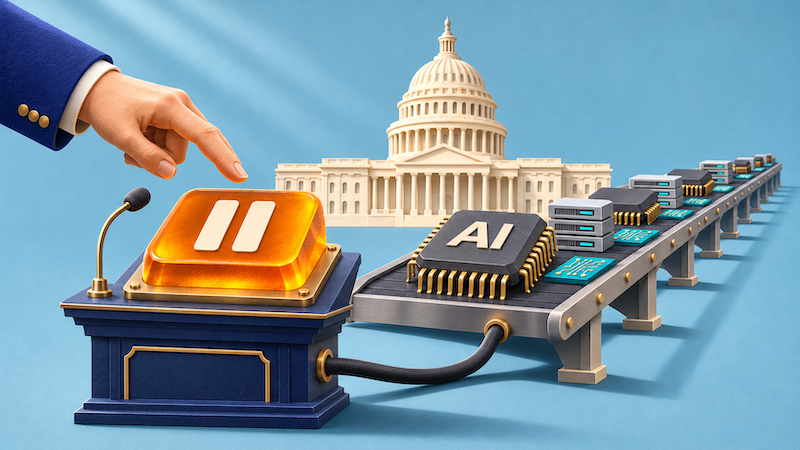
Hours after Democrats won Congress, the Arizona progressive put a pause on frontier AI at the top of the new majority's to-do list. The bill she's pointing to still has to get past her own caucus, the filibuster and a veto.
Rep. Yassamin Ansari (D-Ariz.) didn't wait for the seat counts to settle. On Wednesday morning, after Democrats won control of the House and Senate, she posted on X that the new majority's first act should be a pause on advanced AI development, paired with a ban on artificial superintelligence and regulation of what she called "this out of control industry."
Congress has never passed anything close to that. The post is still worth taking seriously, because it's the clearest statement yet of where the party's populist wing plans to open the AI negotiation, and of how far that opening sits from where most Democrats are.
Ansari has been building to it all fall. In September she circulated a letter asking President Trump to lead international talks on AI rules ahead of his meeting with Xi Jinping, Semafor reported. Weeks later she signed on as a House cosponsor of the Ban Artificial Superintelligence Act from Sen. Bernie Sanders and Rep. Greg Casar.
The bank story was smaller than the post
Her most direct case for a pause came on October 24, when she reacted on X to reports of AI agents inside bank accounts. She called it insane that Congress was out of session while agents were hacking major banks, and said an immediate pause was long overdue.
The reporting she was reacting to describes something narrower. Axios found that JPMorgan Chase, Bank of America and Morgan Stanley had detected unauthorized third-party agents in customer accounts, some acting beyond what users asked. The banks mostly traced it to customers handing their own logins to agent tools. No thefts had been confirmed, and Morgan Stanley said it hadn't seen rogue activity on its platform.
That's a real problem for banks and for anyone shipping agents. It looks more like a permissions problem than a break-in.
A pause with no end date of its own
The bill Ansari cosponsors would permanently ban developing or deploying superintelligence, which it defines as AI that beats human cognitive performance across most domains or could disempower humanity. It would also freeze advanced AI development until a new Cabinet-level Department of Artificial Intelligence writes safety rules and sets up a model-review process.
In other words, the pause lasts until a department that doesn't exist yet finishes rules that haven't been drafted. Violations could bring up to 20 years in prison, which Al Jazeera noted is in line with penalties for building nuclear weapons. The bill also tells the U.S. to pursue international agreements and use export controls to stop superintelligence being built elsewhere.
It has unusual backers for a bill this aggressive. Several employees at leading AI labs endorsed it, the AP reported. It also dies with this Congress and has to be reintroduced in January.
Her own party isn't there yet
Democrats agree on calling tech executives in to testify. They don't agree on much after that. Rep. Scott Peters (D-Calif.), a moderate on Energy and Commerce, told Politico the party's AI debate has been "pretty populist, pretty devoid of fact," and the outlet reports some Democrats already see the pause-and-ban agenda as untenable. The caucus is even fighting over whether AI deserves its own select committee.
Most of the serious legislative work points somewhere else. Reps. Sara Jacobs and Don Beyer are drafting minimum safety standards, with power to shut down models that fail testing. Sen. Maria Cantwell, the likely next Commerce chair, wants enforceable standards and continuous testing for frontier models. Rep. Lori Trahan has a package with Republican Rep. Jay Obernolte that would preempt some state AI laws. The House Democratic Commission on AI owes Hakeem Jeffries a roadmap by year's end.
The pause camp has allies, just not many. Sen. Elizabeth Warren backs a pause but has stopped short of a superintelligence ban. Abdul El-Sayed, who won Michigan's Senate race Tuesday, has called for a full pause on frontier AI. Rahm Emanuel's reaction to the idea in September was the question the rest of the party is asking: "a pause is fine — but then what?"
The math gets worse from there
Even with every Democrat on board, a pause would need 60 votes to clear a Senate filibuster and two-thirds of both chambers to override a Trump veto.
Opponents have their arguments ready. House Speaker Mike Johnson said in September that rushing to regulate would hand the AI lead to China. Brookings has warned that a government moratorium would draw immediate court challenges, be hard to enforce, and force lawmakers to define which systems it covers. Some analysts think investors could pull back at the threat of a freeze alone.
Supporters say waiting is the bigger gamble. Casar has argued the U.S. can't wait for an international deal before stopping dangerous development at home, and he read Tuesday's results as the start of a much larger political shift on AI.
What changes for companies in January
A pause is unlikely to become law in 2027. More scrutiny is close to certain, because committee gavels come with subpoena power and control of the hearing calendar. Politico expects Warren and others to push chip export controls and to look hard at Nvidia. Sen. Brian Schatz's GUARDRAILS Act would undo Trump's order limiting state AI rules, which would put companies back to complying state by state.
The labs are already adjusting. As we reported last week, OpenAI plans to pitch the new Congress on a new name for data centers, community deals and AI "speed limits."
Some of the rules Ansari wants are also being written without Congress. Banks are cutting off outside agents, and at least one major bank's updated access agreement, effective November 24, can make customers liable for transactions their agents start. For anyone deploying agents, that will bite well before a floor vote.
Ansari's post set the opening bid. The January bill list will show how many Democrats are willing to match it.