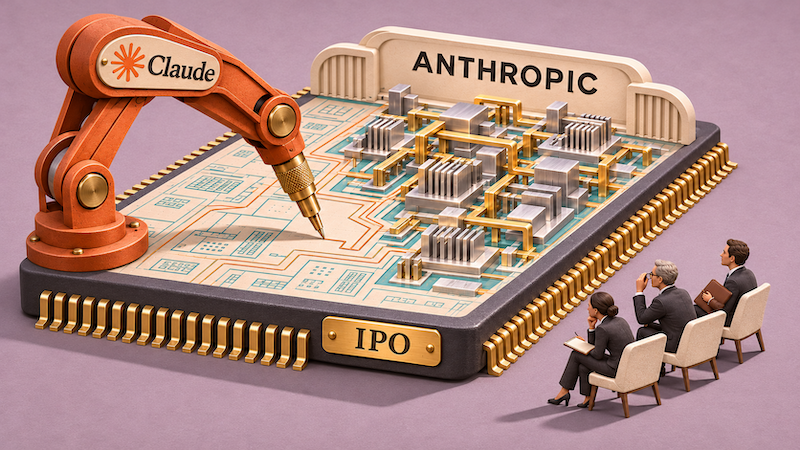
A 15-person Anthropic team is using Claude on custom silicon meant to train and run Claude.
Its engineers measure the speedup against their own estimates of how Nvidia and AMD work.
Weeks before its Nasdaq debut, Anthropic has added chip design to the list of things it says Claude can do.
In recent meetings with prospective IPO investors, the company said its new 15-person chip design team is already using Claude for engineering and design work on custom chips, The Information reported Tuesday. The chips are meant to train and run Claude itself. Anthropic hasn't announced plans to sell the design tooling to anyone else, according to FourWeekMBA.
It makes for a good roadshow slide. What's actually being described is a handful of engineers who use Claude as a tool and say it speeds them up.
The Benchmark Is an Internal Guess
Anthropic's engineers told investors Claude cuts chip-design time compared with their own estimates of how long the same workflows take at Nvidia and AMD, AI Weekly reported, summarizing The Information. So the yardstick is Anthropic's own guess about how its rivals work.
The reporting doesn't say how big the speedup was, which chips the team is building or whether any design has taped out, FourWeekMBA noted.
The claim isn't in Anthropic's filings either. The company filed its S-1 on October 26 and amended it on November 2. Roadshow talk doesn't carry a registration statement's legal liability, and the stronger signal is whether the chip claim ever appears in offering documents, Newsquawk observed.
The Compute Bill Explains the Timing
The amended S-1 puts Anthropic's signed contracts at about $895.4 billion, nearly all of it for compute and infrastructure, with about $69.8 billion due in the 12 months after September 30, StockTitan's breakdown of the filing shows. Broadcom leases Anthropic TPU-based equipment. Google, Amazon and Microsoft sell it cloud capacity. SpaceX's AI unit, Nscale and Lambda run Nvidia chips for it, and a separate AMD deal could pass $20 billion.
That bill is getting more expensive to finance. Blackstone now expects Anthropic to get a junk rating after the IPO, State of AI reported last week, which keeps the cheapest debt out of reach.
Anthropic isn't dropping its suppliers. It told investors it will keep a multi-chip approach built on Nvidia and AMD GPUs, Amazon's Trainium and Google's TPUs, per AI Weekly. Custom silicon still puts it in an awkward spot with Amazon, Alphabet, Nvidia and AMD, which are investors, core suppliers or both, Investing.com reported.
Chip-Design Software Stocks Took the Hit
Synopsys fell 2.5% and Cadence 4.5% in Tuesday trading, according to Investing.com. Anthropic hasn't said it will sell design tools. It has approached several EDA companies about access to their proprietary chip-design data to improve Claude, the same report said. Those are the same companies investors now worry it could undercut.
OpenAI is making the same argument. CFO Sarah Friar said in September that OpenAI used its own models to help design its "Jalapeño" chip with Broadcom in nine months, Investing.com noted.
What It Means for Enterprise Buyers
None of this changes what Claude customers get this quarter. It does show where Anthropic wants to sell next. If Claude can speed up chip design, the argument goes, it can handle specialized engineering well beyond writing code.
Engineering leaders will hear some version of that from their account reps. It's fair to ask them for what investors still haven't seen, which is a number and a baseline.
What Comes Next
The amended S-1 already warns that Anthropic may soon reach its Responsible Scaling Policy's threshold for progress dramatically accelerated by AI, though it says no current model exceeds it, StockTitan noted from the filing. A model that helps design the chips that train its successor is exactly the loop that threshold was written to watch.
Anthropic is expected to list on Nasdaq as ANT before the end of November, State of AI reported. The next amended filing will show whether the chip story makes it into the prospectus.
For now, investors are hearing it in meetings, where nobody has to put a number in writing.