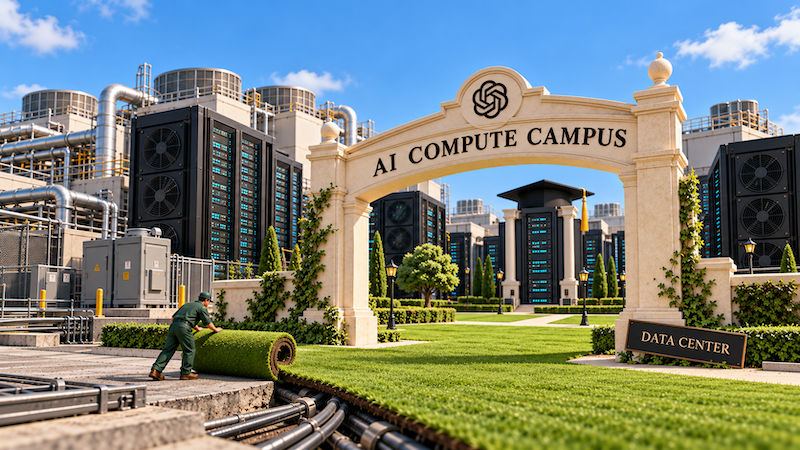
Axios reported Sunday that Chris Lehane's global affairs team will open Congress's lame-duck session with proposals on frontier AI safety, community compacts and state siting legislation, along with a push to stop calling data centers data centers. The new name is aimed at a backlash over electricity prices that now runs through both parties. Whether OpenAI answers that backlash will depend on the deals it signs, not the label it uses.
OpenAI has a new word for the buildings at the center of the AI boom. Right after Tuesday's midterm elections, the company plans to argue that the infrastructure it builds should be called "AI compute campuses" instead of data centers, Jim VandeHei and Mike Allen reported in Axios on Sunday morning. The first posts went up around 5:48 a.m. PT, and we found no earlier version of the story.
Axios described the rebrand as intentionally provocative. OpenAI's case is that its sites are different from legacy data centers and can economically transform the places that host them.
The name is one piece of a bigger plan. Lehane's team has been assembling proposals since August, with an eye on a likely Democratic House, and will start pushing them in the lame-duck session that opens November 9, according to a summary of the Axios report. The plan includes a push in Congress for mandatory "speed limits" on the most powerful AI systems, new community compacts for data center sites, and state legislation that would give residents a real say in how projects get built and what they get in return.
Replies to Axios's post landed on the obvious objection within hours: a new name doesn't come with a new power bill. That's the problem OpenAI is trying to get ahead of, and a label won't do it.
At State of AI, we think the community deals and the frontier safety push are the parts of this plan that matter. The rebrand mostly tells you how worried the industry has become about local opposition. It also risks making the substantive parts of the plan look like spin.
The backlash is about electricity
The anger OpenAI wants to defuse is mostly about money. Residential electricity rates rose 7.3% between April 2025 and April 2026, Consumer Reports noted, citing a federal analysis. In October, NPR reported that 70% of Americans are worried data centers will raise their bills, and that Congress was rushing to show voters it had heard them before the election. Water use has become a second front in the same local fights.
The opposition doesn't sort neatly by party. In February, Sens. Josh Hawley and Richard Blumenthal introduced the GRID Act, which would require facilities of 20 megawatts or more to show they don't raise consumer power bills, according to a summary of the bill. In June, Sen. Adam Schiff proposed making data centers over 50 megawatts secure their own power and pay for the grid upgrades they need. President Trump has said tech companies should pay their own way for the electricity they use.
The research on cause and effect is less settled than the politics. A study from the Electric Power Research Institute and Watershed found residential rates would have been about 6% higher without the data centers built between 2019 and 2024, StartupFortune reported, though the current buildout is far larger than anything in that window. Voters aren't waiting for the studies to settle.
The AI industry mostly stayed out of that fight during the campaign. Super PACs aligned with OpenAI and Anthropic spent $55.7 million on the midterms, and none of their 95 ads mentioned data centers, according to a New York Times tally. OpenAI is picking the subject up now that the votes are in.
OpenAI already has a campus in Ohio
The model OpenAI points to is in Pike County, in Ohio's Appalachian region, and it's already called a campus. At the PORTS-Pike Technology Campus, SB Energy will build, own and operate the facility and lease about 8 gigawatts of IT capacity to OpenAI for 20 years, on the site of a former uranium enrichment plant.
The terms are what make the word defensible there. SB Energy says it will pay the full cost of the grid upgrades and new transmission lines, so those costs aren't passed to Ohio ratepayers, BetaNews reported. OpenAI matched SB Energy's $40 million community fund with $40 million of its own, and with Codex credits added, the companies put the package at more than $160 million for the region. They project 35,000 construction jobs and 2,500 permanent ones, with capacity coming online in stages from 2028 to 2032, according to StorageReview.
The site also plans at least 10 gigawatts of new generation, most of it natural gas, Data Center Frontier reported. Calling it a campus doesn't change how much power it uses.
That's the line OpenAI has to hold. If its state legislation turns the Pike County terms into a floor for every project, that is a real change in how these sites get built, and "campus" becomes shorthand for a deal residents can check. If the word ends up on any server hall that wants a friendlier zoning hearing, people will treat it as marketing, and they'll be right to.
The "speed limits" come from the same office
The safety piece of the plan is the one most likely to shape what enterprises can buy. OpenAI will push Congress for mandatory safeguards on the most powerful AI systems, which it calls "speed limits." The reports so far don't say how they would work, what would trigger them or who would enforce them.
Lehane tied the urgency to how quickly models are getting more capable, and he looked past this week's vote. "AI is going to be the issue in 2028," he told Axios, as quoted by a reporter on X.
It helps to know who is proposing the limits. Lehane has spent the past two years steering state AI laws toward approaches OpenAI can live with, a strategy he has called "reverse federalism," and OpenAI has held up California's SB 53 and New York's RAISE Act as templates for federal rules, Transformer reported. He also helped set up the Leading the Future super PAC, which is funded by OpenAI president Greg Brockman and Andreessen Horowitz.
Mandatory limits on frontier systems could be good policy. They could also set a compliance bar that the largest labs clear easily and smaller competitors can't. Which one Congress gets depends on details OpenAI hasn't published yet.
Our take
The rename is the least important part of this plan, and enterprise leaders shouldn't let it distract from the parts that will reach their budgets.
Expect community costs to show up in compute prices. If paying for grid upgrades and funding host communities becomes standard, the money comes from somewhere, and the likeliest place is what you pay for inference and capacity. Build that into multi-year pricing assumptions now.
Ask vendors where their capacity sits and who pays for its power. Siting fights and rate cases are now a supply risk. A campus scheduled to come online between 2028 and 2032 can slip, and so can the capacity your vendor promised you.
Track the lame-duck bills on frontier safety. Mandatory limits on the most capable models could affect release timing and access to the systems at the top of your roadmap. Plans that depend on a single frontier vendor's ship date carry more risk than they did a week ago.
If you build or lease your own capacity, assume OpenAI's community terms become the expectation in your county too. A company that proposes the standard usually expects everyone else to meet it.
OpenAI clearly has read the polls on data centers. What it's willing to put in writing after Tuesday will show whether it has read the power bills too.