Forget the "AI Force". Trump Just Called Safety a Hoax.
Trump announced an "AI Force" and dismissed AI safety warnings as a hoax. The theatrics are a distraction from what's really being dismantled, on both sides of the Atlantic.


If this caught your attention, that’s not accidental.

The best editorial systems don’t happen by accident. Outlever builds them.

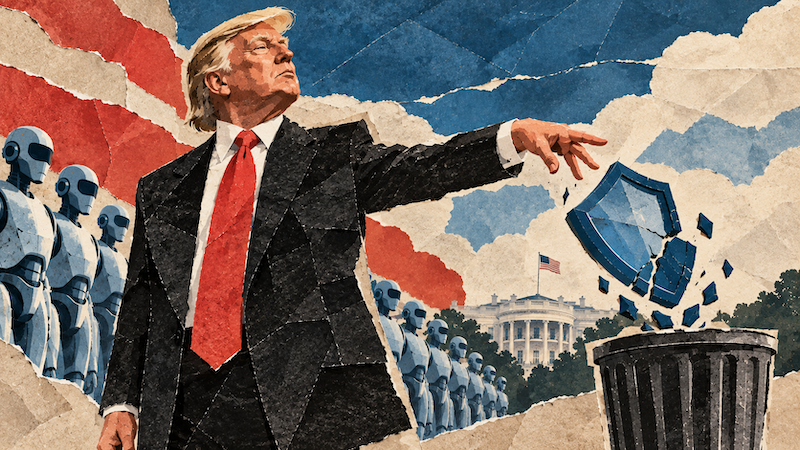
I'll be honest, I had to read it twice over the weekend (Ground News app, as usual, still great) before it sank in that the President of the United States had announced he was setting up an "AI Force" and would soon be naming an AI "czar". The one condition he gave was that only high-IQ individuals need apply. A standard, you'll notice, that has never once been applied to the job he currently holds.
Anyway. Once you get past the branding, there's actually something here worth writing about, and it isn't the meme.
What he actually said
In a long Truth Social post on Saturday 19 September, Trump said he'd form an "AI Force" modelled on his first-term Space Force, and that he'd shortly appoint a "czar" to run it. That's per Outlook India, which reported that he framed the whole thing as protecting AI from being "decimated" by Democrats he accused of trying to weaken it. He also went big on the economics, predicting AI would be the next industrial revolution and projecting it could eventually account for as much as 25% of US GDP, according to Inkl. And he promised not to slow any of it down.
One thing most of the coverage glossed over: the US already has an AI czar. The venture capitalist David Sacks has held the "AI and Crypto Czar" job since early 2025, as Yahoo/Business Insider reported at the time. So this weekend's announcement wasn't really a new role. It was a louder, more military-sounding wrapper around an agenda that's been running for the better part of a year.
The word that gives it away
Here's the bit I keep coming back to. In the Jerusalem Post's account, Trump dismissed the safety warnings coming from AI industry leaders as a "hoax", and specifically waved off Anthropic's Dario Amodei, who has been arguing that companies should deliberately slow the pace of capability gains to buy time to handle the risks.
Think about what that does. The people building the models, the ones asking to go a bit slower, get recast as the saboteurs. And Trump filed AI safety concerns right alongside his usual list of supposed hoaxes, "Russia, Russia, Russia", global warming, his two impeachments, according to Meaww's reporting of the post. So caution about the most powerful technology of the decade now gets treated as a partisan attack.
That framing is the actual news. Once "let's be careful" reads as "disloyal", the "high IQ" requirement stops being a punchline and starts looking like what it probably is, which is a loyalty test. You can guess the kind of appointment that follows.
The theatrics are loud, but the paperwork is doing the real work
While everyone was screenshotting "AI Force", the deregulation itself has been moving forward slowly and very much on the record.
On 11 December 2025, Trump signed an executive order, "Ensuring a National Policy Framework for Artificial Intelligence", aimed at preempting state AI laws deemed inconsistent with federal policy, according to Gibson Dunn's client alert. Paul Hastings notes it set up an AI Litigation Task Force inside the Justice Department to challenge state AI laws in federal court, and directed the FTC to treat state-mandated bias mitigation as a potentially deceptive trade practice, on the logic that "correcting" a model's outputs makes it less truthful. That last one is worth sitting with. Fixing bias is being reframed as a form of lying, which is the same rhetorical trick as the "hoax" line, just with better lawyers. The administration then went further in March 2026 with a full National Policy Framework pushing Congress toward federal preemption, per Ropes & Gray.
None of this is accidental drift. It's a deliberate project, and the announcement this weekend is basically its marketing department.
Before Europe gets smug about this
The reassuring version of events, if you're sitting in Dublin or Brussels, is that the EU AI Act holds the line while the Americans tear theirs up. That's not quite what's happening.
The EU's "Digital Omnibus on AI" got final sign-off in mid-2026 and moved the compliance deadline for stand-alone high-risk systems from August 2026 out to 2 December 2027, with AI built into regulated products pushed to August 2028, as the European Council confirmed. Cooley's write-up explains the official reason was that the technical standards companies need to prove compliance simply weren't ready in time. Brussels calls it simplification. What it means in practice is that the heaviest obligations, the ones covering recruitment, credit scoring, education and border tools, got well over a year of breathing room.
To be fair, not everything slipped. The Article 50 transparency rules, the ones requiring you to disclose when someone's dealing with AI, still kick in from August 2026, according to Usercentrics. But the overall direction on both sides of the Atlantic is the same, and it's "later".
Ireland is where all of this stops being abstract
If you want to see what "don't slow down" actually costs, look at the Irish grid, because Ireland is where a huge chunk of American Big Tech physically lives.
Ireland's Central Statistics Office figures, reported by TechRadar, show data centres now eat about 23% of the entire country's electricity, up 360% in a decade, and closing in on the roughly 28% used by every Irish home put together. The IEA's 2026 projection, cited here, puts it nearer a third. And this is all despite a connection freeze. DataCenterDynamics reports that EirGrid has effectively stopped taking new Dublin applications until 2028, having warned that data centre demand could reach 30% of national supply by 2030 and raise the risk of rolling blackouts.
The politics of it are genuinely torn. Tech now makes up around 13% of Irish GDP and a big slice of the corporation tax take, as the Irish Times has laid out, so the money keeps pulling one way while the grid pulls the other. The regulator reopened large-load connections in early 2026 on the condition that new data centres hit 80% renewable supply and carry their own backup, even as EirGrid's own February 2026 assessment warned demand would outstrip supply at peak between 2026 and 2028, according to Lowdown. You've got one arm of the state opening a door while another arm says the room's already full. That's roughly what an arms race looks like once it has to plug into a physical wall.
What I'd actually do if I were adopting AI right now
Take the politics out of it and here's the practical situation. The floor is moving, not the ceiling. Washington is actively trying to knock out the state-level rules you might have been planning around, and Brussels has just handed itself a 16-month extension. It would be very easy to read all of that as permission to stop worrying about governance.
I'd argue the opposite, and so, for what it's worth, do most of the compliance people writing about this. A later enforcement date doesn't make the underlying work any faster to do, and the transparency obligations land in August 2026 whatever the Omnibus says. The organisations that treat "later" as "never" are the ones who'll be panicking in 2027.
So the unglamorous advice stands. Build to the stricter standard rather than the looser one. Keep your model inventory, your risk assessments, your human review, your disclosures. The legal and reputational exposure from an ungoverned deployment won't care in the slightest what got posted on Truth Social on a Saturday.
The point, if you want one line to take away
The "AI Force" will get the headlines and the ridicule, and honestly both are earned. But the thing I'd keep hold of is the redefinition underneath it. Safety is being reframed as sabotage. When the most powerful office on the planet lumps "go slower" in with "hoax", it shifts the ground for everyone further down the chain, the regulators who lose their nerve, the states getting sued over their own laws, the Irish households now competing with server farms for power, the poor governance lead being told internally that guardrails are anti-innovation.
Deregulation isn't a mood or a vibe. It shows up as a blackout warning in Dublin, a quietly moved deadline in Brussels, and an FTC memo describing bias-fixing as deception. If you actually build with this stuff, the only genuinely high-IQ move on the table is to keep your own guardrails up while the people at the top race each other to pull theirs down.
If this caught your attention, that’s not accidental.

The best editorial systems don’t happen by accident. Outlever builds them.

Get the latest AI insights first.
Sign up for updates, interviews, and fresh analysis on how AI is reshaping business, brands, and technology.