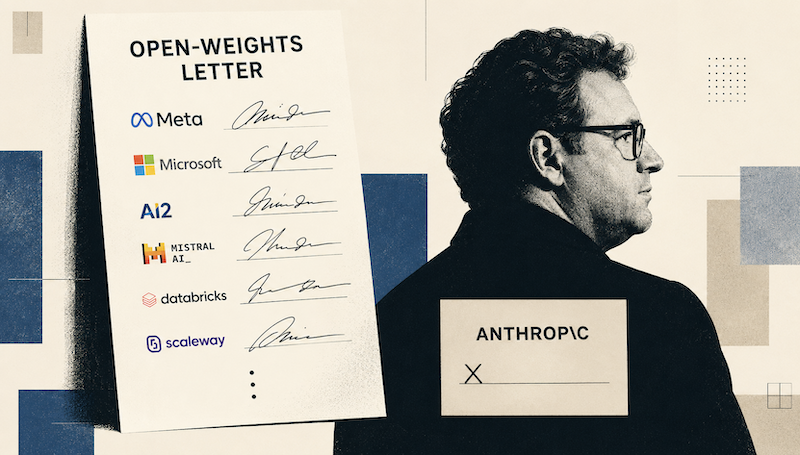
Anthropic spent most of last week as the most conspicuous absence in American AI policy. On Monday, Dario Amodei tried to end that.
The Anthropic CEO published a post on the company's site setting out where the lab actually stands on open-weight models, after several days of accusations that it was quietly lobbying Washington to restrict downloadable models and, by extension, to hobble the Chinese labs eating into its market. His denial left little room: "Anthropic has never advocated for a ban on open-weights models."
Some background. On July 24, a coalition of 25 companies published a three-page letter titled Open Weights and American AI Leadership, urging policymakers to avoid premature restrictions on downloadable models. CNBC reported that the signatories argued concerns about unlawful distillation should be handled through targeted legal and commercial frameworks rather than broad restrictions on the technique itself. The list covered a lot of ground: Nvidia, Microsoft, Meta, IBM, Dell, Palantir, Mistral, Hugging Face, Mozilla, the Linux Foundation, Andreessen Horowitz and Y Combinator, among others. Jensen Huang fronted it with the first post of his life on X, which The Next Web noted went on to clear 11 million views.
Three names were missing, and they were the obvious three: OpenAI, Google and Anthropic, the closed-model leaders with the most to gain from a crackdown. Tom's Hardware pointed out that the letter landed four days after reports that the Trump administration was reviving a push to ban Chinese models, though the document itself never names China. Within roughly a day the signature count had doubled to 50, and Forbes reported that OpenAI was now among them. Google signed too, per Axios. Anthropic still hadn't.
The Three Asks
Amodei's argument is that the letter collapses two questions that ought to stay separate. One is whether weights should be downloadable at all. The other is whether the most capable models should be tested before they ship. He answers yes to the first and wants regulation on the second.
He also concedes the uncomfortable part up front. Axios reported that he acknowledged a ban would shield US labs like his own from competition, and said that had never been his goal. His reasoning is that it wouldn't work regardless, since the actors he's worried about are unlikely to be legitimate American businesses downloading models through official channels.
In place of restrictions he proposes three narrower measures, summarized by CNBC from the post. The first is tighter control of advanced chips and chipmaking equipment flowing to authoritarian governments. The second is a crackdown on industrial-scale distillation, the practice of training a model on the outputs of a more capable one. Anthropic has already taken that fight to Congress: CNBC reported that the company wrote to the Senate Banking Committee last month alleging that Alibaba, developer of the Qwen models, had carried out what it called the largest known distillation attack against its systems. The third is mandatory safety testing for any sufficiently capable model, open or closed.
The distinction he keeps returning to is capability against licensing. What a model can do should set the requirements, not how it gets distributed. Models without dangerous capabilities, he writes, are a public good.
Where the Actual Disagreement Is
All the concessions obscure one real fight. Amodei accepts that open models expand access, competition and customer control. What he rejects, according to Axios, is the letter's stronger claim that open weights make AI safer by handing cyber defenders an advantage over attackers.
His counter is asymmetry. Tech Startups summarized the argument this way: in areas like biology, offensive capability advances faster than defensive capability, so a model that meaningfully lowers the barrier to producing a dangerous agent creates a problem that vaccines and countermeasures still take years to answer. More researchers reading the weights doesn't close that gap on any useful timeline.
Neither side has moved much on this. The Register quoted OpenUK chief executive Amanda Brock making the opposing case in support of the letter, arguing that security risks in software and AI are better managed openly and collaboratively than behind closed doors. That is the disagreement in one line. The open-weights camp treats transparency as a security property in itself. Amodei treats it as one that holds up to a point and then stops holding.
Amazon Picks a Side
Amodei's post went up the same day Anthropic's largest investor went the other way.
AWS chief Matt Garman announced on LinkedIn that Amazon had signed. He said there are elements of the letter that need further definition over time, but that the company supports its broad direction. He framed the decision as continuity rather than a shift, noting that Amazon has offered open-weight models on Bedrock since 2023, and closed with a line that reads as a mild dig at the closed-model camp: "No single model will define AI leadership."
Amazon has put tens of billions of dollars into Anthropic. That it signed anyway says something about how lopsided the industry consensus has become, and something about how comfortably a hyperscaler can hold both positions at once. Bedrock sells Claude. Bedrock also sells open-weight models. Anything that narrows the catalogue is bad for Bedrock.
What Happens Next
The trigger for all of this was Kimi K3, the Moonshot AI release that Axios described as approaching US frontier performance at a fraction of the cost, and which CNBC reported has outperformed leading American models on some industry benchmarks. The letter never mentions Moonshot or DeepSeek by name. Everyone reading it knows what it's about.
Amodei has now committed to a position he will have to keep defending: in favor of open weights, against industrial distillation, in favor of mandatory testing. The question is whether it survives contact with a policy process that tends to deal in categories rather than capability thresholds. Washington has always found it easier to ban a class of thing than to define a threshold and build the machinery to test against it.
Anthropic is betting the harder version is achievable. So far no other frontier lab has joined it.