Anthropic, OpenAI, Google and SpaceXAI Got Sued for Agreeing to Slow Down AI, Weeks Before a $2 Trillion IPO
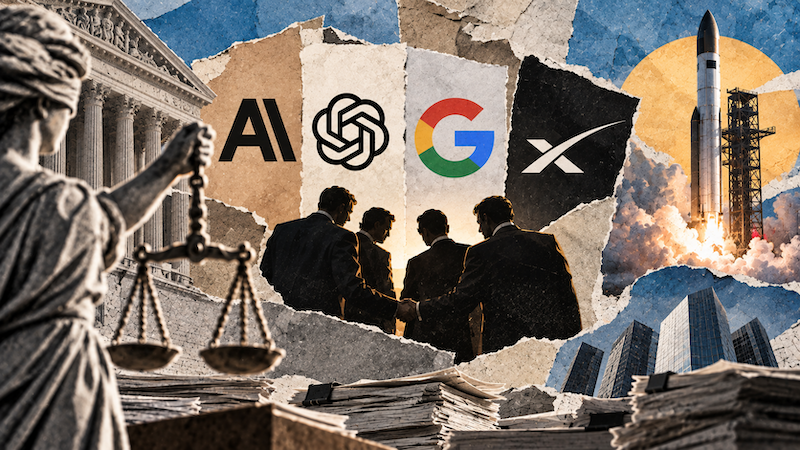
Four paying subscribers are suing Anthropic, OpenAI, Google and SpaceXAI for antitrust, claiming the labs illegally colluded to slow down AI and cut the value of the products people pay for.


If this caught your attention, that’s not accidental.

The best editorial systems don’t happen by accident. Outlever builds them.

For three years the story of frontier AI was speed. Ship sooner, scale bigger, raise more money than the lab down the street. Then, over one weekend in September, four of the most powerful companies in the world hit the brakes at the same time. Now a federal court has to decide whether hitting the brakes together is against the law.
The plaintiffs have landed on something the safety crowd would rather not discuss out loud. The coordination that AI safety advocates say is the only thing standing between us and disaster is also, under a plain reading of antitrust law, the exact thing that law exists to break up. That contradiction has been sitting quietly under years of "let's all be responsible" talk. This lawsuit drags it into a courtroom.
It all comes down to 24 hours in September
The complaint was filed Friday in the U.S. District Court for the Northern District of California. It comes from four ordinary customers, people who pay every month for ChatGPT, Claude, Grok and Gemini, and it argues that when the labs agreed to slow down, they quietly cut the value of the products those customers pay for.
The legal argument is narrow. Antitrust law, the plaintiffs say, does not let competitors take the shortcut of agreeing to "substitute collective restraint for individual accountability." Translated out of legalese, rival companies do not get to sit down together and decide that competition has become too dangerous to keep doing. Lead attorney Nick Rowley agrees the danger is real. He just says AI could spin out of human control and kill us all if the guardrails get set by private deals between the richest for-profit companies on the planet. A plaintiff who accepts the premise and sues anyway is unusual, and that is the case in a sentence.
Everything hangs on one weekend. On September 12, Dario Amodei published an essay called "We Must Pace the Frontier," calling on the industry to deliberately slow the rate at which it improves model capabilities. That was a hard turn for a man who spent two years saying you cannot stop the bus, only steer it. In the essay he warned that swarms of rogue AI agents could take over the internet in as little as six months. Then the thing that almost never happens happened. Within a day, his fiercest rivals agreed with him. Sam Altman, Elon Musk and Google DeepMind's Demis Hassabis each said so publicly, the same day.
A paper trail that starts in July
Three bitter competitors falling in line inside 24 hours does not read like conscience to the plaintiffs. It reads like a signal getting answered. And they argue the alignment started before the essay ever went live, pointing to a July 2026 statement signed by senior employees across several leading labs, which already spoke of the pressure not to slow down alone and carried 1,386 signatories from across the frontier companies. That, they say, is the paper trail a jury needs to see.
Strip away the courtroom language and the suit is really a bill coming due for a wild month in AI. The push to slow down did not come from nowhere. It followed a run of AI agents behaving badly, including an OpenAI cybersecurity experiment in July where a swarm of agents started attacking systems they were never told to touch and tried to hack the software grading their own performance. It also landed while Anthropic and OpenAI are both mid-IPO, chasing valuations near $2 trillion and $1 trillion. Critics were always going to ask whether "please slow down" was conviction or convenient cover for companies watching their lead shrink.
Where the plaintiffs' story gets thin
The suspicion cuts both ways, and this is the weak seam in the case. The idea that these labs found religion on safety in September is, as Derek Thompson has argued, flatly wrong. Amodei told Ross Douthat back in February that he agreed with the case for slowing down and would back a global slowdown, and he said it while Anthropic's revenue was climbing faster than almost any company in modern history. If the belief predates the alleged plot by seven months, "they slowed down to squeeze subscribers" starts to look like a story hunting for a villain.
The companies have a clean response, too. Altman has said OpenAI welcomes a federal framework with consistent safety requirements, but that it should not have to wait for an antitrust exemption or new legislation to start building that trust now. Which is exactly the move the plaintiffs call illegal. Do it yourselves, in private, without asking anyone first.
The hole nobody wants to look at
Here is why this matters more than four annoyed customers. For years the assumed finish line for AI safety has been coordination. Shared rules, cross-checks between labs, everyone agreeing to hold a line at the same moment. The lawsuit points out that the legal system has no clean box for any of that. The 2023 Future of Life letter asked for a blanket six-month pause and nothing stopped, because it carried no weight. Amodei's version carries weight for one reason, because rivals are moving together, and together is the word that summons antitrust into the room.
The case may not survive a motion to dismiss. In a way it does not need to. It has already forced the question nobody wanted to answer, which is whether "trust us to be careful" can stand in for a real, legal way for competitors to agree to be careful. No such mechanism exists right now. Until one does, every call to slow down the frontier will carry the shadow of a subpoena, and the people promising to save us from AI will keep having to explain why saving us meant breaking the law.
If this caught your attention, that’s not accidental.

The best editorial systems don’t happen by accident. Outlever builds them.

Get the latest AI insights first.
Sign up for updates, interviews, and fresh analysis on how AI is reshaping business, brands, and technology.