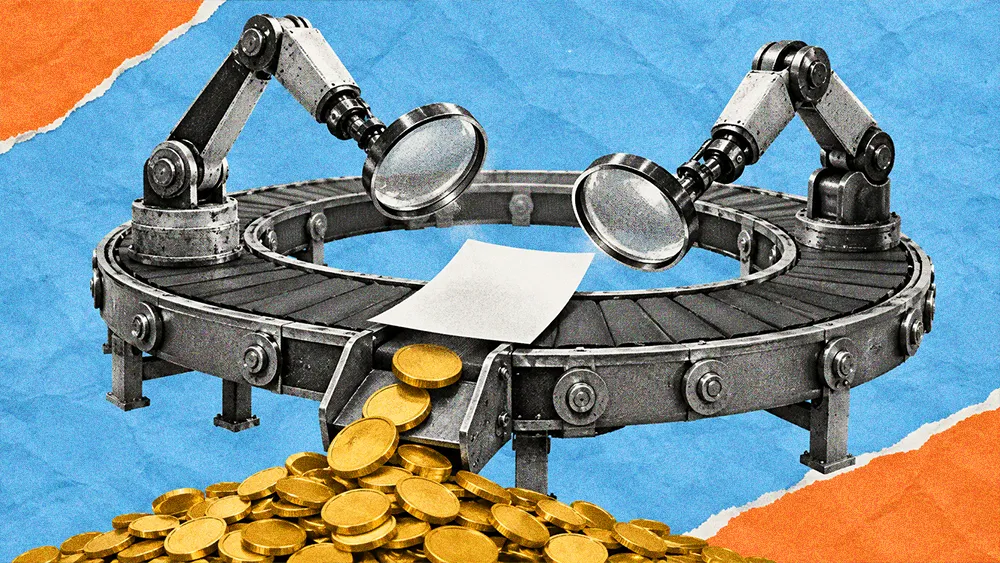

We could make a 10x efficiency gain, then an approval gate reduces it back to 5x. Whether we retain the entire 10x is totally up to how good the adoption is.
 Dharma MuthukrishnanChief AI Officer, Techjays
When mid-market leaders ask what their AI investment has returned, the answer usually comes back as hours saved on a single task. A proposal drafts itself in minutes, or a report that took a week assembles overnight. Those numbers are real, but they capture the smallest share of the return. A faster step speeds up the work downstream of it, shrinks the error margins companies have priced in, and frees teams to take on work they used to turn away. The same math also misses what drags those gains back down: every review, approval, and phone call a workflow still routes through a person. The full return comes from redesigning the workflow around AI, not accelerating one step inside it.
Dharma Muthukrishnan is Chief AI Officer at the AI transformation consultancy Techjays, which helps mid-market companies reimagine how their work gets done. He brings more than a decade of experience designing and building scalable software and led engineering teams at ADP and Athena before joining Techjays, where his focus spans cloud architecture and AI-driven applications. His approach is to build the ROI case for each engagement around the gains most companies leave off the ledger.
"A system that has a defined process and steps is likely to get you an even higher return on investment. It can improve your efficiency by 10x. A 10-member team can now compete with a 100-member team," Muthukrishnan says. Reaching that ceiling depends on counting everything the work changes, and on what stands between the system and the finish line.
Capacity is the first return, but not the whole one
Every AI rollout starts paying back in the same place: the team doing the work can suddenly take on more of it. Muthukrishnan treats that capacity as the opening line of the ROI case rather than its total. "With any AI rollout, you'll immediately start to get the efficiency gain or capacity unlock. A 40-member team in a particular department that takes a month to do a piece of work can now be doing 2x or 3x of what they were capable of," he says.
Capacity is the gain most dashboards are built to catch, and it's usually where the measurement stops. The returns that follow are harder to trace back to the tool, which is why they rarely make it into the business case.
The second return shows up after the step AI touched. Sales makes it easiest to see, since how quickly a team responds often decides whether it wins the work. "Because the system is faster, everything in your next level of workflow will also get faster. Take people who use AI for their RFP responses, or anything that comes in as a request by email, where the system helps them respond and estimate faster. The faster you respond, the more your opportunity of getting the deal increases," Muthukrishnan explains.
He counts this opportunity gain among AI's hidden benefits. It lands as revenue in a sales report rather than as hours saved in an operations review, so the two rarely get connected.
Accuracy shrinks the buffer built for mistakes
The third gain Muthukrishnan describes comes from a cost most companies have stopped noticing. Manual work carries a predictable rate of rework, and businesses plan around it. "Whatever people are doing manually right now will have some kind of human error associated with it. A certain percentage will be done wrong, which might require rework or sometimes end up as a loss. You just adjust to it. We usually keep buffers to manage those kinds of human errors, and sometimes that may nullify your profit at the end of the day," Muthukrishnan says.
Estimating is where those buffers run widest. A bid depends on more variables than any estimator can weigh, and past jobs only partly predict the next one, so the contractors Techjays works with pad their numbers to cover what they may miss. "It's humanly not possible to think through all the scenarios when they're planning estimations. With AI, the error loss will be minimized," he notes.
A smaller buffer means more competitive bids and less profit set aside for mistakes. "These are all hidden gains the company will get. We consider all of those, and then we calculate the ROI for the implementation," Muthukrishnan adds.
Human touchpoints set the ceiling
Once every gain is on the ledger, the question becomes how much of it survives the rest of the workflow. In Muthukrishnan's view, the technology is rarely the limit. "Right now, humans are the bottlenecks. The systems are actually good," he says.
The constraint sits at every point where the work still passes through a person. "Somebody has to do that review, somebody has to phone the client and get it confirmed. All the agentic parts might run 10x faster, but there's still a human in the middle layer doing what they're doing now, connecting with the hauler, connecting with transport, or managing logistics. All of that is going to stay human-based until those things are also automated," he explains.
Each handoff takes back part of the gain. A task that drops from 10 days to one doesn't help the customer if the order still sits in an approval queue, so measuring a single step can overstate the return while measuring the whole workflow shows where the next redesign belongs. "We could make a 10x efficiency gain, then an approval gate reduces it back to 5x. Whether we retain the entire 10x is totally up to how good the adoption is, or how complex the people-to-people relationships are in the business," Muthukrishnan says.
For a mid-market company, that makes a realistic baseline more useful than a headline multiplier, with each human step redesigned around the agents raising it from there. "In a defined workflow, where there is a defined input, a process, and an output, we can easily see a 2 to 3x improvement," he concludes.