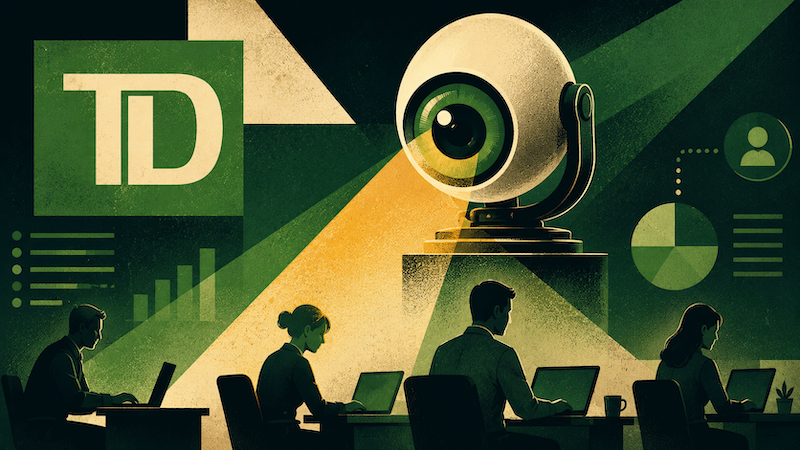
TD Is Going to Start Monitoring Some of Its Employees. Meta Did the Same Thing Two Months Ago.
Two months ago it was Meta logging keystrokes to train AI. Now a Canadian bank is tracking its financial-crime staff to lift productivity.


If this caught your attention, that’s not accidental.

The best editorial systems don’t happen by accident. Outlever builds them.

Toronto-Dominion Bank has told some of the people who hunt financial crime for a living that it is about to start watching how they work. The detail comes from Reuters reporter Nivedita Balu, who reviewed a recording of a team call and a document TD shared with staff.
According to that Reuters reporting, the lender is rolling out software to track employees on its financial-crimes and risk-management team, logging the time they spend across browsers, internal chat, and meeting apps. The framing from the bank is the one you would expect: this is about productivity.
The tool is a workforce-analytics product called WorkiQ, the kind of software that turns a workday into a stream of measurable activity. The framing from inside the room, judging by the consent and privacy questions Reuters says employees raised on the call, was a good deal less enthusiastic. That reaction is the pattern with these tools. The pitch is almost always efficiency, and the people being measured almost always start by asking who else gets to see the readout.
Hold that next to what Meta just did
Meta ran a version of this two months ago, in a program first reported by Reuters in April. The company had quietly installed tracking software on its US employees' work laptops through an effort called the Model Capability Initiative, capturing keystrokes, mouse movements, clicks, and the occasional screenshot.
Per that Reuters reporting, US employees could not opt out, while European staff were exempt because GDPR would not allow it. Meta said the data was not for performance reviews but raw material to train AI agents that can operate a computer the way a person does.
The backlash came fast, with Reuters noting that employees called the program dystopian. By June, according to follow-up Reuters reporting, Meta had walked part of it back, adding a way to pause collection for half an hour and a process to request an exemption.
That was not the company's only move of this kind. Last week we covered Meta reining in internal AI usage and building a central dashboard, called AI Gateway, to monitor employee token spending in real time, complete with automated alerts for unusual spikes. The original memo was first reported by The Information's Jyoti Mann. The data is different, but the instinct is the same one: instrument the workforce, watch the meter, and call it efficiency.
Put the two side by side. Meta turned its workers into training data; TD is turning its risk team into a productivity readout. The excuses really are different. One company says it needs examples of how humans use computers, the other says it needs to know where the time goes.
The underlying capability is the same in both cases, and so is the basic move. Instrument a workforce, then present the instrumentation as something done for the benefit of the people being measured. When a Silicon Valley AI lab and a 170-year-old Canadian bank reach for the same kind of tool in the same quarter, it is less a coincidence than a pattern.
Activity is not the same as output
There is a basic problem at the center of all of this. Time on a browser is an input, not an output. It tells you a person had a tab open, and almost nothing about whether the work in it was any good.
We made a version of this argument earlier this year. As The Information reported, Meta's tokenmaxxing leaderboard rewarded employees for raw AI usage, right up until people noticed that usage is an input, an expensive one, and that once usage becomes the scoreboard, employees optimize for the scoreboard rather than for results.
A stopwatch on a browser works the same way. When visible time becomes the thing being measured, what tends to increase is visible time, not work. People keep a chat window open, sit through a meeting that did not need to happen because it reads as collaboration on the dashboard, and perform busyness for an audience of one piece of software.
It is also worth asking why this is spreading now in particular. Two pressures point the same way. The first is cost, because AI has made monitoring cheap. Activity logs have always existed, but AI can now turn a flood of raw telemetry into something a manager will actually read.
The second pressure is the AI bill itself. As we reported from his comments at OpenAI's Intelligence at Work event, Sam Altman has said that complaints about burning through a whole year's AI budget in a single quarter went from something he never heard to one of the most common things customers raise, according to Axios. Under that kind of pressure, measuring employees more aggressively can start to feel like ordinary diligence rather than surveillance, and the line between the two gets harder to see.
The Canadian wrinkle, and why a promise not to misuse the data rarely holds
The geography matters here. This is a bank, in Canada, applying activity tracking to the team responsible for catching financial crime, and each of those facts adds friction that the Meta story did not carry.
At the federal level, the US places almost no limit on worker surveillance. Yale law professor Ifeoma Ajunwa made the point bluntly to Reuters when the Meta story broke, noting that there is effectively no federal ceiling on it. That is part of why Meta could log keystrokes on American staff while exempting Europeans.
Canada sits somewhere in the middle, with privacy rules that lean harder on consent and reasonable purpose than US law does, but without the near-prohibition that applies in Europe. So the consent questions TD employees raised on that call, as recorded by Reuters, are not just grumbling. Consent is a real legal and cultural factor in the country where the bank operates.
The work itself makes the tracking look especially ill-matched. A financial-crimes and risk team does investigative, judgment-heavy work, the kind where minutes logged in a browser are about the weakest measure of value you could choose.
There is also a trap that almost every company in this position falls into. The reassurance is always some version of "managers will not see the detailed data," or "this will not be used for performance." Meta offered that reassurance too, in its statements to Reuters and others.
The difficulty is that once detailed behavioral data exists, the gap between a training signal and a performance signal is very thin, and the people being measured understand that perfectly well. A promise cannot undo a capability. What holds is a technical and governance limit that makes misuse impossible in the first place, not a memo asking staff to trust that it will not happen.
Why it matters
The biggest cost here is not legal exposure, real as that is. It is trust, which is the one input that never shows up on a dashboard. As Inc. reported in the wake of the Meta program, career analysts warned that the employees most likely to leave when monitoring is handled carelessly are the strong performers and the younger staff.
Those are the people a bank's financial-crime team can least afford to hand to a competitor that did not install the stopwatch. It is entirely possible to measure your way into a workforce that performs visibility rather than doing the work, and to end up with a detailed dashboard tracking the decline.
That leaves a question TD, Meta, and every leadership team quietly drafting a monitoring policy this quarter are all facing. Companies are spending unprecedented sums handing work to AI agents that no one clocks by the minute, while using some of that same AI to start clocking their human staff by the minute.
If the real aim is to find out where the work is and is not paying off, that is a reasonable thing to want. But the firms that come out ahead over the next couple of years are unlikely to be the ones with the most detailed view of their people. They are more likely to be the ones that understood the difference between watching someone work and knowing whether the work is any good, and that recognized a browser timer was never going to tell them the second thing.
If this caught your attention, that’s not accidental.

The best editorial systems don’t happen by accident. Outlever builds them.

Get the latest AI insights first.
Sign up for updates, interviews, and fresh analysis on how AI is reshaping business, brands, and technology.