The Great Unbundling of the AI Lab
Alphabet lost close to $200 billion in a day because four researchers changed jobs. The frontier lab built around one famous name is coming apart, and Google just showed everyone how.


If this caught your attention, that’s not accidental.

The best editorial systems don’t happen by accident. Outlever builds them.

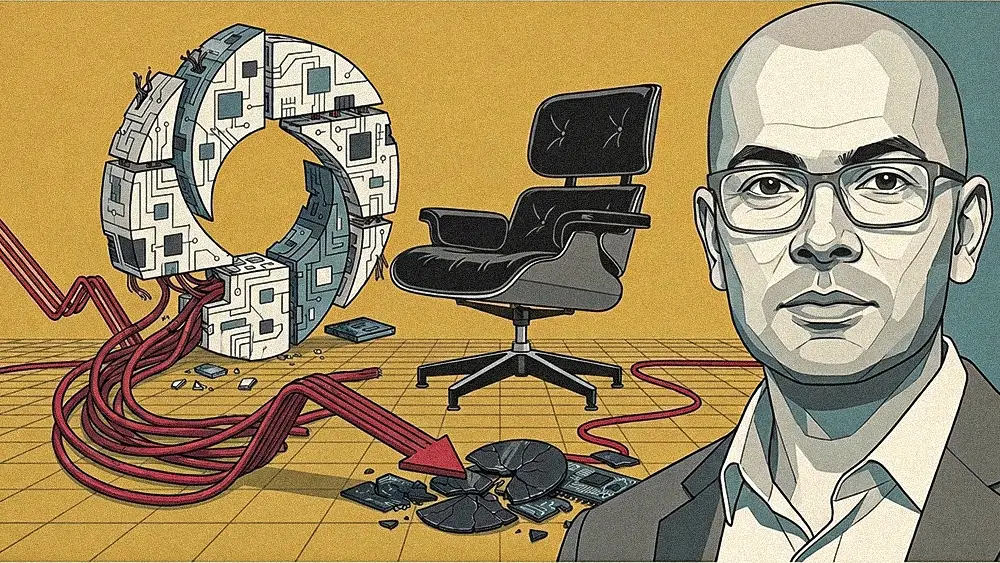
Here is what Alphabet announced on August 5. Demis Hassabis leaves day-to-day leadership of Google DeepMind to become its chairman, picking up a newly created role as chief scientist of Alphabet, staying in London, and spending more of his time on Isomorphic Labs. Koray Kavukcuoglu, the unit's chief technology officer and Google's chief AI architect, takes over operations as senior vice president reporting directly to Sundar Pichai, with Gemini model development, frontier research, the Gemini app and the developer platforms under him (The Decoder). Jeff Dean leaves after 27 years, taking Sanjay Ghemawat, Oriol Vinyals and Quoc Le with him to found Discovery Loop, a public benefit corporation in Palo Alto (CNBC). Alphabet is backing it as a founding investor and supplying compute for at least the first year, GeekWire reports.
Bloomberg put the intraday drawdown at as much as 5.5 percent; Reuters had the stock down 4 percent shortly after the news. Against a market capitalization near $4.6 trillion, that range is worth somewhere between $180 billion and $250 billion. There was no earnings revision attached, no regulatory decision, no product recall. The repricing was a response to who is sitting in which chair.
That reaction deserves to be taken seriously, because it implies something the industry's public messaging generally denies.
Running a lab stopped being a research job
For most of the past decade an AI lab was organized around a single person. DeepMind meant Hassabis. OpenAI meant Altman and Sutskever. The founder-scientist held the research direction, the recruiting pitch, the press strategy and the reporting lines at once, and it worked because the organizations were small enough that those roles rarely pulled against each other.
They pull against each other constantly now. A frontier lab in 2026 has a compute procurement function, a safety evaluation apparatus, a developer platform, a consumer application with hundreds of millions of users, and a public launch calendar that investors judge it against every quarter. Very little of that work is research, and most of it is operations.
Hassabis's memo reads differently once you hold that in mind. On AGI, he wrote that, "like many of you, I feel it is close at hand," and framed the move as buying himself the time and space to think about what comes next rather than manage the present (Axios). A Google spokesperson told Reuters he will have few direct reports and will focus on research and strategy around the societal effects of AGI. Pichai, for his part, called the work "vitally important to Alphabet and humanity." You can read all of that as conviction or as a tidy handoff of the grind. Either reading lands on the same structural fact: Hassabis has traded operational control for research latitude, and Google has handed execution to a thirteen-year insider who has been close to Gemini's technical direction for years.
Google is not the first to do this. Ilya Sutskever left OpenAI to found Safe Superintelligence. Mira Murati left to found Thinking Machines. Across the field, the people who set research agendas have been stepping out of operational roles, either sideways into chief scientist titles with almost no direct reports, or out of the building entirely and into small labs with narrow mandates. The model where one name describes a lab is being taken apart by the people it was named after, and nobody has yet shown that the resulting organizations run as well without them.
The most cited researchers in the field have stopped building chatbots
Discovery Loop wants to automate the whole experimental cycle: propose an experiment, implement and run it, evaluate the result, iterate, thousands of times over, at a pace sequential human effort cannot match. Its own site describes the ambition as letting a handful of people do research and engineering work that today takes very large teams. Wired's Steven Levy, who interviewed all four founders before the announcement, reports the idea came together only a few weeks ago.
It launches into company. Periodic Labs, founded by former OpenAI and DeepMind researchers, was in talks earlier this year to raise at least $500 million at a $7.5 billion valuation, Forbes reported. Lila Sciences is building robotic laboratories that run experiments continuously. Isomorphic, which Hassabis now has more time for, is the drug discovery version. CuspAI is working on materials.
What makes Discovery Loop notable is the seniority of the people involved. Dean and Ghemawat wrote the papers behind MapReduce, Bigtable, Spanner and the Google File System, which is to say the distributed systems work that made internet-scale computation possible in the first place. Vinyals and Le co-authored the sequence-to-sequence research that sits directly upstream of the transformer. Between them they account for an unusual share of the citation mass in the entire field, and they have concluded that the problem worth their remaining working years is the discovery process itself.
There is commercial logic underneath the idealism. Scientific work supplies something consumer software cannot, which is unambiguous failure. A catalyst performs or it does not. A material holds or it does not. After two years of the industry arguing about benchmark contamination and evaluation by vibes, a domain with hard ground truth is attractive both scientifically and to anyone thinking about durable advantage.
The skepticism is equally well founded. When MIT Technology Review visited these companies late last year, Lila's labs were largely empty and Periodic was starting with manual synthesis while it waited on its robotic setup. PitchBook counts more than $1.3 billion raised across the AI materials cohort in two years against a commercialization path that investors in the space concede is long and uncertain, since producing a part in a lab is a great deal easier than producing an acceptable one at scale. Venture returns on the discovery loop remain hypothetical.
Incumbents have learned to fund the research they cannot house
The detail drawing the least attention is that Alphabet holds a stake in Discovery Loop and is providing its compute, a point WSJ reporter Meghan Bobrowsky flagged in her first thread on the news and Pichai confirmed in his own post.
This has become a familiar structure. Microsoft and OpenAI. Amazon and Google both inside Anthropic. Now Alphabet holding equity in a company assembled entirely from its own departing senior staff, running on its own cloud.
The reasoning is easy to follow. A trillion-dollar company cannot offer what a fifteen-person lab offers, which is concentrated equity, one mission, no product organization, no launch calendar, and no ten-stakeholder review before anything ships. Facing the loss of that work altogether, incumbents have decided they would rather underwrite it, keeping the option value on any breakthrough while pushing the burn rate and the organizational headaches off their own books. It converts a retention failure into a portfolio position, and other companies will copy it.
The case for reading less into this
Wednesday's selling left little room for nuance, so some is worth adding.
Hassabis has not left the company. Kavukcuoglu is no caretaker appointment; Pichai noted that he built DeepMind's deep learning team and helped drive breakthroughs including WaveNet and DQN. Dean is 58 and told University of Washington computer science graduates in June that he first got the startup itch back in 1999, when Google had twenty people above what is now a T-Mobile store in Palo Alto, per GeekWire. That is a human explanation rather than a strategic one. Google also retains the deepest research bench in the industry and the only fully integrated silicon stack among the frontier labs.
The pressure is nonetheless real. Reuters notes the flagship Gemini release remains unshipped against a planned June launch, with Hassabis's memo pointing to an unreleased Gemini 4. This summer took Noam Shazeer to OpenAI, and Nobel laureate John Jumper, Jonas Adler and Alexander Pritzel to Anthropic (TechCrunch). Axios reported in July that morale inside the unit had slipped, with one employee saying flatly, "We're behind," and with the company's April Pentagon agreement surfacing repeatedly in exit interviews. Google disputes that morale is affecting model quality and says first-half attrition was normal.
Even so, the direction of causation is genuinely unclear. Senior people leave companies that are falling behind. They also leave companies that are doing fine, when the field around them is full of fundable opportunity and their equity has vested. Both conditions apply to Google right now.
What actually settles the argument
If the market read Wednesday correctly, then a handful of individual researchers materially determine the trajectory of a multi-trillion-dollar company, the compute-and-data thesis of the past three years is weaker than advertised, and the scarcest input in artificial intelligence is a very small number of people who all know each other by first name.
If the market got it wrong, and research talent at the frontier is more substitutable than a 5 percent drawdown suggests, then Wednesday was a $200 billion overreaction to an org chart, and the more interesting story is four exceptional engineers who got tired of shipping models and went to do science.
The next two quarters will tell us which. A strong Gemini 4 under Kavukcuoglu would damage the talent-scarcity thesis badly and force a re-examination of every AI valuation resting on a claim about having the best researchers. A weak one, or another slip, and every lab in the industry will be rewriting its retention packages before the end of the year.
What has already ended is the period when you could describe a frontier laboratory by naming one person. That was always a story the labs told about themselves as much as a description of how they worked, and Google has now stopped telling it.
If this caught your attention, that’s not accidental.

The best editorial systems don’t happen by accident. Outlever builds them.
Get the latest AI insights first.
Sign up for updates, interviews, and fresh analysis on how AI is reshaping business, brands, and technology.