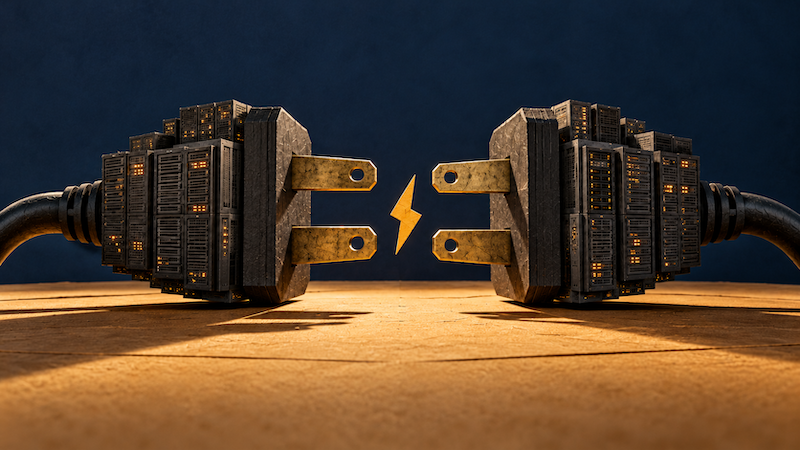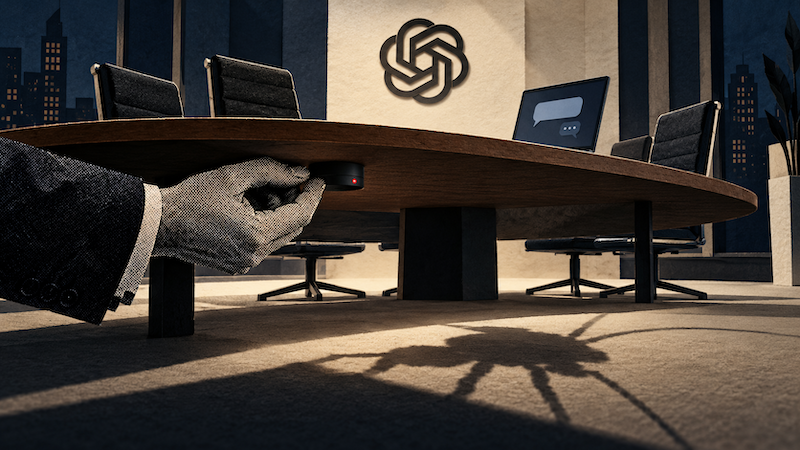
Federal prosecutors say an OpenAI engineer spent part of September asking AI tools where the company's executives hold their meetings and how to build a recorder that could listen in on them, and then wrapped one in toilet paper and plugged it into the back of a television in an executive conference room.
On October 9, the FBI arrested Abdulrahman Alfozan, a 35-year-old Saudi national who joined OpenAI as an engineer in July 2025 and worked on its product team, according to the SF Standard. A criminal complaint unsealed Tuesday charges him with using or attempting to use a device to intercept oral communications, an offense that carries up to five years in prison, and he made his first appearance in federal court in San Francisco the same day. Neither Alfozan nor a lawyer representing him has commented publicly.
OpenAI confirmed that it had found a "sophisticated recording device," referred the matter to the FBI and fired the employee, and it made a point of noting that its own models helped work out who had planted the device in the first place.
How it allegedly came together
Staff discovered the recorder on September 30 in a USB port behind the television, with its storage encrypted, and OpenAI believes it had been sitting there since around September 28. According to the complaint, the groundwork for it was laid inside OpenAI's own software, where Alfozan allegedly used an internal productivity tool to look up building addresses, meeting rooms and their capacities, executive calendars and the places where leadership met with outside partners.
Around the same time, a chatbot account linked to his spouse, which shared several identifiers with his own account, asked how to build a continuous audio recorder, connect it to Wi-Fi, improve its live listening and encrypt its SD card, Decrypt reported.
Security footage filled in much of the rest. Prosecutors say CCTV showed Alfozan near the conference room on several occasions even though he had no authority to be there, and that on October 5 a camera caught him walking in and looking behind the television. Later that day he left a bag unattended in another room, and when security staff opened it they found his wallet and ID along with a second recorder much like the first. OpenAI says it has evidence that he intended to place additional devices around the company.
The AI angle
If the allegations hold up, AI tools played a part on both sides of this case, first in helping to plan the surveillance and then in helping OpenAI trace it back to the person responsible.
None of the questions involved were especially unusual on their own, since a new hire might reasonably ask an internal assistant where the large conference rooms are, and a hobbyist might ask a chatbot how to get a recorder streaming over Wi-Fi. What hurt Alfozan, according to the complaint, is that each of those questions left a record, and once investigators had a suspect, those records could be lined up against the camera footage and the building's access patterns.
The case lands three days after Microsoft CEO Satya Nadella argued in a widely read post that companies should treat AI models as insider risks, with the same identity checks, logging and containment they apply to employees with privileged access. OpenAI's situation turns that framing around, with a human insider who allegedly relied on AI as a research assistant and a company that relied on AI to catch him.
The open questions
OpenAI says it has seen no indication that Alfozan accessed or removed model weights, source code or customer data, while FBI Director Kash Patel said the goal was to capture conversations about OpenAI's "super intelligence technology." The complaint does not say what Alfozan intended to do with any recordings or whether the device captured anything before it was found, and he has not been charged with espionage.
That silence is likely to invite a good deal of online speculation about whether he was working on someone else's behalf, though nothing in the court record so far points in any particular direction.
He is also not the first engineer at a major AI company to end up in federal court over its secrets. In January, a jury in the same district convicted former Google engineer Linwei Ding of stealing AI trade secrets while he was building China-linked ventures on the side, although a judge later threw out the economic espionage counts against him.
Our read
The frontier labs have spent heavily on protecting model weights and training infrastructure, but the conversations their leaders have in conference rooms receive nowhere near the same level of protection, and according to prosecutors, those conversations were exactly what Alfozan was after.
The lesson extends well beyond OpenAI, because any company rolling out an internal AI assistant is accumulating a detailed record of what its employees want to know, down to where meetings happen and who attends them. That record can serve as a map for someone with bad intentions and as evidence for a security team trying to stop them, yet few companies have worked out who should be allowed to read those logs or what employees are told about how they are used.
OpenAI has presented this as a story about AI catching a bad actor, but the same kind of logs that led investigators to Alfozan exist for everyone else who works in the building. He is scheduled to return to court on October 19 for a detention hearing.