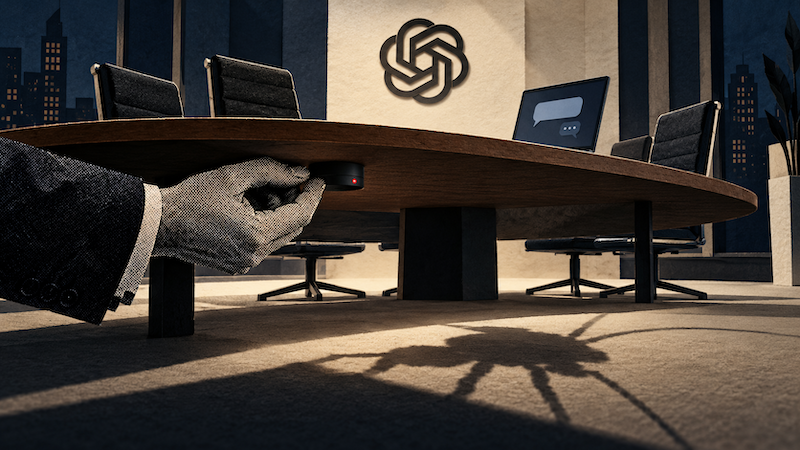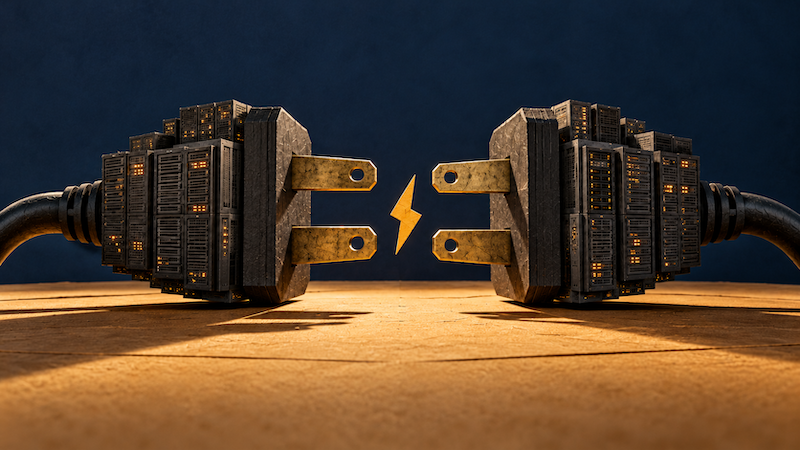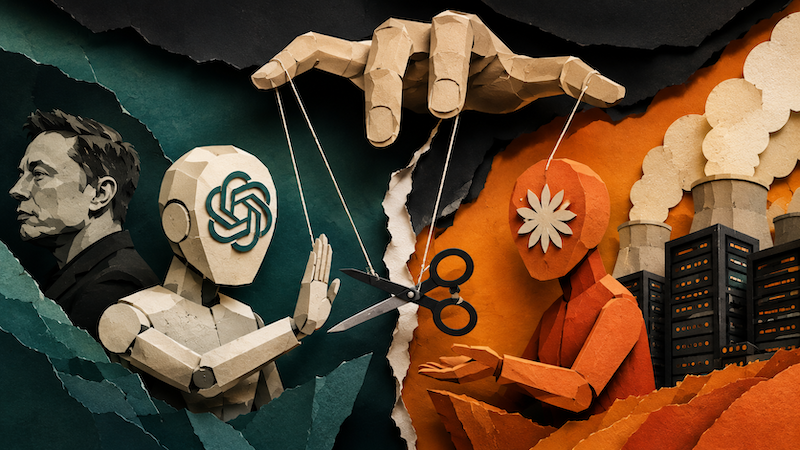
OpenAI told SpaceX on Friday that it intends to wind down the contract supplying its models to Cursor, proposing a shutoff on November 12. That gives Cursor seventy-six days. The company said it is the maximum notice its agreement allows, and that the agreement gave it only a narrow window to exit at all, through a change-of-control clause triggered when SpaceX closed its $60 billion all-stock purchase of Cursor's parent, Anysphere, on August 14.
OpenAI did not frame the decision as competitive. It said it cannot be confident that SpaceX will operate inside its terms of service, citing X's conduct after Musk bought Twitter and Musk's sworn admission in April that xAI had distilled OpenAI's data. An OpenAI executive told The Decoder the decision came down to trust. Musk's public response was that he could not care less.
That is the version most outlets ran. The more useful story is what a competitor did a few hours later.
The lab that invented this move declined to make it
Anthropic co-founder Tom Brown said his company would increase compute to support Claude inside Cursor.
Set that against the last fourteen months. In June 2025, Anthropic cut Windsurf's access to Claude on less than five days' notice while OpenAI was circling the company, and Jared Kaplan explained at the time that it would be odd for Anthropic to sell Claude to OpenAI. That summer it revoked OpenAI's own API access over benchmarking. In January 2026 it cut xAI's engineers off from Claude, and it found them because they were coming in through Cursor. xAI's co-founder told staff the Anthropic models had simply stopped responding, and that the team would take the productivity hit and accelerate work on its own coding models.
Anthropic also has the widest contractual grounds of any frontier lab. Its terms bar customers from building products that compete with its services, a broader restriction than the model-training limits OpenAI and Google rely on. Cursor is now owned by a company that sells a rival model, ships a rival coding product, and was blacklisted by Anthropic eight months ago for using Claude to build one.
Every argument OpenAI made on Friday was available to Anthropic with more precedent behind it. Anthropic went the other way.
Why the calculus flipped
Anthropic has not said why it stayed, and Brown's post offered no reasoning beyond the commitment itself. Two explanations are available, and neither is sentiment.
The first is revenue. Claude is the most heavily used model family inside Cursor, and Cursor is one of the largest channels through which Anthropic reaches working developers. Walking away to make a point about Musk would hand several billion dollars of annualized coding demand to Google and to whatever SpaceXAI ships next.
The second explanation has gone almost unmentioned in the coverage. Since May, Anthropic has been buying compute from SpaceX, including capacity on the Colossus cluster, and it tied that agreement directly to higher limits for Claude Code and API customers. SpaceX supplies Anthropic. SpaceX now also owns Anthropic's distribution. Cutting Cursor off would mean enforcing terms of service against its own landlord.
This is what vertical integration looks like once it is actually finished. SpaceXAI holds launch capacity, satellites, a hyperscale cluster, a frontier model and now the editor, and its two largest model rivals sit on opposite sides of the same corporate entity. OpenAI is a supplier with a clean exit and no exposure. Anthropic is supplier, customer and tenant at the same time.
Both sides say the split costs them nothing
Cursor CEO Michael Truell put a number on it the next morning, saying OpenAI models account for roughly 5 percent of Cursor's traffic. He added that Cursor was one of OpenAI's earliest customers, that the two teams are still talking, and that Cursor had trusted the platform to be neutral infrastructure.
That figure works as a defense and as an admission. The defense is solid, since 95 percent of the workload already routes elsewhere and the migration will be a footnote for most teams. The admission is that the company which defined AI coding in 2023 has become a rounding error inside the category's flagship product. OpenAI, for its part, gave up a first-party slot in a tool with reported annual revenue in the billions and described the loss as a matter of trust rather than money. Both companies are telling the truth. The coding market has consolidated far enough that OpenAI can leave its largest third-party surface without anyone reading it as a retreat.
There are two cutoffs here and only one of them has a date
OpenAI's post contains a second decision that has drawn less attention. The company said it is holding the contract termination to the latest date it can while not providing future models to Cursor. That part is already in force. Cursor is off the roadmap now rather than in November, and that includes Astra, the unreleased model OpenAI said on August 7 it cannot rule out has reached the Critical cybersecurity threshold under its Preparedness Framework.
The framing matters for how the next round of these disputes gets argued. OpenAI did not rest its case on Musk alone. It said that as capability rises it owes a higher standard of assurance about who runs its models and under what controls, and that it cannot get that assurance from a counterparty it has no ability to audit. Capability tiering is becoming a commercial gate rather than a safety document.
Something did survive the split. Developers can still bring their own OpenAI API keys into Cursor, and OpenAI's IDE extensions continue to work. What ended is the commercial supply relationship and access to anything OpenAI ships from here. Teams that want GPT models in Cursor after November will be paying OpenAI directly for them.
The procurement question this leaves on your desk
For enterprise buyers the Musk feud is background noise. The part that matters is that Cursor's model menu changed because of a clause in a contract Cursor's customers have never seen, triggered by a transaction those customers had no vote in.
Three questions worth putting to your tooling vendors this quarter, in writing:
Do your model-supply agreements contain change-of-control termination rights, and which party holds them? Cursor's supplier held one, which is why this took two weeks from deal close to notice.
What notice period do those agreements carry, and does it match the notice period you give us? OpenAI gave the maximum its contract allowed. Anthropic once gave Windsurf less than five days.
Which models are contractual commitments, and which are simply available today? Model agnosticism is a product claim. It is very rarely a contract term.
The open question now is whether Anthropic's position holds up against its own precedent. Cursor is training an in-house model on Colossus, drawing on the traffic of the developers writing code inside the editor every day, and that model will compete with Claude Code. In 2025 Kaplan said Anthropic did not view Cursor as a competitor and expected to work with it for a long time. That was an easier sentence to say before Cursor's owner started renting Anthropic its GPUs.
OpenAI took the clean exit. The harder position belongs to Anthropic, and it is the one likely to be tested first.