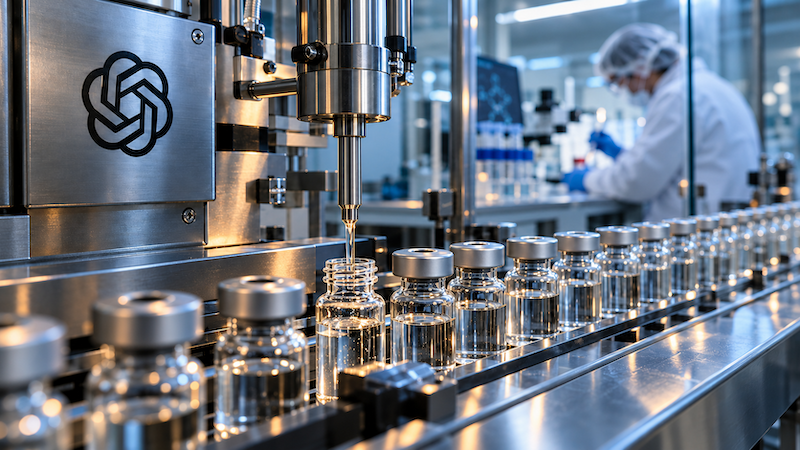
Orchestra’s agents monitor studies and flag delays across drug programs, the stage of a medicine’s life that takes far longer than discovery.
When a manufacturing batch fails, the problem rarely stays in manufacturing. A clinical trial waiting on that batch gets pushed back, and so does the work scheduled around the trial.
OpenAI used that scenario to explain why it bought Orchestra Bio, a startup whose AI agents help pharmaceutical companies manage drug development. The company told Axios about the deal on Tuesday. Orchestra’s team and technology will become part of Rosalind, OpenAI’s family of models and tools for life sciences research. Terms weren’t disclosed.
CFO Sarah Friar wrote on LinkedIn that the combined product will help scientists “connect discoveries with the studies and decisions needed to advance new treatments.” Most of the money and attention in AI for science has gone to discovery so far. Orchestra works on what comes afterward, which in pharma can take most of a decade.
What Orchestra Does
Orchestra makes software for running drug programs. According to OpenAI’s announcement, scientists and program leads assign agents to monitor studies and research campaigns. When a problem comes up, the agents figure out which activities and deadlines it affects, gather the relevant information and compare possible responses. People make the final decision.
The rest of Rosalind covers earlier stages. GPT-Rosalind, which OpenAI launched in April for vetted U.S. enterprise customers such as Amgen and Moderna, helps scientists work through biology and chemistry problems. Rosalind Workbench connects the model to lab tools and data. Decrypt described the split this way: Rosalind helps decide what to test, and Orchestra handles what follows.
Orchestra was founded in the fall of 2022 and has raised about $20 million from investors including Andreessen Horowitz, Insight Partners and 8VC, according to Caplight data cited by Decrypt. With a company that size, OpenAI is mainly getting a team that has spent four years studying why drug programs slip, along with the product it built.
Most of the Clock Runs After Discovery
Investors have poured money into AI drug discovery. Isomorphic Labs raised $2.1 billion in May. Chai Discovery tripled its valuation to $3.8 billion with a $400 million Series C. In July, OpenAI researcher Miles Wang was reported to be raising about $200 million at a $2 billion valuation for a drug discovery startup of his own.
Finding a promising molecule is only the start. OpenAI puts the time from target discovery to U.S. approval at roughly 10 to 15 years. Getting one approved drug to market can cost more than $2.6 billion, and fewer than 10% of candidates that enter human trials make it to pharmacy shelves. A lot of that time goes to coordinating internal teams, contract research organizations and contract manufacturers, often on systems that don’t share data.
Software that tracks those handoffs across a drug company’s whole portfolio can save time on every program it touches. And once a company’s project data lives inside it, switching to something else gets expensive.
Two Labs, Two Bets on Medicine
Anthropic, OpenAI’s closest rival, has taken a different route into the same industry.
It bought Coefficient Bio for roughly $400 million in April and launched Claude Science in June. At that launch, Anthropic said it would develop drugs itself, starting with neglected diseases. In September, Reuters reported that the company had set up a wet lab, though it isn’t running clinical trials.
Anthropic is concentrating on early research and doing some of the science itself. OpenAI is going after the operational software drugmakers already buy, alongside Rosalind partnerships with Novo Nordisk and Moderna. Those choices set up different relationships with pharma companies. Anthropic will sell tools to drugmakers while also developing drugs of its own in a few disease areas. OpenAI wants its software running inside their programs.
Why OpenAI Wants the Development Stage
Friar has said OpenAI wants more from science than subscription revenue. In a January blog post, she wrote that as AI moves into areas like drug discovery, licensing, IP-based agreements and outcome-based pricing will share in the value it creates. Decrypt took that to mean OpenAI would like a cut if its tools help produce a hit drug.
Charging for outcomes requires measuring them, and that’s easier in development than in discovery. A drugmaker can count how many months earlier a trial started and put a dollar figure on it. Working out how much of a molecule’s success came from a model’s suggestion is much harder.
Orchestra adds to a string of OpenAI health and science moves this year. In January, the company launched ChatGPT Health and bought the medical records startup Torch. It also built the Prism research platform, and five days before this deal it announced the Rosalind Academic Plan for university labs. Competition is growing as well. LinkedIn News recently called AI for science red-hot, and former OpenAI executives have started companies in the space.
The Open Questions
OpenAI hasn’t said when Orchestra’s agents will show up in Rosalind, how many customers Orchestra has, or whether current contracts will carry over unchanged, OpenTools pointed out. Pharma teams will want those answers before they rely on the product.
Data access could matter more. Software that monitors an entire drug program can see failed batches, vendor disputes, trial delays and internal arguments over whether to keep going. Reuters reported that Anthropic’s pharma customers may worry the company could learn from their competing programs, even with their data walled off. OpenAI should expect the same questions, and Orchestra would give it a closer view of customers’ programs than a chat model does.
Drug development also depends on judgment calls and working relationships with outside partners, and much of that never gets written into a tracking system. Orchestra leaves decisions to people. Customers will find out over time whether its analysis actually changes what those people decide.
Where the Decade Goes
Most AI-for-science funding has gone toward speeding up discovery, which makes up a small part of a 10- to 15-year timeline. Orchestra puts OpenAI in the much longer stretch between a promising result and an approved drug, where delays are costly and easier to measure. Adoption by Rosalind customers will show whether drugmakers want an AI company that involved in how they run their programs.