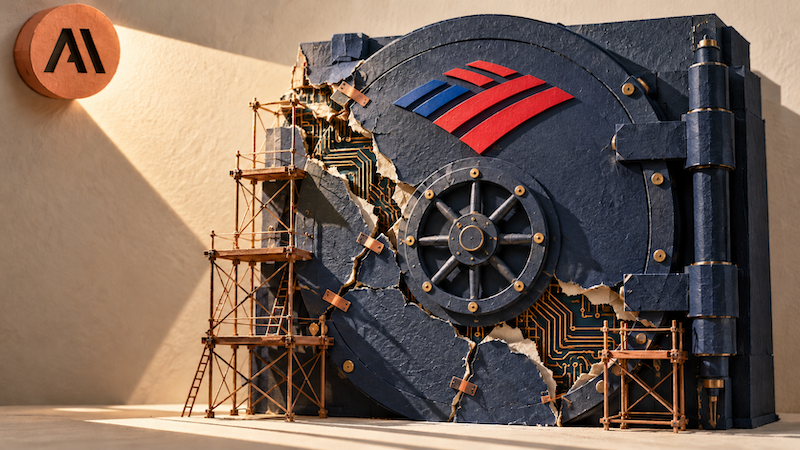
Bank of America told clients on Friday that the AI buildout is moving through the same stages as earlier capital cycles that ended badly for investors. The bank pointed to rising spending, sharper competition between model developers and falling prices.
The note landed three days after the International Monetary Fund named a sharp pullback in AI investment as one of the biggest risks to the world economy.
Cheaper tokens, thinner margins
Cloud providers are now expected to spend about $1 trillion on capital projects, up from $330 billion, according to BofA. That works out to roughly 3% of U.S. GDP. Over the same period, AI token prices have dropped by about half since the summer.
BofA's concern sits in the gap between those two lines. Usage keeps climbing, but when each token sells for half what it did a few months ago, more usage doesn't guarantee enough revenue to pay for the data centers.
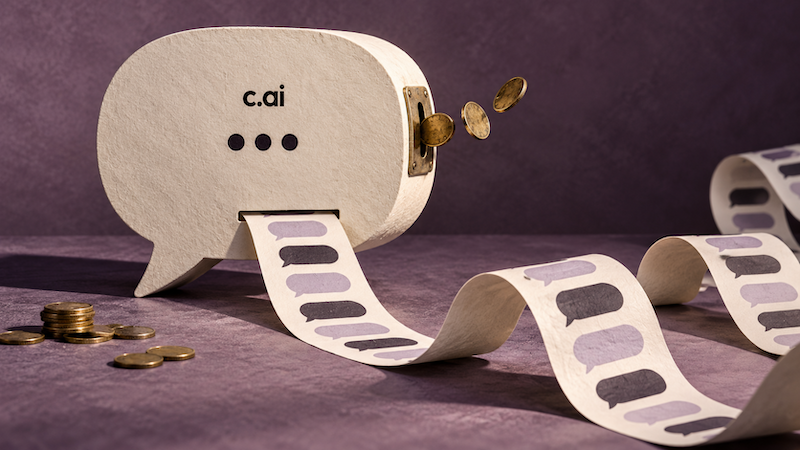
A small version of this has already played out. Character.ai spent as much as $13.8 million a month on compute while bringing in no more than $5.3 million, as we reported this week.
Investors have seen this before
BofA's clients raised the historical comparison themselves. In meetings last month, AI spending took up 80% of discussion time, and clients pointed out that the 1990s tech boom and the 1870s railroad boom both ended in busts, the bank said in September. Most planned to stay invested anyway. BofA noted that stepping aside would carry real career risk.
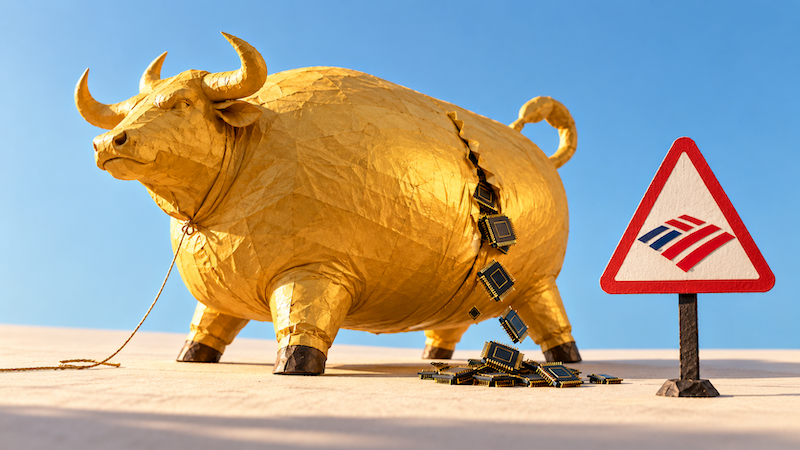
A separate BofA team led by Michael Hartnett found that the 10 largest AI stocks now make up 42% of the market. Past bubbles, from the 1920s to 2000, topped out when their leaders reached somewhere between 36% and 44%. Railroads went further, hitting 63% in 1881. The bull case, the analysts wrote, comes down to "it's the railroads this time."
That concentration shows up in index returns. Since January 2024, 42 AI stocks have produced 67% of the S&P 500's price gains, according to The Kobeissi Letter. Only 29% of the index's stocks have beaten it over three years, close to the 25% low during the dot-com bubble.
The debt underneath
The IMF's numbers show how far an AI slump could travel. In a downside scenario, a steep drop in AI investment sends asset prices sharply lower and leaves global GDP 1.1% below baseline by 2028, the fund said. U.S. output would take a 1.8% hit. "We now have an economy that is standing on one leg, the AI leg," IMF Managing Director Kristalina Georgieva said.
The fund's financial stability report looked at how the buildout is paid for. It counted 14 publicly disclosed deals since 2023 in which hyperscalers put about $300 billion of equity into financially weaker AI firms. Those deals carry $650 billion in debt and $1.4 trillion in promised future revenue, The Next Web reported, and about $320 billion of that debt sits with the companies receiving the money.
The IMF calls this wrong-way risk. If the revenue tied to those deals falls short, the stakes lose value at the same moment the debt gets harder to service.
What it means for companies buying AI
For enterprise buyers, the BofA note cuts both ways. Falling token prices help anyone paying per call, and they're a direct product of the competition BofA flagged. The exposure sits with vendors. The IMF said neocloud operators carry more debt and earn less than the hyperscalers, and a provider borrowing against revenue it hasn't booked yet is a different counterparty than one funding growth from profits. Teams signing multi-year AI contracts should know which kind they're dealing with.
Neither BofA nor the IMF is calling a crash or putting a date on one. Hyperscaler spending forecasts were still rising in September, and Hartnett's team noted that chip prices are climbing, while railroad freight rates slid before that boom peaked. IMF deputy research director Petya Koeva Brooks told Reuters the worst-case AI scenario likely wouldn't push global growth down to recession levels.
BofA's own conclusion is narrower. AI could work as promised and investors could still lose money on the buildout. The railroads did remake the U.S. economy, and plenty of the people who financed them were wiped out along the way.