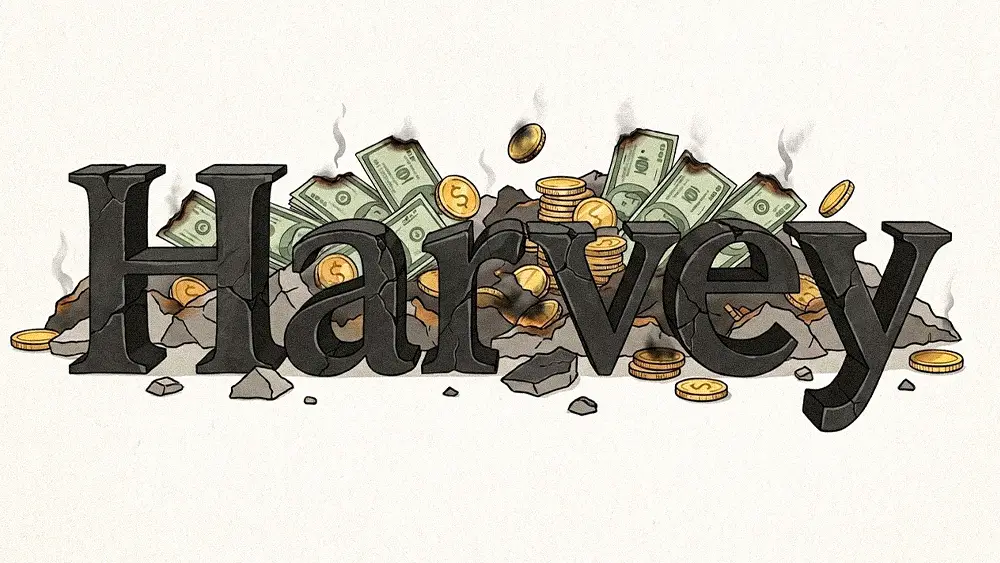
The Frontier Labs Are Selling You Inventory and Calling It a Moat
Frontier model prices fell 99% in three years and open weights are six months behind. Who's left standing when the models are worth nothing, and who gets paid?



If this caught your attention, that’s not accidental.

The best editorial systems don’t happen by accident. Outlever builds them.

Nobody can agree on how much these companies earn, which is the most useful fact in the sector right now.
Depending on which credible-looking source you opened this month, OpenAI's revenue is $19 billion, $25 billion or $33 billion. Anthropic's is $7 billion, $47 billion or $69 billion. Same companies, same quarter, off by a factor of five.
The explanations are mundane enough. Some of those figures are annualized run-rate, meaning a good month multiplied by twelve and presented as an annual fact. Others are booked revenue. Anthropic reports on a gross basis, counting the full end-customer spend flowing through AWS, Google Cloud and Azure as its own revenue while booking the partner payouts as expense. OpenAI reports closer to net. When OpenAI's audited financials leaked to the Financial Times in June, the company that had spent a year being described as a $25 billion business turned out to have booked $13.07 billion in 2025 against a $20.9 billion operating loss, which is an operating margin of roughly negative 122 per cent.
There is a structural reason none of this resolves. As one valuation analysis put it this summer, frontier labs have no true peers: their cost of goods sold scales with usage in a way software's does not, they live and die by chip access without being hardware companies, and the only two obvious comparables are both private and unprofitable, so checking one against the other just relocates the uncertainty.
Every industry reaches a point where its accounting conventions become the story rather than a footnote to it. This one is there now, and it bears directly on the question the sector keeps not asking out loud: if the models themselves end up worth nothing, what exactly is anyone holding?
The pricing pages already answered the capability question
The strongest argument in AI at the moment is an argument about prices, which is why it gets less attention than it deserves.
GPT-4 launched in March 2023 at $30 per million input tokens. By this spring Google was serving Gemini 3.1 Flash at $0.10 per million input, a 99.7 per cent reduction across three years, on a model that comfortably beats the thing it replaced. Epoch AI's work on cost-per-capability milestones puts the annual rate of decline anywhere between 9x and 900x depending on which benchmark you anchor to, which is a wide range but every value in it is catastrophic for anyone hoping to sell tokens at a premium. DeepSeek's flash tier currently runs around fourteen cents per million input tokens. That is not a promotional discount. It is a statement about where the floor sits.
The open-weight story matters less for any individual release than for the shape of the whole. Five independent families arrived at roughly frontier quality within months of each other: DeepSeek, Qwen, Kimi, GLM and Mistral. One lab getting there early is luck. Five is a structure. Moonshot published weights for Kimi K3 in July and Artificial Analysis scored it 57 on its Intelligence Index, against 61 for the strongest closed model on the same board. GLM-5.2 shipped in June under an MIT license with a million-token context window, and Reuters had it competing with the American closed frontier on coding and agent work at a fraction of the price.
Some skepticism is warranted here. Evaluation harnesses differ enough that cross-model comparisons should be treated loosely, GPQA alone gets reported on several incompatible scales, several Chinese benchmark results have drawn scrutiny, and open models still fall down visibly on genuine generalization, the tasks that resemble nothing they were trained on. But the pattern has now repeated often enough to plan around. Open weights trail the frontier by six to twelve months and then close on precisely the capabilities that looked defensible the year before.
Which makes a frontier lead a depreciating asset running on a faster schedule than the GPUs used to train it.
Cheap inputs, enormous bills
This is where the bear case usually overreaches.
If per-token prices fell 280x over two years, revenue ought to have fallen with them. Instead enterprise AI spend rose about 320 per cent over the same period. Both numbers are correct, and the mechanism connecting them is unglamorous: Gartner's March analysis has agentic workloads consuming between five and thirty times more tokens per task than a standard chatbot exchange, retrieval architectures inflate context windows several times over, and monitoring agents run continuously rather than when someone types something. Finance teams watched the unit price collapse, watched their monthly bill triple, and reasonably concluded that somebody was lying to them.
Nobody was. It is Jevons paradox with a Slack integration, and it explains how Anthropic went from roughly a billion in run-rate to tens of billions inside eighteen months on coding and agent workloads rather than a consumer chatbot.
So commoditization does not mean nobody makes money. Electricity is a commodity and utilities are enormous businesses. What commoditization reliably does is move the profit somewhere else, away from the thing being commoditized and toward whoever controls access to it, distribution of it, or the workflow wrapped around it. Whether the labs have revenue was never really in doubt. Whether that revenue services their capital structure is a different question entirely.
The financing is the thesis
Roughly $725 billion of hyperscaler capex in 2026, up about 77 per cent from $410 billion the year before. The Bank for International Settlements puts the five largest at more than a trillion dollars across 2025 and 2026 combined and notes, in the flat register these documents use for alarming things, that the commitments are outpacing earnings and free cash flow and pushing companies into debt markets. Morgan Stanley and J.P. Morgan both estimate the sector needs to issue something like $1.5 trillion in new debt over three years.
Set against that, the combined revenue of every pure-play frontier lab is a small fraction of the infrastructure spend. The labs occupy the middle of the value chain, holding the unit economics, while Nvidia takes 88 per cent gross margins at one end and the platforms absorb the capex risk at the other.
Two accounting details sharpen it. Hyperscalers depreciate AI hardware over five to six years against an economic life that is plausibly closer to two or three, an understatement of true depletion estimated at around $176 billion across 2026 to 2028, which flatters current earnings and moves the pain into a later fiscal year. And Moody's flagged roughly $662 billion of signed but not-yet-commenced data center leases sitting off balance sheet under GAAP's lease commencement standard, an obligation larger than the combined on-balance-sheet debt of the same firms. The gap is visible in the raw figures: the four US hyperscalers bought $433.9 billion of property and equipment in the four quarters through March 2026 against roughly $149 billion of reported depreciation.
The sloppy version of this argument is that AI is fake, and it is easy to dismiss because it is wrong. The precise version, as one analyst framed it in June, is that inference revenue cannot grow fast enough, at falling prices, to service the debt and depreciation on infrastructure built for a demand curve nobody has yet observed. That is a financing thesis rather than a technology thesis, and it survives perfectly well in a world where every model works exactly as advertised.
Three ways to be left standing
None of them involve having the best model.
The first is vertical integration. If compute costs are eating your margin then owning the compute is the obvious answer, and Google is the only participant that owns silicon, model, cloud and consumer distribution end to end. Everyone else is a tenant to some degree. Anthropic's hedge against this is distribution breadth, being the only frontier model available across AWS Bedrock, Vertex AI and Azure Foundry simultaneously, which is a real advantage and a different asset from owning the building.
The second is owning the workflow. The standard line is that LLM switching costs are trivial, since swapping an API endpoint bears no resemblance to replacing an ERP system. Then companies try it. A Zapier survey found 89 per cent of enterprises confident they could switch providers, while 58 per cent of those who actually attempted a migration ran into failures or unexpected difficulty. The lock-in lives in the prompt scaffolding, the eval suites, the fine-tunes, the agent harness and the accumulated institutional knowledge of how one specific model tends to fail. Business logic has quietly migrated into artifacts that do not port, which is why the average enterprise migration project now runs around $315,000.
That is where durable value is accumulating, and it accrues to whoever owns the harness, who need not be whoever owns the weights. Every provider understands this, which is why they are all shipping coding agents and orchestration layers rather than raw endpoints. Whether the harness or the weights turns out to be the defensible layer strikes me as the most important unresolved question in the industry, and I don't think anyone knows the answer yet.
There is a counterweight worth registering. When Anthropic's Fable and Mythos models were suspended in June under a US export control directive, days after launch, production workflows built on them broke overnight, and the episode became the standard argument for multi-model routing. Concentration risk is a board-level topic now. Lock-in and the flight from lock-in are accelerating at the same time, which is a peculiar thing to underwrite.
The third route is not needing any of it. Midjourney does roughly $500 million in revenue with about forty people and no venture funding at all. That is an excellent business, and it is also an almost perfect refutation of the current funding model, since it suggests some of the best returns of this era will come from companies no large fund can deploy half a billion dollars into.
Where the bodies will be
In the middle. Any lab carrying frontier-scale training costs without frontier-scale distribution, proprietary compute or a consumer surface is in an unsurvivable position, because there is no stable ground between defining the capability ceiling and being the cheapest credible option. If the product is essentially API access to a good model, five open-weight families will match it within a year and undercut it by ninety per cent.
Then there is the part a piece about venture hype has to say plainly. Anthropic's Series H closed at $965 billion post-money in May. OpenAI's March round closed at $852 billion, with Amazon leading at $50 billion and Nvidia and SoftBank in at $30 billion each. At those entry prices the exit universe is an IPO or nothing, because no acquirer for either company exists anywhere on earth. Public market investors underwriting a 2027 listing will have to decide whether an operating margin of negative 122 per cent at $25 billion of revenue is a temporary training-cost bulge or a structural feature of frontier model economics, and reasonable people will disagree about that for as long as the numbers stay private.
The uncomfortable implication, for anyone whose money is already in, is that a company can win its industry outright and still lose its investors money. Returns are set by entry price, not by market position. Amazon won e-commerce, which was of limited consolation to anyone who bought in March 2000 and needed liquidity before 2007. The people responding to all of this with "but AI is real" are answering a question nobody serious is asking.
The case I might be wrong about
Take the strongest form of it. If capability gains keep compounding on economically valuable work, the frontier premium may never commoditize, because the value of the best model inside a long agentic loop is superlinear. One bad decision at step four poisons the next forty steps, and when a wrong answer is expensive the expensive model is cheaper on total cost once you count the engineer who cleans up after it. That is a real moat and it shows up in procurement decisions being made today.
Add to it that the open-weight lag might be structural rather than temporary, since closing the remaining distance requires compute access that export controls and sheer capital intensity restrict. Add that Chinese open weights face procurement resistance in Western enterprises for reasons unrelated to benchmark scores. Add that the six-to-twelve-month gap has never actually been observed shrinking to zero.
If that reading is correct, two or three labs sustain a genuine price premium indefinitely, the capex is justified after all, and this piece ages badly.
Four things I'm watching
Whether anyone converts a frontier lead into a sustained price premium for more than two consecutive quarters. Nobody has managed it yet; every lead so far has been priced away within months.
The depreciation crossover in 2027 and 2028. As recognized D&A compounds at 30 to 40 per cent annually, hyperscaler margins compress mechanically whatever AI revenue does. The thing to watch is whether capex guidance holds when that arrives.
Open weights moving from evaluation into revenue-critical production, which is a different milestone from benchmark parity and a much slower one.
Gross margin disclosure at IPO. The first honest S-1 from a frontier lab will settle more arguments than three years of commentary have managed.
So who wins?
There will be winners. Considerably fewer than the funding implies, and winning will mean something less romantic than the current story suggests: owning compute, owning workflow, owning distribution, or being small enough that none of it applies.
What is actually being underwritten at these valuations is the belief that the model is the asset. Three years of pricing pages suggest the model is inventory. Valuable, perishable, and repriced every six months by somebody willing to give it away.
If this caught your attention, that’s not accidental.

The best editorial systems don’t happen by accident. Outlever builds them.


Get the latest AI insights first.
Sign up for updates, interviews, and fresh analysis on how AI is reshaping business, brands, and technology.