FedEx's Reinvention as an AI Data Company: What Is Actually Happening?
How FedEx is quietly turning 2 petabytes of daily shipping data into a business, and what that reinvention actually looks like underneath the headlines.


If this caught your attention, that’s not accidental.

The best editorial systems don’t happen by accident. Outlever builds them.

FedEx put out a LinkedIn post recently that sums up its AI ambitions in a few lines: two petabytes of data a day, a strategy that pairs its physical network with predictive AI, and a taped conversation with Alan Murray and The Wall Street Journal. The video is real. Raj Subramaniam and Vishal Talwar recorded it at the WSJ Leadership Institute's Technology Council Summit on September 14, 2026, and the WSJ Leadership Institute talks are also on Apple Podcasts. But the caption skips the harder and more interesting question, which is what it actually takes to turn one of the world's largest logistics networks into a data business without breaking the operation that already pays the bills.
Two petabytes a day, and a new use for it
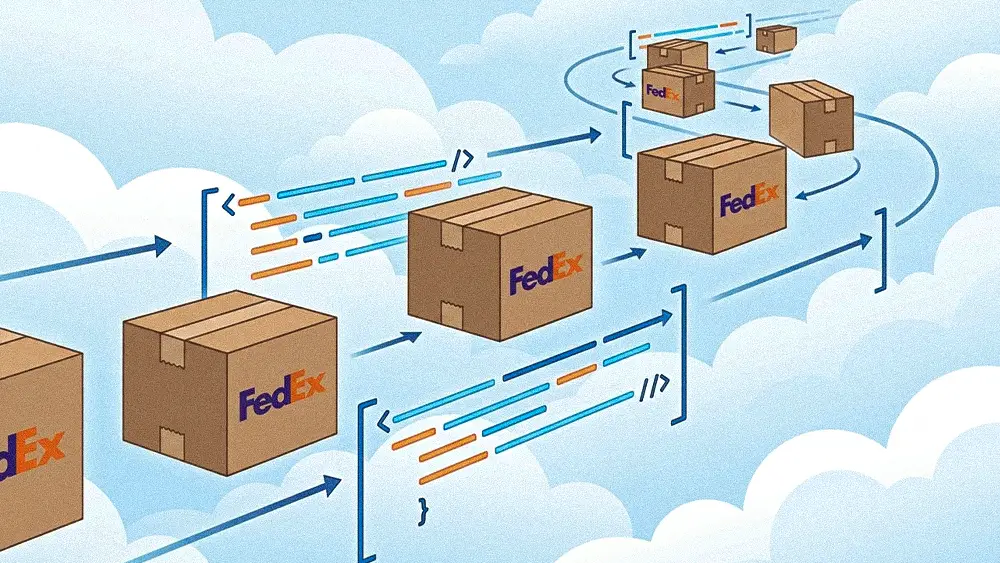
FedEx says its network moves nearly 17 million shipments on a typical working day and generates about 2 petabytes of data, according to the company's newsroom. For most of its history that data was just a byproduct of moving boxes, and nobody built much on top of it. What has changed is that FedEx now wants to treat the data itself as the valuable thing rather than as leftover.
You can see the shift in a phrase its executives keep repeating, about moving from shipping goods to orchestrating data. The National CIO Review describes FedEx building product platforms on top of that data, including Surround for customer monitoring and a commerce platform, and looking to sell those capabilities as new revenue. In other words, the company that delivers the package wants to become the company that warns other supply chains when something is about to go wrong.
A new executive with a combined mandate
The strategy has a clear owner, and he is fairly new to FedEx. The company's leadership page and CIO Dive both note that Vishal Talwar joined in August 2025 as EVP and chief digital and information officer and president of Dataworks, reporting to CEO Raj Subramaniam. He came over from Accenture, where he ran growth for its technology unit. Combining IT operations and data strategy under one person says a fair amount about where FedEx thinks its value now sits.
Fixing the plumbing first
Before FedEx can run AI agents at any real scale, it has to modernize the systems underneath them. The WSJ first reported, and PYMNTS summarized, that the company is replacing hundreds of legacy systems with a cloud-first platform and consolidating its data sources, a project it expects to finish by the end of 2027. Digital CxO describes this data platform, called Atlas, as a deliberate step that has to land before the 2028 agent goal. Talwar put the reason plainly to the Journal: "If I give you bad information, you will make bad decisions." That is the case for spending years on the foundation before doing anything visible.
How the agents are set up
The target is specific. In the WSJ's reporting, FedEx said it wants AI agents involved in more than half of its operational workflows by 2028, and it already uses them to write and test code and to help customers clear customs. As Talwar told the paper, "Every employee and every task in the globe will get adapted to AI and will improve with AI."
The design is more considered than a single chatbot. Digital CxO and the WSJ both describe a hierarchy. Manager agents break a problem into pieces, worker agents carry out the tasks, and audit agents check the results, which leaves the system with a record of who did what. The caution is earned. Gartner expects more than 40% of corporate AI agent projects to be canceled by the end of 2027 over cost, unclear value, or weak controls.
The early results
Some of the payoff is already measurable. At the company's investor day, covered by Sourcing Journal, Talwar said that using sensor data and FedEx's own AI models to predict equipment failures in its sorting systems is saving roughly $10 million a year. In the WSJ Leadership Institute session, he added more numbers. Research time for air maintenance dropped from 30 minutes to three, and the company has recovered tens of millions in annual revenue by using AI to catch odd-sized, mis-tracked packages that should have carried a surcharge.
The same intelligence reaches customers at the last mile. VentureBeat reports that FedEx Surround, built on the Dataworks platform and its Package Fingerprint feature, gives customers predictive analytics and real-time information about the network, the package, and its environment so that problems can be headed off. What customers actually want, Talwar told the WSJ, is to not be surprised. He pointed to guaranteed two-hour delivery windows on shipments coming from Asia to the US.
Training half a million people
This only works if the workforce can use it. Business Chief reports that FedEx's entire C-suite spent two days in Silicon Valley while the company was choosing partners, and that FedEx built a role-based AI training program on Accenture's LearnVantage platform. Talwar told Computer Weekly the response has been organic, with couriers and operators emailing him to say the training is opening up new career paths, and he describes the agents as adding to the workforce rather than cutting it.
Judging it by the business, not the buzzwords
Maybe the most unusual thing about FedEx's approach is what it refuses to track. In his own remarks, Talwar has said companies should avoid getting distracted by AI metrics that do not connect to business results, and that the numbers that still matter are growth, profit, customer experience, and how well the operation runs. The responsibility also sits at the top. At the WSJ summit, Subramaniam said no company can succeed at AI unless its CEO takes an active role in it.
That is the fuller answer to what FedEx is doing with AI. The agents are the part people notice. The bigger effort is quieter and slower: the data platform, the leadership changes, the retraining, and a decision to measure all of it by ordinary business results. If it works, the AI shows up in unremarkable ways, as fewer breakdowns on the sorting line and more packages that arrive when they are supposed to.
If this caught your attention, that’s not accidental.

The best editorial systems don’t happen by accident. Outlever builds them.


Get the latest AI insights first.
Sign up for updates, interviews, and fresh analysis on how AI is reshaping business, brands, and technology.