Developing story. We'll update this article as the banks share more.
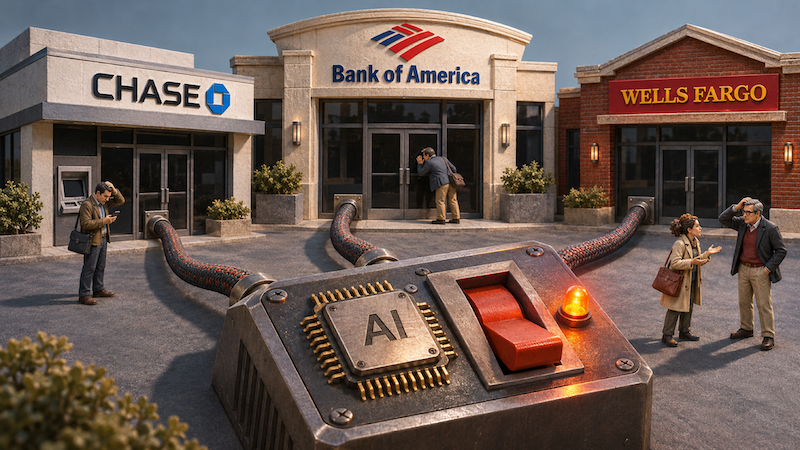
Customers at Chase, Bank of America, Wells Fargo and U.S. Bank started reporting problems Monday morning. They couldn't log in, see balances, move money or use some ATMs, according to Gray News. Reports on Downdetector began climbing around 9 a.m. Eastern. By 1:30 p.m., Chase had drawn more than 4,300 reports, Bank of America more than 1,200 and Wells Fargo about 500, Daily Voice reported.
Two of the banks have acknowledged the problem. Wells Fargo posted on its website that online banking was temporarily unavailable, and Chase's support team told a customer on X it was working to fix an issue with online banking, NBC Chicago reported. Some Chase app users saw a banner saying some services weren't available, the AP reported. As of early afternoon, none of the banks had named a cause or said whether the problems at different banks are connected.
The third big outage in four days
Monday's trouble lands on a jumpy week. Microsoft had a long outage last week that took down Outlook, Teams and Copilot, according to the AP. On Friday, the FAA grounded every departing flight in the country.
We covered Friday closely, and some of that coverage leaned toward AI. The FAA had just expanded SMART, its new AI traffic planning tool, to all 22 of its en route centers, and when the Homeland Security secretary said officials were looking at it, we ran the headline "Feds Are Now Looking at Whether the FAA's New AI Tool Caused Today's Nationwide Ground Stop." By the weekend, the explanation was much more ordinary. Transportation Secretary Sean Duffy said an L3Harris contractor was swapping old copper wire for fiber and replacing a router at a remote FAA site when that router started flooding the others, CBS News reported. FAA Administrator Bryan Bedford said Saturday the agency still hadn't pinned down a definitive root cause, per CNBC.
As we wrote this morning, everyone's first instinct right now is to ask whether AI did it. We're not going to guess this time. Nothing reported so far points to AI, a cyberattack or any other specific cause at the banks.
What a multi-bank outage can mean
When several big banks have problems at once, a shared vendor is one of the first places investigators tend to look. Banks lean on the same payment processors, networks and cloud providers. During a multi-bank disruption in May 2025, Bank of America told customers it was dealing with a vendor-related issue affecting multiple banks, according to Yahoo News. It's a useful precedent, though it says nothing yet about what happened Monday. Each bank could also be dealing with its own separate problem.
The past week does show where the risk tends to sit. Friday's ground stop started with a routine hardware upgrade inside a decades-old network. The banks run some of the most modernized systems in any industry, and they're still exposed to the same kind of change going wrong somewhere in a chain of suppliers they don't fully control.
The AI part is coming anyway
Banks are also wiring AI deeper into those same systems. JPMorgan expects to spend about $19.8 billion on technology this year, including more money for AI, AI News reported, citing Business Insider. As AI agents start handling fraud checks, customer service and back-office work, they'll become one more dependency every outage investigation has to clear.
Customers locked out of their accounts want to know what broke, and so do regulators and the bank's own engineers. A bank that can quickly say what changed and what it has ruled out will hold on to more trust than one that leaves a "try back later" banner up all afternoon.
Our take
The last four days were mostly not about AI, whatever the headlines suggested. The outages we can explain so far came from ordinary changes to complicated systems, like a router swap at a remote FAA site. That's the risk most enterprises are carrying right now, and adding AI on top makes it harder to see.
On the day something breaks, leaders should be able to say what changed in the last 24 hours. They should also know which outside vendors sit in the path of their core services, and who at each one can confirm or rule it out. If those answers take a day to assemble, the speculation will fill the gap, as it did Friday. We'd rather report the cause than guess at it, and the banks can help by telling customers what happened as soon as they know.
This story will be updated.