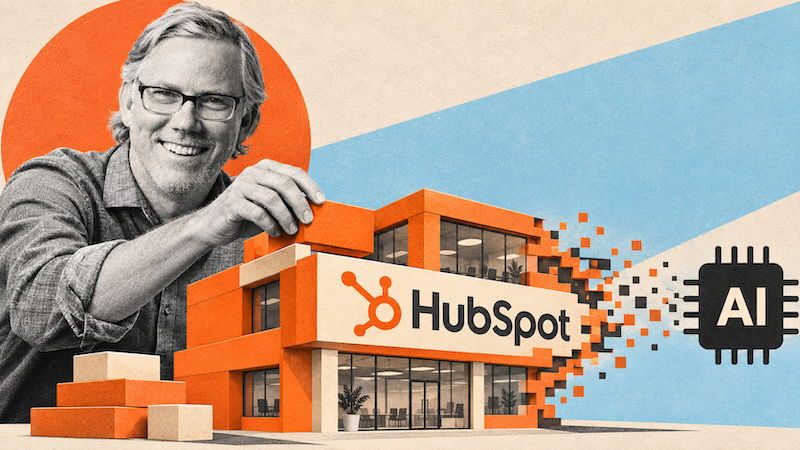
Brian Halligan is running HubSpot again. As of Thursday morning, Yamini Rangan is out as CEO and off the board, a new CFO is on the way from Adobe, and the company's own announcement describes Halligan's mandate as reimagining HubSpot from the ground up across product, go-to-market and culture. Halligan's word for it is "refounding."
The market liked the sound of that. Shares jumped about 9% in premarket trading, per Seeking Alpha, which takes a little of the sting out of a stock that is still down roughly 49% this year while the S&P 500 is up 11%.
Rangan's record is not the problem, at least not on paper. Under her, HubSpot grew from 135,000 customers to more than 311,000 and from $1.3 billion in revenue to an expected $3.7 billion this year, CMSWire noted. Boards do not usually fire executives who nearly triple revenue. They do it when they stop believing the next five years will look anything like the last five.
Founders don't come back for a tune-up
A founder return is the corporate equivalent of pulling the fire alarm. Starbucks did it, Apple did it, and in every case the message to employees and investors was the same: the professional managers ran the existing playbook well, and the existing playbook is the thing that's broken.
HubSpot's version has a sharp irony to it. Halligan built the company on inbound marketing, the idea that you publish useful content, rank in search, and let customers come to you. He co-wrote the book on it. That funnel is precisely what AI is dismantling. When Pipedrive announced the biggest restructuring in its history last month, CEO Paulo Cunha pinned it on AI-driven search drying up the free web traffic that fueled the company's growth, according to LayoffHedge's summary of Estonian reporting. Buyers now ask a chatbot which CRM to use. They don't click through ten blog posts to get there.
The pricing model is under the same pressure. HubSpot still charges mainly by seat and contact tier, and Rangan warned in the third-quarter report that customers would keep scrutinizing budgets and prices into 2027, Startup Fortune reported. The company has already started hedging. In April it moved two Breeze AI agents to pay-per-result pricing, charging $0.50 per resolved customer conversation and $1 per recommended lead, and in October it let customers swap seats for AI credits mid-contract, per CMSWire. It also cut nearly 660 jobs, about 7% of staff, a month before the CEO change.
That sequence tells you the board's diagnosis. Cutting costs and tinkering with pricing was the incremental fix. Bringing back the founder is an admission that incremental fixes won't be enough.
Everyone is refounding something
HubSpot isn't alone, and it isn't even first this month. Canva announced on Nov. 4 that 1,271 people, about 22% of the company, would be laid off, moved or reassigned, and Melanie Perkins framed it as a need to "refound Canva" after growth slowed for the first time in a decade, Dealroom reported. Two companies, two founders, one word, eight days apart. That is no longer a coincidence. It's the new vocabulary of software.
Pipedrive is cutting 267 of its 380 jobs in Estonia, the country where it was born, and closing its Lisbon office of about 220 people, Estonian World reported. Freshworks cut 11% of its workforce in May while its CEO said over half the company's code is now written by AI, per Outlook Business. Microsoft offered voluntary buyouts for the first time in its 51-year history to about 7% of its U.S. workforce, eMarketer reported. One tracker built on Layoffs.fyi data puts Oracle's cut at 30,000 positions, the year's largest, per ValueAdd VC.
The aggregate numbers are worse. By Aug. 6, tech layoffs for 2026 had already passed the total for all of 2025, Yahoo Finance reported, citing Fast Company. Layoffs.fyi now attributes 36% of this year's cuts to AI, up from 16% last year, according to an analysis of its data. More than one in three.
The stock charts read the same way. monday.com's shares have fallen about 76% over five years, Yahoo Finance noted. Atlassian was down roughly 57% at its March lows, SaaStr found, and last week it dropped 16% in a day on a quarter that beat estimates, Trefis reported. Investors are no longer punishing bad results. They're punishing the business model, and the money they pull out of seat-priced software keeps flowing to the frontier labs and the companies that sell them chips.
Then there's the sales floor, where the desperation is on full display. Our inbox takes in more than 300 pitches a day, nearly every one promising an AI agent that will change our lives. One AI sales startup, Monaco, has been sending caviar and Dom Pérignon to get a demo on the calendar. Caviar, for a demo. When the product can't open the door anymore, apparently the luxury gift basket has to.
Building the thing that kills you
The most interesting part of HubSpot's year may not be anything Halligan does next. It's something his co-founder already did.
In August, HubSpot CTO Dharmesh Shah launched YouSpot, an AI-native CRM for one-person companies, built inside an innovation group called HubSpot Next. It has a free tier and a $10-a-month Pro plan with no seats to count. Shah has been careful to say it is not for teams with a go-to-market function, and he tells those buyers to go with HubSpot.
Take that at face value and it's a smart way to pick up solo operators HubSpot was never going to win. Read it the other way and it's a co-founder building a product with no seat license, no implementation and a price tag that rounds to zero, inside a company whose stock has been cut in half by investors who think AI makes seat licenses obsolete. Every incumbent says it will cannibalize itself before someone else does. HubSpot is one of the few actually shipping the thing that could do it.
That is what a refounding probably has to mean if the word is going to mean anything. Not a rebrand of the existing suite as an "agentic customer platform," which HubSpot already did, but a willingness to let the $10 product grow up and eat the expensive one.
Halligan offered his first hint at what that means within hours of taking the job. "We're now the Customer Harness Company," he posted on X, echoing HubSpot's announcement, which describes the company's third chapter as building a "customer relationship harness." In AI, a harness is the scaffolding around a model: the tools, memory and permissions that turn a chatbot into an agent that can actually get work done. Read that way, Halligan is telling the market HubSpot no longer wants to be the place salespeople log their calls. It wants to be the layer AI agents plug into to reach your customers. It's a smart pitch. It's also an admission that the CRM, the product HubSpot spent a decade selling by the seat, is turning into plumbing.
Nobody has the new playbook
The honest read on all of this is that no one knows how it shakes out. Not the boards bringing founders back, not the investors swinging Atlassian 16% on a beat, and not the founders themselves, who are rewriting their playbooks in public in real time. Anyone who claims to have the answer is selling something, possibly with caviar.
What's breaking is the machinery of SaaS: seat-based pricing, inbound funnels, headcount-heavy sales teams. What isn't breaking is the stuff underneath it. You still get what you inspect, and AI has made inspection cheaper, not optional. People still buy from people they trust, which no gift basket can manufacture. The basics still win: call your customers, follow up when you said you would, write down what you heard. Doing the right things in the right order still beats doing more things, and no stack of new tools has ever fixed a broken process. And sales reps still want to win. Give them a clear process and a price they can explain, then get out of the way.
Halligan's return is a bet that the person who wrote the last playbook is the best one to tear it up. It might be right. Either way, when the founders start coming home, it's because the house they built doesn't fit the neighborhood anymore.