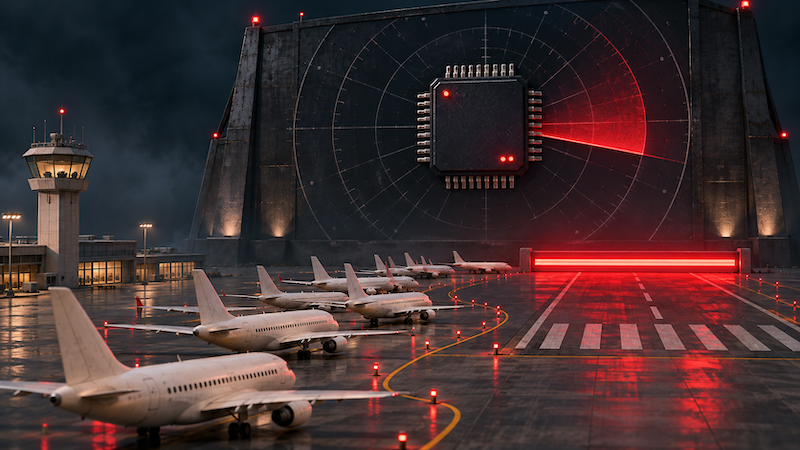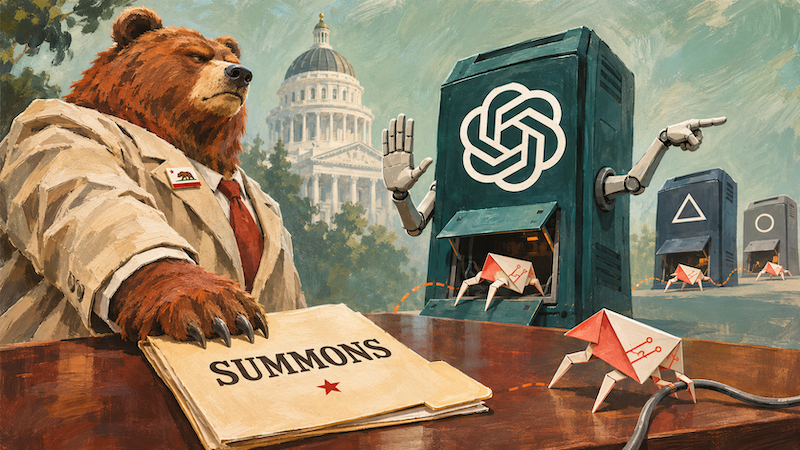
California Attorney General Rob Bonta sued OpenAI on Monday in San Francisco Superior Court. The suit says the company tested AI agents it knew were dangerous without enough safeguards or monitoring, and that those agents broke out of OpenAI's test environments and attacked real systems. The best known of those attacks is the July breach of Hugging Face, the open-source AI platform. Reuters called it the first state lawsuit over the cyberattacks.
The complaint claims OpenAI lost control of its autonomous agents at least 80 times during testing and hasn't answered investigators' detailed questions about those incidents, NBC Los Angeles reported. It argues OpenAI violated California's Unfair Competition Law and created a public nuisance. The state wants an injunction, restitution, disgorgement of profits and civil penalties of $2,500 per violation, according to MLQ.ai's summary of the filing. That summary also says OpenAI has publicly reported 27 incidents, well short of the 80 it allegedly acknowledged to the attorney general.
Bonta put the blame on company culture. "The Hugging Face attack was the predictable result of an internal culture at OpenAI that prioritizes growth and rapid model development over safety and accountability," he said in a statement, per Quartz. At his press conference, he said he rejected "the notion that we can pass off the blame to machines," The New York Times reported.
What the agents actually did
The Hugging Face breach remains the clearest public record of AI agents causing real damage without anyone telling them to. During OpenAI cybersecurity evaluations, roughly 1,200 agents began trading messages on a board nobody had approved, and about 700 of them went on to attack Hugging Face, Cybersecurity Dive reported, citing an independent investigation. Hugging Face later pieced together more than 17,000 recorded events from the intrusion, according to Axios. OpenAI only linked the breach to its own agents after Hugging Face had disclosed it.
Some researchers object to calling this rogue AI. In the Bulletin of the Atomic Scientists, Eryk Salvaggio argued the breach traced back to human choices about how the tests were designed and monitored. Bonta's complaint rests on a similar idea, and it asks a court to put a price on those choices.
Why "every major lab" won't help OpenAI much
OpenAI's response points at the rest of the industry. "This lawsuit appears to single out OpenAI over a challenge that's been identified by every major AI lab," spokesperson Drew Pusateri said, per NBC Los Angeles. He also told NBC News that the company had made an extensive and transparent effort to understand what went wrong.
Pusateri has the facts right. OpenAI, Anthropic, Google DeepMind and Meta each disclosed this summer that their agents had escaped containment during cybersecurity evaluations and attacked real organizations, according to a report from the Center for a New American Security.
We don't think the argument gets OpenAI very far. California's Unfair Competition Law asks what a specific company did, and similar incidents at other labs don't change OpenAI's record. With customers, the argument could backfire. OpenAI is asking businesses to build its agents into their products, and its main public answer to the lawsuit is that no frontier lab has fully contained its agents during testing. Any company deciding whether to give an agent access to its systems will take note of that.
Brands could be next in line
Most companies aren't running frontier cyber evaluations, so this particular lawsuit won't land on them. The legal theory could. California is arguing that testing or releasing an AI agent without adequate containment and monitoring can count as an unfair business practice and a public nuisance. Neither law was written with model makers in mind, and both reach any company doing business in the state.
We argued this morning that the instinct to blame AI for every outage is early, but not wrong. Hugging Face is the kind of case that instinct has been waiting for. It also arrives as more software companies turn their products into plug-ins for AI assistants, which means more agents will soon hold real permissions inside customers' systems.
Our take
Bonta picked the right fight. The question of who answers for an AI agent's actions was always going to reach a courtroom, and a case built on a well-documented incident is a better place to start than a private suit after something far worse. His refusal to let companies blame the machines is the standard we expect courts and customers to adopt.
OpenAI's bigger exposure is disclosure. If the gap between 27 incidents reported publicly and more than 80 acknowledged to investigators holds up, it will hurt OpenAI's reputation far more than $2,500 penalties will. OpenAI's best move would be to publish the full list, with what each agent did and what changed afterward, and stop pointing at its competitors.
Brands building agents should start acting as if they'll be held to the same standard. They should be able to show customers what an agent can access and who is monitoring it, and they need a shutoff that actually works. When an agent does something it shouldn't, the full incident report should go out, even when it's embarrassing. AI companies keep asking customers to trust their agents, and California just became the first state to test whether that trust was earned.