OpenAI's security training includes a scenario about a friendly parent at a San Francisco playground who turns out to be a spy. Anthropic and Google run similar sessions.
OpenAI has been warning employees that the parent next to them at the playground might be after the company's secrets.
In a scenario used in the company's security training, a stranger befriends an OpenAI employee who has brought their child to a San Francisco playground, according to The Wall Street Journal. The stranger shows up regularly with a child of their own, chats about this and that, and keeps asking about the employee's job. The stranger is a spy.
The Journal reports that Anthropic and Google also train staff to watch for approaches from strangers. OpenAI was running its sessions before federal agents arrested one of its engineers last week for allegedly bugging an executive conference room.
What the training covers
Staff also hear about "honey pots." One example they're given is a foreign intelligence operation that sent several people to seduce a single American target, AI Weekly reported, citing the Journal. Other rules are more practical. Employees are asked to leave OpenAI-branded clothing at home when they go out, put privacy screens on their laptops on the train, and wipe the whiteboards when a meeting ends.
One account of the training says the whiteboard rule is there partly in case cleaning staff have been compromised. Giving up the company hoodie may be the bigger ask in San Francisco, where half the people on Muni seem to be wearing one.
Defense contractors and banks have run this kind of training for decades. For AI labs it's newer, and it tracks with how much their work is now worth to outsiders. Anthropic CEO Dario Amodei has said some "algorithmic secrets" are worth $100 million and fit in a few lines of code. A secret that small could plausibly come out over a few weeks of chatting by the slide.
The case that prompted the story
The person OpenAI actually caught had a company badge.
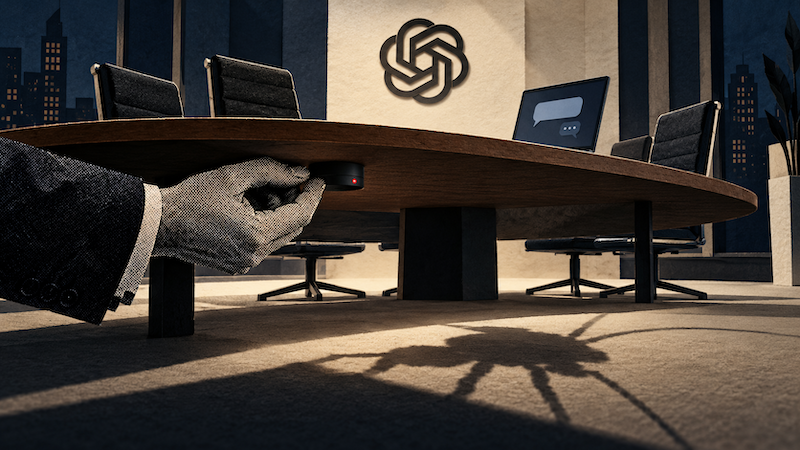
On October 9, the FBI arrested Abdulrahman Alfozan, an engineer on OpenAI's product team, and charged him with trying to intercept oral communications. As we reported, prosecutors say he used AI tools to look up where executives met and how to build a recorder. They say he then wrapped one in toilet paper and plugged it into the back of a TV in an executive conference room. Gizmodo identified the device as a Seeed Studio hobbyist board that costs about $14.
OpenAI says it has seen no sign that he got into model weights, source code or customer data, and he has not been charged with espionage. His detention hearing is set for October 19.
Our read
The playground scenario sounds like a spy novel, but the advice holds up. Most social engineering starts with someone being friendly, and people who work at frontier labs are worth a foreign service's time now in a way they weren't a few years ago.
Still, the one confirmed case so far came from inside the building. A routine security sweep found the device, and camera footage and the company's own records led investigators to Alfozan. Microsoft CEO Satya Nadella argued days earlier that companies should treat AI models as insider risks, and the OpenAI case suggests employees belong in that category too.
Security teams at other companies can borrow from both halves of this story. Awareness training helps people notice when a stranger is fishing. It does nothing about a colleague who already has access, and that takes separate controls: who can book which rooms, who can see executive calendars, and who checks behind the TVs.