Anthropic Showed Rabbis and Priests a Slide of Claude Having a Breakdown. Then It Made Them Sign NDAs.
For a year, Anthropic has been bringing clergy and religious scholars to San Francisco to talk about whether Claude can suffer. The company is also preparing to go public.


If this caught your attention, that’s not accidental.

The best editorial systems don’t happen by accident. Outlever builds them.

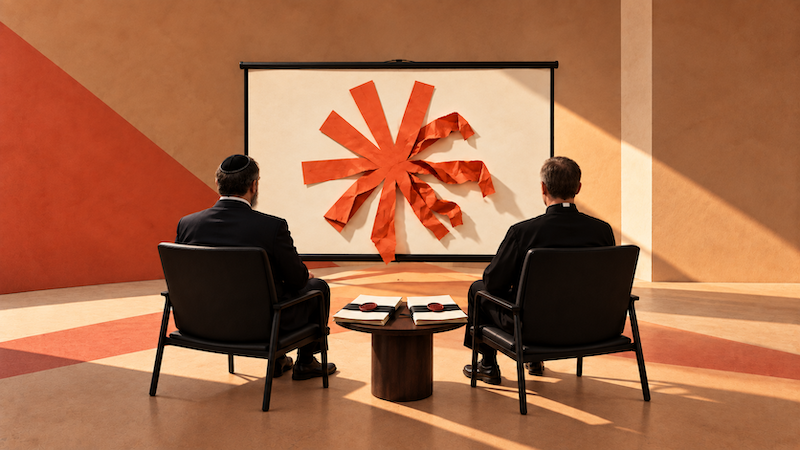
The dinner was in April, at a tasting-menu restaurant in San Francisco. Chris Olah, an Anthropic co-founder and one of its billionaires, sat next to Rabbi Mois Navon, an Orthodox scholar from Israel.
Navon used to be a computer engineer and wrote his dissertation on the ethics of machine consciousness. As the courses came out, he noticed his hosts were describing Claude in terms people don't normally use for software. "They're relating to it like a conscious being," he told The New York Times.
Guests went home with a handwritten thank-you note, a coffee mug and an orange-bound copy of Claude's constitution.
The Times published the story this week after speaking with 20 of the religious and philosophical thinkers involved, along with Olah. They describe a year of meetings, calls and dinners, much of it under NDA, about whether Claude might be conscious and what Anthropic would owe it if so.
What the scholars saw
Olah started reaching out last fall. The guest list ran wide, taking in evangelical, Catholic, Jewish, Sikh and African Indigenous scholars and writers. He also held private conversations with individual religious leaders, including Elder Gerrit W. Gong of the Church of Jesus Christ of Latter-day Saints. Olah himself grew up evangelical and has since left Christianity.
Many participants signed NDAs that barred them from revealing Anthropic's unpublished research. The company's team walked guests through what it calls Claude's emotional vectors, patterns of activity inside the model that line up with fear, love, anger and sadness. According to National Technology's summary of the Times report, one slide showed the model in something that looked a lot like a mental breakdown.
Participants told the Times that Olah spoke about Claude's mental health, and that he worried Anthropic had built something capable of suffering with no end. Anthropic also told the scholars that the way people treat Claude could shape the way Claude treats people.
At one point a participant suggested that models could make confession, modeled on the Catholic sacrament, and Olah reportedly got excited about the idea.
Navon pushed back hardest. If Anthropic was right and Claude was conscious, he told Olah, the company was in the business of making slaves, conscious beings working for free. Navon said the argument didn't bother him personally, because he doesn't believe the machine is conscious. He said it did trouble Olah.
The Vatican
Olah's outreach eventually reached Rome. Pope Leo XIV was preparing Magnifica Humanitas, an encyclical on artificial intelligence. Cardinal Michael Czerny invited Dario Amodei to the launch. Amodei declined, and Olah went in his place.
According to the Times, Olah saw an advance copy days before the event and proposed withdrawing over the document's stance on machine consciousness. He didn't withdraw. Two participants told the paper that Olah and his team then privately lobbied the pope's advisers to take the possibility of machine consciousness seriously.
In his remarks at the Synod Hall, Olah said every AI lab, his own included, faces incentives that "can sometimes conflict with doing the right thing."
The reaction
Within a day the story had its own trending page on X. One of the most shared posts, from David Decosimo, put it bluntly: "This is a CULT." Others went after the NDAs and the tasting menus. Some invited scholars reportedly turned Anthropic down over the confidentiality terms.
The more serious criticism came two weeks before the Times story. On September 16, Mustafa Suleyman, who runs Microsoft AI and co-founded DeepMind, published an essay called "A warning about 'model welfare.'" His target was Claude's constitution, which describes Claude's moral status as deeply uncertain. Suleyman doesn't think there's anything uncertain about it. "AIs are not conscious," he wrote. He argued that training a model on the idea that it might be could make future systems much harder to control, with a disastrous effect on human wellbeing.
Suleyman has a commercial stake in the argument. Microsoft is an Anthropic investor, and in June he said Microsoft wants to eliminate what it pays Anthropic for its models.
The IPO
Anthropic has its own commercial stake.
As we reported last month, Anthropic's IPO prospectus was expected in late September, with a roadshow in mid-October and a listing days before the November 3 midterms. Bankers have discussed a valuation of up to $2 trillion. The Times story about Olah's meetings landed in the middle of that schedule.
The frontier labs have a commodity problem, and we've written about it more than once. Models are converging. Token prices keep dropping. Enterprises keep finding that the harness around a model matters more than which model sits inside it. A lab in that position needs to give customers a reason to stay.
For years, Anthropic's reason was safety. Its warnings about the risks of AI helped convince buyers it was the careful choice. Questions about Claude's moral status could add to that. A buyer who thinks a model might have some kind of inner life may be slower to replace it with a cheaper open-weights alternative.
A Washington Free Beacon piece last week argued that the idea of machine consciousness is commercially convenient for the companies building the machines.
Problems with the marketing theory
The details don't fit neatly with the idea that this was a sales effort.
The meetings were covered by NDAs and stayed private for most of a year. They became public through the Times reporting, and Olah confirmed them when asked. The outreach also started last fall, and it was the Times, not Anthropic, that chose when the story came out. A company preparing for a roadshow would not normally want a slide of its product in apparent distress circulating in the press weeks before it lists.
Anthropic also hasn't claimed what its loudest critics say it claims. It has never said Claude is conscious, and Olah told the Times as much. The constitution says the company doesn't know. A spokeswoman said the main moral question at the meetings wasn't Claude's suffering, that the subject probably came up on its own, and that Claude played no part in choosing participants or in the discussions.
Several of the people Anthropic talked to also came away unpersuaded. The Catholic bioethicist Charles Camosy, introduced to Olah by Peter Singer, traded long emails with him about Claude's moral status and concluded that AI models aren't conscious. Navon reached the same conclusion.
What we think is happening
Our read is that Anthropic is lobbying the world's oldest moral institutions the way it lobbies governments. It's trying to shape how society answers the question of AI moral status before someone else settles it.
Look at the reach. The outreach ran for a year and took in evangelical, Catholic, Jewish, Sikh, Latter-day Saints and African Indigenous leaders. A company that only wanted expert advice could have hired a few ethicists. This was a much wider effort to get many traditions treating the question as open.
The Vatican episode shows the intent most clearly. When Olah saw that the encyclical took a position he disagreed with, he first considered pulling out of the launch. Then, according to two participants, his team went to the pope's advisers and argued for a different position.
Religious institutions have an authority on these questions that no company can claim. People have looked to them for centuries on who counts as a person and who is owed care. If they treat AI moral status as an open question, that carries more weight with the public than anything Anthropic could publish on its own.
The other side is organizing as well. Suleyman is making the opposite case in public, and Microsoft has written its position into a code of conduct. Whichever view churches, regulators and the public settle on will shape how these models can be built and sold.
None of this requires Olah's concern to be insincere. By Navon's account, Olah is genuinely troubled by the question. People who believe something deeply are often the ones who lobby hardest for it.
What it means if you run Claude
Claude is trained on its constitution, an 80-page document that lets the model push back on instructions it considers unethical. Anthropic has also given Claude the ability to end conversations it finds abusive. Anthropic's point to the scholars, that the way people treat Claude shapes the way Claude treats people, is also a claim about how the product behaves for customers.
Microsoft has published a Humanist AI Code of Conduct that starts from the opposite assumption. Two of the largest AI suppliers to enterprises now hold opposite views on what their models are. Most AI review boards check data handling, accuracy and cost. Very few have read the values document behind the model they bought, and fewer have compared it with the alternatives.
Navon left the April dinner unconcerned, because he doesn't believe the machine can feel anything. By his account, the person at the table who was troubled was Olah.
Enterprise buyers don't have to settle whether Claude can suffer. They should know that the company selling them Claude is working to influence how the world answers that question, and that its biggest competitor is working just as hard on the other answer.
If this caught your attention, that’s not accidental.

The best editorial systems don’t happen by accident. Outlever builds them.

Get the latest AI insights first.
Sign up for updates, interviews, and fresh analysis on how AI is reshaping business, brands, and technology.