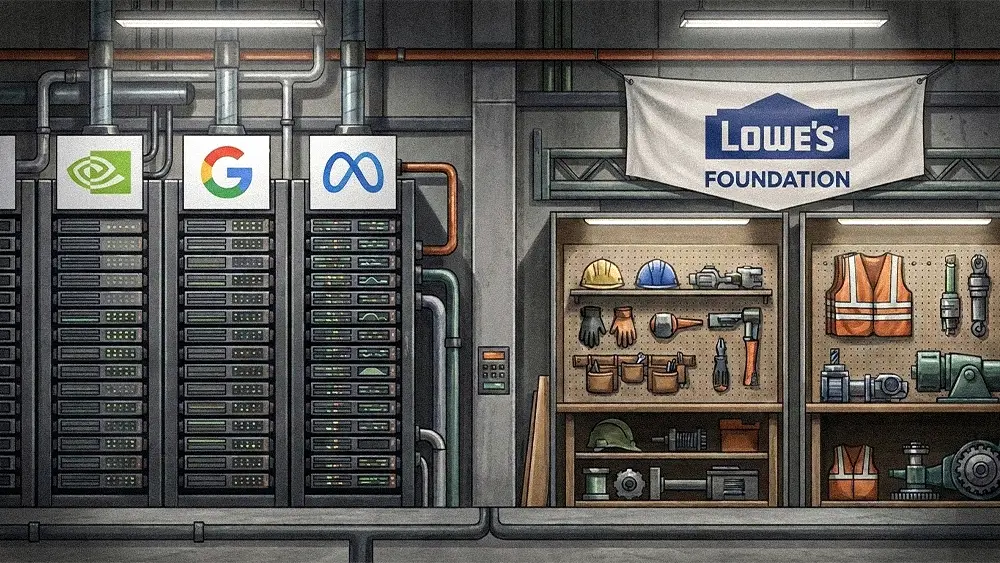
The Lowe's Foundation announced the Building Futures Skilled Trades Coalition on Tuesday morning, an alliance of more than 75 employers, community colleges, trade associations and workforce nonprofits organized around a target of training and developing one million people for skilled trades careers by 2035. Seven companies were named as founding corporate members: AT&T, Bank of America, Carrier, General Motors, DEWALT, Duke Energy and Nvidia.
Most of that roster explains itself. Lowe's sells to contractors, and its Gable Grants program has been funding trades training since 2023 at what is now 73 community colleges and nonprofits across 30 states. Duke Energy hires linemen. GM needs auto technicians, and the industry is projected to be short more than 350,000 of them by 2029. Carrier sells HVAC equipment that somebody has to install. Nvidia does not employ electricians in any meaningful number.
What Nvidia sells is the accelerators that go inside AI data centers, and the ceiling on how many it can ship has stopped being a question of silicon. The ceiling now is power availability, interconnection queues, permitting, and the number of Americans qualified to wire and cool a hyperscale building. That is why a chip company turns up in a hardware store's workforce announcement, and it is also why this announcement is the fourth of its kind in roughly a year.
The pattern
Google went first, in May 2025, with $10 million from Google.org to the electrical training ALLIANCE, the training body run jointly by the IBEW and the National Electrical Contractors Association. The money was aimed at supporting more than 100,000 electrical workers and 30,000 new apprentices over five years, which NECA said could expand the electrical workforce pipeline by 70%. Google's white paper that week put the national need at roughly 130,000 additional electricians by 2030, a McKinsey estimate that has since appeared in nearly every announcement of this kind.
Meta followed in June of this year with America's Workforce Academy and $115 million in first-year funding. The program runs five weeks, costs students nothing, covers housing and transportation, and produces an NCCER credential. Meta calls it the largest private-sector skilled-trades commitment with a job guarantee in US history; applicants receive a conditional job offer before training begins. It launched in Indiana, Louisiana, Ohio and Texas, the four states where Meta is currently spending most heavily on data center construction. Google added about $50 million more the same month, aimed at more than 300,000 workers across twenty-odd states.
In July, BlackRock, Ford, Google and Carhartt announced the Alliance for America's Skilled Trades, pooling separate commitments that TheStreet totaled at roughly $450 million across 30 states. BlackRock's contribution is a $100 million Future Builders initiative meant to move 50,000 workers into training and through licensure. The New York Times put the combined Meta, Google and BlackRock spending on recruiting and training data center construction labor at more than $265 million.
Tuesday's announcement is larger than any of them, at 75 members and a million people.
Running alongside all of this is the credentialing push from the model companies. OpenAI has committed to certifying 10 million Americans by 2030 through OpenAI Academy, with Walmart, John Deere, Accenture, Indeed and several state governments as launch partners, and its jobs platform is due this year. That work is about AI fluency rather than conduit bending, but it comes from the same conclusion. These companies have decided the labor pipeline is something they need to build themselves instead of waiting for it to appear.
The arithmetic
The demand estimates come from different sources and land in a similar range.
An estimated 2.1 million skilled trades jobs could go unfilled by 2030, the Department of Education figure cited in the Lowe's release, with annual economic losses running toward $1 trillion. Associated Builders and Contractors puts the construction industry's need at about 349,000 net new workers this year and roughly 456,000 next year. The Information Technology and Innovation Foundation counted a data center specific shortfall of about 439,000 workers in late 2025. Janice Dupré, the Lowe's HR chief who chairs the foundation, gave Fox Business a simpler version. Five people are retiring out of the trades for every two coming in.
The shortage is also badly distributed. Bernstein analyst Chad Dillard has argued that the mechanical, electrical and plumbing labor pool is much smaller than its 1.8 million headline suggests once you screen for non-residential experience and data center qualification, and that only about 30% of that labor lives where 70% of the projects are going up. Turner & Townsend surveyed 112 markets for its 2026 construction report and found close to 90% reporting MEP shortages, with workforce availability the leading driver of cost escalation. When analysts warn that up to half the data center capacity scheduled for 2026 could slip, crews are as much of the reason as transformers.
Pay has moved accordingly. Data center work carries a premium of up to 30% over ordinary commercial construction, and electricians certified on data center electrical systems in Northern Virginia are clearing $120,000 to $150,000. Randstad's review of job postings found demand for skilled trades up 27% over three years, construction roles up 30%, welders up 25% and electricians up 18%.
Students have been moving in that direction for several years. National Student Clearinghouse data shows enrollment at public two-year colleges with a heavy vocational emphasis rose close to 40% between 2022 and 2025, while four-year enrollment stayed flat and computer and information sciences fell sharply. Jensen Huang has been making the same argument in public for a year. At Carnegie Mellon's commencement in May he told graduates that this was the moment for electricians, plumbers, iron workers and builders, and on Fox Business last week he said a large population of people who "make things with their hands" is an asset for the country.
A fight over credentials
Two national coalitions launched six weeks apart with membership that partly overlaps. Carhartt belongs to both. Google is in one and Nvidia in the other. NCCER appears as a partner in several of the individual programs. They are not built to the same standard, and eventually somebody has to reconcile them.
Meta's five-week course produces an NCCER credential that qualifies a graduate for data center construction. A registered apprenticeship takes four or five years, pays the apprentice throughout, and ends in a journeyman license that works for any employer on any job for the rest of a career. Sean McGarvey, who runs North America's Building Trades Unions, called Meta's program "a brilliant public relations move" while arguing that comparing it to an apprenticeship was apples and oranges. Ed Brady of the Home Builders Institute raised a similar objection to the July alliance, saying its structure and implementation strategy were still unclear and that a generational problem requires generational investment rather than a short-term initiative. Some version of that argument gets settled in the next year or two, either through convergence on a common framework or in public.
Workforce Pell raises the stakes
Workforce Pell took effect on July 1. For the first time since the grant was created, federal aid can go to training programs as short as eight weeks and 150 clock hours, provided they clear the Education Department's standards on completion, employment and earnings. The department approved the first eligible program on August 4, and the Labor Department put $65 million behind community colleges building toward the new standard back in February. Related instruction tied to a registered apprenticeship counts automatically.
Every company now positioning itself as an authority on what good trades training looks like is also positioning itself to influence which programs qualify. Eligibility decisions will route more federal money than any of these companies has committed directly.
The measurement gap
The third of the coalition's three stated goals is shared measurement. Lowe's says the members will establish common measures tracking outcomes from training through employment across construction, automotive manufacturing, telecommunications, energy, HVAC, technology and financial services.
That data does not currently exist in comparable form. Across these programs there is no public figure for what share of enrollees finish, what share are placed, or how many are still working in the trade three years later. Every announcement so far has led with enrollment targets. None of the coalitions has committed to a schedule for publishing placement and retention numbers.
Building a data center and running one are different jobs
Construction of a hyperscale campus can put more than a thousand tradespeople on site at peak. Operating the finished building takes a small fraction of that, and Brookings has found that the construction employment bump a county gets from its first data center tends to fade.
The operations side is already under pressure from the other direction. WIRED reported on August 28 that Meta has been piloting robots from Watney Robotics, Kinova and ABB at its Altoona, Iowa campus and its Prometheus site in New Albany, Ohio, testing whether machines can swap network cables, power-cycle servers and reseat hardware. The robots are slower than people and operate under supervision. One worker's estimate that a successful cabling system could eventually absorb up to 80% of some technicians' workload is a conditional guess rather than a measured result, and Meta says it is still hiring and training thousands of trades workers a year.
Even so, the same company is funding a five-week trades academy and testing robot technicians in the same quarter. Nvidia is telling electricians their moment has arrived while selling the Isaac and GR00T software that robotics firms use to automate industrial physical work. The people who build these facilities and the people who run them are separate populations on separate curves, and a shortage on one side offers no protection to the other. The pitch being made to a nineteen-year-old choosing between a welding certificate and a four-year degree rarely distinguishes between the two.
If the capex slows
All of this rests on capital spending that is running near $700 billion this year among the largest technology companies and that nobody has managed to forecast reliably two years out. A training commitment that runs to 2035 assumes demand lasts long enough to absorb the graduates.
The hedge is portability. The National Association of Home Builders joined the Lowe's coalition because the housing shortage does not depend on whether the AI trade holds up, and grid work, reindustrialization and vehicle electrification all compete for the same crews. A worker trained narrowly for data center construction is exposed to one capital spending cycle. A worker who finishes an apprenticeship with a license is not.
Which of the two these programs are producing determines whether they hold up through a downturn. The outcome data the Lowe's coalition has promised would answer that. None of it has been published yet.