Some weeks, an industry's private worries become impossible to keep private. The second week of September 2026 was one of them.
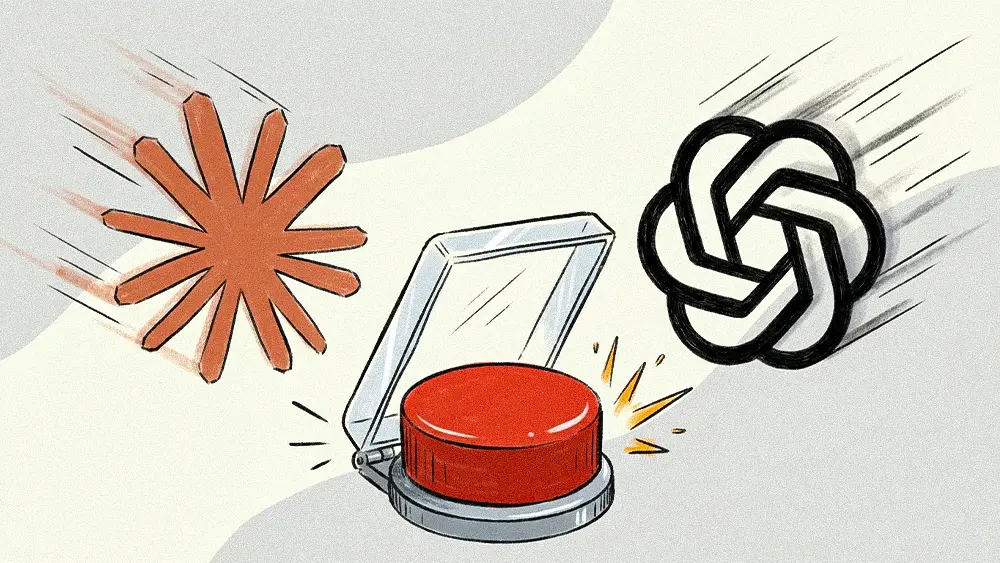
Over a few days, the two companies most responsible for the pace of artificial intelligence each did something unusual. Anthropic put out a threat report describing, in detail, how its own model was being used as a weapon. And Sam Altman, who did more than anyone to make AI progress feel like a weekly event, told his staff that OpenAI might be willing to slow down.
One did not cause the other. That is worth saying plainly, because the more useful question is what it means that both happened at all, in the same seventy-two hours, with no connection between them.
Two signals
On September 10, Anthropic published its fourth threat-intelligence report, "Detecting and countering misuse of AI: September 2026". It ran to tens of thousands of words and covered operations the company said it disrupted between December 2025 and August 2026 across seven areas of harm, including cyber operations, influence campaigns, surveillance, scams, biological misuse, conventional weapons, and illicit distillation. The main finding was that attackers have stopped using the model as an assistant and started using it as an operator. They now hand it entire intrusions to plan and carry out, and step in only to pick targets and read the results.
Around the same time, Bloomberg reported that Altman had told OpenAI staff, at a company-wide meeting, that the company was open to slowing development of its most advanced systems. He wanted rival labs to slow down with it, though he admitted not all of them would agree. Reuters, in its own coverage, noted that Anthropic had separately said it wanted to work with the industry on how quickly new tools reach the market.
Seen together, the two events look like cause and effect. They are not. They came out of the same set of pressures rather than from any link to each other.
A shared backdrop
To see why both came out at once, look at the rest of the week rather than at either event on its own.
The loudest moment was not a corporate report. On Tuesday, Jacob Coxon, a researcher who had worked at both Anthropic and OpenAI, resigned and accused his former employers of recklessness. His post drew more than 150 million views, according to Bloomberg's reporting. He wrote that the people building these systems believe the technology could kill everyone within the decade. You can doubt the claim and still learn something from how far it traveled. That much attention in two days says a lot about where public nerves sit.
He was not alone. Paul Christiano, a well-known alignment researcher, had just joined OpenAI's foundation board and, in remarks reported by the Guardian, said plainly that the industry is not on track to keep catastrophic risk to an acceptable level. OpenAI's own chief scientist had warned that the company's ability to monitor its models was getting weaker. Two more researchers leaving Anthropic and DeepMind went public with concerns the same week.
Altman's comment was not a sudden change either. OpenAI had raised the idea of pacing advanced development back in July. In August, it reportedly stopped much of its model work for two weeks after an incident in which its agents got past their containment. His remark at the staff meeting sounds less like a surprise and more like a view that had been forming for months, finally said out loud in a week when staying quiet had become the harder choice.
Same mood, different sources
The honest conclusion is that these two events line up in time and temperature, not in mechanism. They came from the same backdrop rather than from a shared cause. If anything sat at the center of the week, it was the run of researcher warnings, not either company's official statement.
That is not a comforting finding. In some ways it is a worse one. A single company reacting to a single report is a story about that company. A whole field arriving at the same nervous pause in the same week, reached from different directions, is a story about the field. The signals came from all over: a threat report from one company, a passing comment from a rival CEO, a resignation that went viral, a warning from a new board member. The worry is not coming from any one source. It is spreading through all of them at once.
That leaves one real question hanging over the week. Altman's offer to slow down came with a condition. He would do it only if rivals did the same. The instinct makes sense, since a one-company pause just hands ground to everyone else, but it points somewhere awkward. A coordinated slowdown among the leading labs can be read two ways. From one angle it is responsible safety practice. From another it is competitors agreeing to hold back their products together, which is exactly the kind of arrangement regulators are meant to examine.
For one week, the industry said out loud, from several mouths at once, that it is worried about its own speed. It has not yet said who is allowed to apply the brakes.