OpenRouter Was Never Neutral
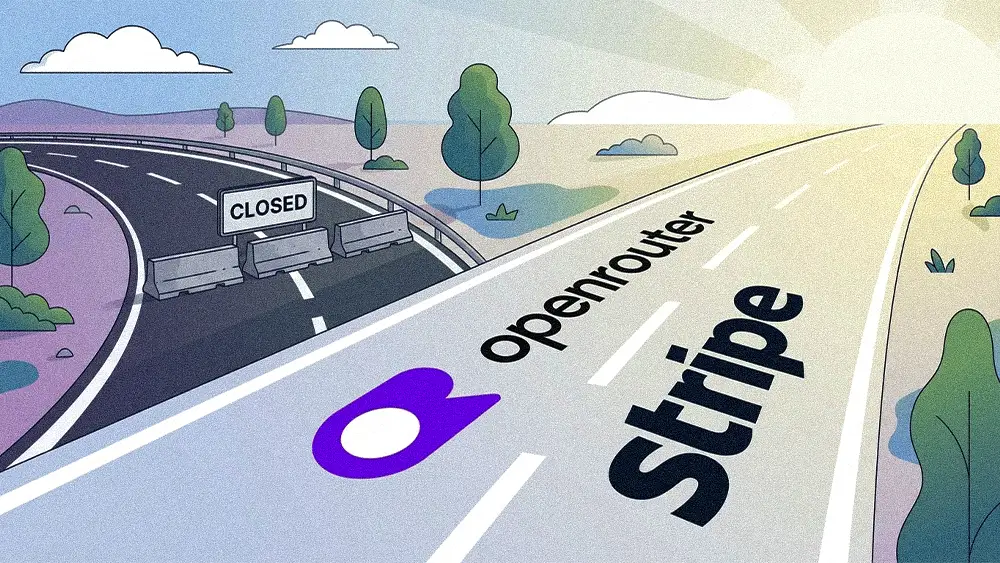
Stripe is paying north of $7 billion for the router behind AI's most-cited usage data. That router's impartiality was never audited, published or contractually committed.


If this caught your attention, that’s not accidental.

The best editorial systems don’t happen by accident. Outlever builds them.

In June 2025, models from Google, OpenAI and Anthropic accounted for roughly 70% of the token volume running through OpenRouter. Twelve months later it was closer to 30%, with Chinese open-weight models holding the majority, according to platform usage data charted by Bloomberg and recirculated widely after OfficeChai published it in June. CNBC's investigation on 7 July put a narrower version of the same finding on the record: the share of tokens US companies routed to Chinese models through OpenRouter has stayed above 30% every week since 8 February 2026, peaking at 46%, against an 11% average over the preceding twelve months and 4.5% in the first half of 2025.
That data has done an enormous amount of work over the past six months. It has appeared in Bloomberg charts, in equity research warning of capital destruction in US AI investments, in congressional scrutiny of American firms using Chinese models, and in more or less every China-versus-US think piece published since the spring. It gets treated as more honest than benchmarks, and reasonably so, because it records what developers actually paid to run in production rather than what a lab claimed on launch day. Vercel's Harpreet Arora gave CNBC the cleanest summary of why the numbers moved: price is doing the work, and when a task does not need the best model, teams route it to the cheapest one that clears the bar.
It is also a single company's transaction log. OpenRouter knew this and leaned into the role, publishing an analysis of more than 100 trillion tokens of anonymised usage in collaboration with a16z under the title State of AI. The router had become the scoreboard.
On Wednesday, Stripe confirmed it is buying the scoreboard. Bloomberg first reported the finalised agreement on 16 August at above $7 billion. Axios put it north of $8 billion in cash and stock. CNBC, citing the New York Times, reported roughly $7.5 billion with $1.5 billion allocated to OpenRouter's founders. Stripe's own announcement disclosed no price at all, describing the target as a gateway routing across 400-plus models from more than 80 providers, used by NVIDIA, Zoom and Lovable. TechCrunch reported that OpenRouter had closed a $113 million Series B in May at a $1.3 billion valuation, with Sequoia, Andreessen Horowitz, Menlo Ventures and Alphabet's CapitalG among the investors. Bloomberg's reporting put annualised revenue at roughly $50 million as of April.
Most of the reaction went straight to neutrality, which is the right instinct. But the standard version of that argument rests on a premise I think is wrong, and the error is more interesting than the deal.
The neutrality everyone is worried about losing
The consensus runs roughly like this. OpenRouter was neutral. Developers trusted it to route to whatever model fit their budget and latency bar, with no stake in which one won. That was easy to believe while the shareholders were venture funds holding no competing AI product. It gets harder when the owner has its own position in the stack. The mitigating factor, offered in nearly every write-up, is that Stripe has no foundation model, which puts this well below where we would be if AWS or Microsoft had made the same purchase. TheStreet made that argument explicitly; Forbes, KuCoin's markets desk and the National CIO Review all ran variants of it within seventy-two hours.
All of that is reasonable. The problem is the first sentence.
OpenRouter's neutrality lived in the cap table, never in the product. There was no audit, no published routing weights, no contractual commitment, no governance structure, nothing a customer could point at and verify. What existed instead was an absence of any reason to cheat. Sequoia and a16z and CapitalG do not care which model serves a given request, so the routing could be assumed clean, and everybody assumed it.
Nobody had yet needed a guarantee, which is a different situation from having one. For four years the distinction cost nothing, so nobody priced it, and the vocabulary hardened anyway. By 2026 essentially every piece written about the company was calling it the largest neutral router in AI. The Next Web used the phrase while reporting the acquisition. Chris Zeoli's widely shared analysis of China's open-weight position called it the largest neutral router of LLM traffic in the same passage that established it as the evidentiary basis for the entire argument. Nobody who wrote that sentence had seen a routing weight.
To be exact about the claim, since the alternative reading is the more inflammatory one: this is not an allegation that OpenRouter's routing was ever tilted. I have no evidence of that and no particular reason to suspect it. The claim is narrower and in some ways worse. No mechanism ever existed by which a customer could have found out, and the entire market proceeded as though one did.
Why "Stripe has no model" only gets you partway
The mitigation is real, and I want to be clear about that, because there is a version of this argument that treats every acquisition as equally suspect and this one genuinely is not. Had a frontier lab or a hyperscaler bought OpenRouter, the router would sit directly above a product its owner was trying to sell, and the conflict would be disqualifying on its face. Stripe wants tokens to flow and to be billed. It has no particular preference about whose tokens.
Two things complicate it anyway.
The first is that Stripe already sits on the other side of the router. It processes payments for frontier AI labs. OpenRouter itself has been a Stripe customer since well before the deal: a Stripe case study published on 29 January described OpenRouter using Stripe Invoicing, Stripe Tax and Radar to bill more than five million developers, with Alex Atallah quoted praising how Stripe handled payment complexity. The Defiant flagged the obvious irony six and a half months later, which is that Stripe has now bought the account. Forbes' Janakiram MSV notes that the commercial relationship predates the acquisition talks entirely, which is also how Stripe got close enough to the numbers to know what it was bidding on. You do not need to own a model to hold commercial relationships with the people whose models you are arbitrating between.
The second is more basic and tends to get skipped. Routing has never been neutral in the sense the word implies. A router optimises for something: price, latency, availability, throughput, uptime, some blend of these that a developer can partially configure and mostly cannot see. Forbes' Sandy Carter described the actual controls developers get as provider ordering, price ceilings, exclusions and data retention rules, which is a set of preferences, configured by you where you bother and by defaults where you do not. "Neutral" was always shorthand for "the objective function contains nothing except your interests." An acquisition does not insert bias into a system that had none. It hands the objective function an owner, and that owner has a take rate, a billing product it would like to attach, and a strategic interest in the aggregate flow data.
Nobody at Stripe can settle this by promising to behave. The incentive sits in the structure and outlasts whatever anyone intends. Patrick Collison could mean every word of it and the position would be unchanged.
What the price is actually betting on
Against roughly $50 million in annualised revenue, a purchase price above $7 billion works out somewhere north of 140 times. Nobody pays that for current cash flow. The purchase only makes sense as a bet that models commoditise, that none of them stays decisively ahead long enough to matter, and that the arbitrage between them is where margin eventually settles.
The usage data makes that bet look half right, in a way that should worry the buyer.
On volume, commoditisation has already happened. Chinese open-weight models crossed a majority of platform traffic during 2026, with Dataconomy reporting in late July that Chinese-developed models had taken all five top spots in OpenRouter's global rankings for the first time, on a platform then processing over 20 trillion tokens a week. Price explains most of it. OpenRouter's Justin Summerville told CNBC that open Chinese models run 60% to 90% cheaper than the leading Anthropic and OpenAI offerings, and Vercel's data showed Z.ai's GLM-5.2 posting the fastest adoption of any model it tracked in 2026, with daily token volume up roughly 27-fold and customer count up roughly 80-fold in its first full week.
On revenue, it has not happened at all. Closed frontier models kept disproportionate revenue per token, concentrated in agentic work, long-horizon reasoning and anything where a failed run costs more than the tokens it saved. Even at the depth of the volume collapse, Anthropic held a top-two vendor position on the platform. That combination is strange until you accept that two different markets are being measured with one instrument.
So the router captures the cheap lane thoroughly and takes a thin cut of the expensive one. If capability keeps separating rather than converging, Stripe has bought a toll booth on the wrong road. Presumably it is betting the separation closes. Reasonable people disagree about that, and the disagreement is worth more attention than the deal mechanics.
The part that actually bothers us
There is a second-order problem sitting underneath the neutrality argument that has barely come up, and I think it is the bigger one.
We have been calibrating our shared picture of the AI economy against an instrument we cannot inspect, operated by a company with a commercial interest in what it measures.
That was already true before Stripe showed up, and a handful of analysts have been saying so. A Global Semi Research analysis asked directly whether OpenRouter constitutes a panoramic view of the market or a laboratory, and argued the 61% figure circulating in Chinese tech media was closer to a statistical illusion than a measurement. Writing on the CNBC numbers, the analyst Rishabh Kumar and others made a narrower version of the same point: 46% of routed tokens is not 46% of enterprises, 46% of revenue, or 46% of production-critical workloads, because a model can accumulate enormous token share on long-context, repetitive, low-cost tasks without ever winning the hard work. Forbes' Janakiram MSV, writing after the acquisition, put it plainly, cautioning readers to treat OpenRouter's view as a sample rather than a census given the platform's heavy creative and roleplay usage sitting alongside production traffic.
Those are ordinary sampling problems, disclosed and argued about in public, which is what you want. An independent aggregator's biases stay in that category. Ownership by a company with adjacent commercial interests adds a second kind, not because anybody is going to falsify a chart, but because an incentive now exists to shape what gets published, what gets aggregated, and when it gets released. Whether that incentive ever gets acted on is unknowable from outside. That is the whole problem.
I do not think Stripe will cook the numbers. I think it very obviously will not. But the reason I believe that is the same reason everyone believed OpenRouter was neutral, which is that I cannot see a motive. We have just spent a week watching what that kind of confidence is worth when ownership changes.
A chokepoint nobody asked for
There is a policy dimension here that neither party went looking for, and it is further along than most of the deal coverage suggests.
A US payments company now operates the layer through which the majority of routed developer traffic reaches Chinese models. On 21 July, Treasury Secretary Scott Bessent told Fox Business that the administration had found what he described as watermarks of American models inside Chinese ones and could sanction the firms responsible, per CNBC and TechCrunch. He also floated requiring American companies that deploy Chinese models to disclose that fact to customers, a proposal that, if it ever became rulemaking, would land squarely on whoever operates the routing layer.
The pressure is already being applied from both directions. Reuters reported on 7 July that China's Ministry of Commerce was in talks with Alibaba, ByteDance and Z.ai about restricting overseas access to their most advanced models, and the following day US lawmakers confirmed they were investigating Airbnb and Cursor's parent company Anysphere over their use of Chinese AI. The flow itself has already proved sensitive to policy shocks: when export controls forced Anthropic to suspend global access to Fable 5 and Mythos 5 on 12 June, before the Commerce Department lifted the restriction and access was restored on 1 July, Chinese model usage among US firms surged in the gap.
Washington has spent three years trying to apply pressure to a market of hundreds of models and dozens of providers, with limited success, because there is nowhere obvious to push. A single company routing the majority of that traffic is a far easier target, and Stripe has just volunteered for the position. The economics run the other way, since the cheap lane is where cost-sensitive developers live and the entire value of the router lies in helping them find it. None of that gets resolved on engineering grounds.
What to demand instead
Whatever Stripe does next matters less than whether buyers change what they ask for.
The distinction that matters is between neutrality you infer from ownership and neutrality you can check in the product. The first expired on Wednesday. The second mostly does not exist yet, though the components are not exotic and several already ship in partial form. Published routing criteria, including the weights between price, latency and availability. Developer-set provider ordering, price ceilings and exclusions as default controls rather than buried settings. Bring-your-own-key arrangements where the provider bills you directly, so that the router's revenue does not scale with your inference spend. Retention and training-use commitments on prompt data that survive a change of control. Logs an enterprise procurement team can actually audit.
Competing routers started pitching precisely this list within hours of the Bloomberg report. OrcaRouter published a post arguing that a router is only independent if nothing about your spend is its revenue, and that OpenRouter's neutrality being worth $7 billion to Stripe is itself the reason developers should treat neutrality as something to verify rather than assume. That is a competitor's marketing and should be read as such. It is also correct, and it is the test worth applying.
The pattern
Neutral middleware has a predictable life cycle. It appears when a market fragments, becomes load-bearing because fragmentation makes arbitration valuable, and then gets bought, precisely because it became load-bearing. Ad exchanges went this way. Payment routers did. App stores never really pretended otherwise. The arbitration layer almost never stays unowned once it starts to matter, and the people depending on it are almost never ready for the moment it stops.
The AI industry has spent three years arguing about which model wins. That argument turned out to be less consequential than who owns the layer deciding, and who owns the record of what got decided. Both questions got answered on Wednesday for something north of $7 billion.
Stripe bought an asset that was for sale under terms nobody had bothered to write, which is what companies do. An entire field built its shared understanding of its own market on a measurement it could not check, called the arrangement neutral, and only found out the arrangement was contingent when somebody put a number on it. That will happen again at the next layer where a middleman becomes load-bearing. It will keep happening until buyers start asking for proof instead of assurances.
If this caught your attention, that’s not accidental.

The best editorial systems don’t happen by accident. Outlever builds them.


Get the latest AI insights first.
Sign up for updates, interviews, and fresh analysis on how AI is reshaping business, brands, and technology.