Salesforce Is Betting You'll Never Close Slack Again
Software development was the last big category of work that required leaving Slack. Salesforce just closed that gap, and coding is only the start.


If this caught your attention, that’s not accidental.

The best editorial systems don’t happen by accident. Outlever builds them.

Slack has been repeating a version of the same line since roughly 2014: this is where work happens. For most of that time it wasn't quite true. Work happened near Slack. You'd argue about the deploy in Slack, go do the deploy in a terminal, then come back and post a screenshot of it. That distance keeps shrinking, and it shrank again this week.
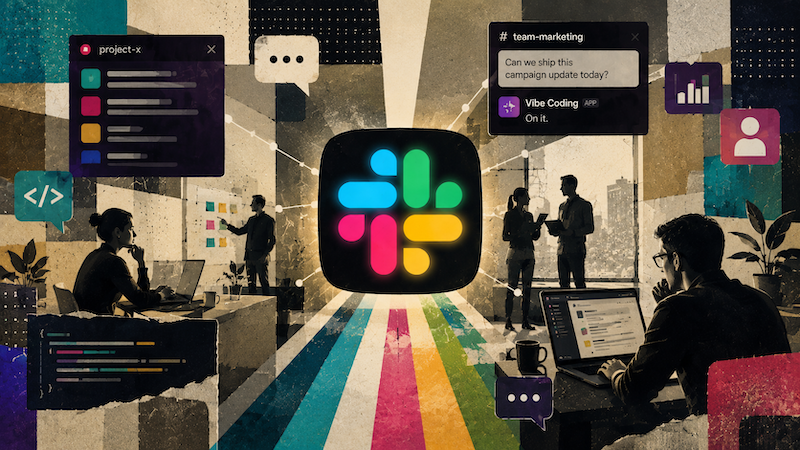
Slack has launched a new feature that enables teams to collaborate with AI agents without leaving the platform. Per The Verge, Slack users can now tag agents, including Anthropic's Claude and GitHub Copilot, in designated coding channels to make updates and fix bugs. "AI coding is now a team sport," the workplace messaging app said in a press release. Slack Code is available for users on any plan.
How it works
Say someone drops a bug report in a channel. Normally that report becomes a ticket, the ticket becomes a branch, the branch becomes a pull request, and by the time anyone reviews it the original conversation has gone cold. With Slack Code, whoever spotted the bug tags a coding agent in the thread instead. The agent opens a dedicated code channel, reads the screenshots and context already sitting there, and starts proposing changes. That channel gets its own tabs for the discussion, the diff, and a live preview of the output. Anyone in the room can jump in, redirect the agent, or shut it down. When the work is finished the channel archives itself and stays searchable.
Plenty of companies have shipped agents that write code, so that part isn't much of a surprise. The location is what makes this one worth paying attention to. Software development was the last big category of work that clearly required leaving Slack, and Slack has now built it a room inside the building. It also widens who gets to participate, since a product manager can push a small fix through without ever opening a terminal.
This has been building for a while
Slack Code sits on top of a steady accumulation of similar moves. Earlier this year, Slack parent company Salesforce also revamped its Slackbot as an AI tool. This week's release also brought a dedicated Agents tab where every agent and active session gets a home, DMs with agents that work more or less like DMs with coworkers, and a one-click way to bring an agent built elsewhere into a workspace.
Salesforce has said the code channel APIs will eventually open up beyond software, so a marketing team could run a campaign in one and a legal team could run a document review. That's probably the more revealing detail in the whole announcement. Coding is just the entry point here.
The business logic is easy enough to follow. In a workplace full of agents, whoever holds the context has the advantage, and by context I mean the conversations, the decisions, and the half-formed complaints that eventually turn into requirements. Slack already holds a lot of it. Every feature that keeps a task from leaving the app adds to that pile, and the bigger the pile gets, the more useful the agents become. Salesforce would very much like that loop to keep spinning.
Some caveats
Slack isn't replacing the underlying stack here. Agents in code channels still open pull requests against repos that live on GitHub. What Slack is claiming is the front door and the approval desk, which is a genuine land grab but a narrower one than the launch language suggests.
There's also a fair question about whether chat is the right home for the parts of work that benefit from being slow. Code review is supposed to have some friction in it, and Slack is built to strip friction out. Salesforce's answer is a required human sign-off before anything reaches production, which is sensible, though approving a production deploy in the same app where you approve the lunch order is a slightly different act than approving it in a tool built for nothing else.
None of that really changes the direction of travel, though. Slack spent a decade as the place people talked about work, and it's now going after the work itself.
If this caught your attention, that’s not accidental.

The best editorial systems don’t happen by accident. Outlever builds them.

Get the latest AI insights first.
Sign up for updates, interviews, and fresh analysis on how AI is reshaping business, brands, and technology.