Sequoia Spent the Summer Measuring 20 Years of Hype. The Companies That Mattered Were Never on the List.
Sequoia ranked 20 years of Hacker News hype against the companies actually founded each year. The winners were almost never in the conversation.



If this caught your attention, that’s not accidental.

The best editorial systems don’t happen by accident. Outlever builds them.

Hype is one of the few things in technology that everyone complains about and almost nobody measures. Konstantine Buhler, a partner at Sequoia, spent the summer trying to fix that. Working with intern Oliver Cho, he ranked the most-discussed topics on Hacker News for every year since 2007, then placed under each year the most valuable company founded in that year. The resulting chart is worth looking at before reading anything written about it, including this.
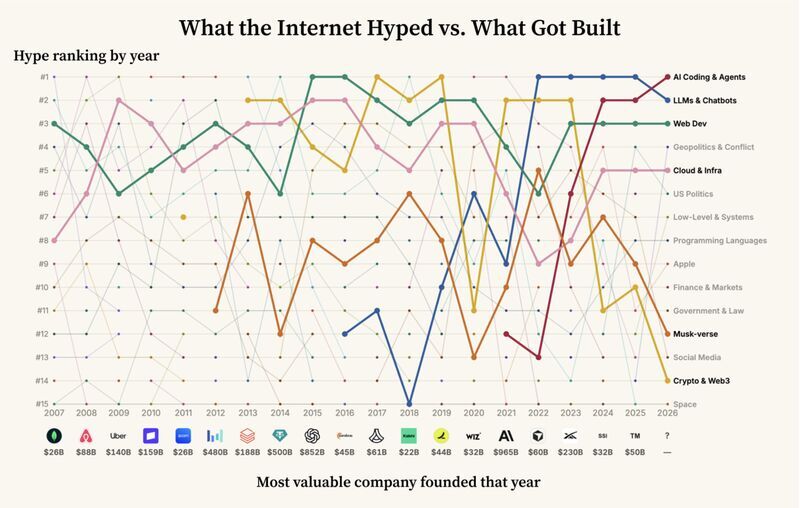
The two rows rarely line up, which is the whole point of the chart.
Airbnb was founded in 2008, when the dominant topic was Google. Uber arrived in 2009, while the forum was busy arguing about low-level programming. Anthropic was founded in 2021, the year the internet belonged to crypto. Buhler's conclusion is blunt: "Chasing hype rarely leads to enduring outcomes."
It's worth asking why that would be true, because the obvious reading of the chart is not quite the right one. Brian Chesky and Joe Gebbia were not making a contrarian bet against Google in 2008. They were renting out air mattresses, which was not a position on anything. The chart may be capturing something less romantic than defiance: the companies that end up mattering most tend to come out of categories that don't exist yet, and a category that doesn't exist yet cannot rank on a list of what people are discussing. Hype requires a shared vocabulary. The most valuable thing in any given year is often still too strange to have one.
That reframing matters for how you use the finding. It isn't advice to do the opposite of whatever is popular, which would be its own kind of herd behaviour. It's a reminder that the ranking is a map of consensus, and consensus is not where the returns are.
For enterprise buyers rather than founders, the practical version is duller and more immediately useful. The topic sitting at number one is the category where you have the least leverage. Every vendor in it is priced against a narrative, the field is crowded with companies that raised on the same thesis, and there is a decent chance the eventual winner hasn't been founded yet.
Trends announce themselves years before anyone acts on them
Buhler's second finding cuts against the first, and he doesn't entirely reconcile them.
Nothing on the list arrives without warning. Topics surface five or six years early, near the bottom of the rankings, and climb slowly. LLMs first cracked the top 15 in 2016 and didn't reach number one until 2022. AI coding entered at number 12 in 2021 and tops the list in 2026. Crypto showed up in 2011, six years before its 2017 peak and a decade before the 2021 one. Buhler's read is that internet subcommunities tend to know where the puck is headed well before the rest of the market does.
So the chart isn't an argument for tuning out the discourse. It's an argument for reading further down the page, where practitioners are already using something that doesn't yet have an analyst category or a Gartner quadrant.
The complication is one Buhler's own third finding implies but doesn't spell out. Position twelve in any given year contained plenty of things that went nowhere. We remember 2016's entry for LLMs because of what happened next, and the chart, by design, only records the topics that survived long enough to be worth plotting. Reading the bottom of the list is not a strategy so much as an admission that by the time something reaches number one, the interesting decisions have already been made by other people.
The honest version of the finding is narrower than the exciting one. It doesn't tell you which of this year's obscure topics matters. It tells you that whichever one does has probably already appeared, and that if you first hear about a category from a vendor's keynote, you are five years late rather than early.
Fourteen straight years of Musk
The third finding resists the framework entirely. What Buhler calls the "Musk-Verse", the cluster of topics around Musk's companies, has held a top-15 position every year for fourteen years running.
His argument is that durability is itself the signal: sustained attention online is rare, and when it holds, it usually marks something real. That seems right, though probably for unglamorous reasons. Most topics spike and collapse inside eighteen months because most topics are announcements. Something that holds for a decade is usually attached to physical construction, hiring, and shipped product, all of which generate a steady supply of things to argue about. Persistence may be less a measure of importance than a measure of whether anything is actually being built.
For a buyer, that's still the more useful test. A category that has generated continuous argument for a decade has survived at least one funding winter and several rounds of disappointment, which is more than can be said for whatever is at number one this year.
What the chart can't tell you
The dataset is one community, and a specific one. Hacker News over-indexes on infrastructure, developer tooling, and the preoccupations of a particular slice of American technologists. Whole categories that generate enormous revenue and no forum threads are invisible here by construction, which is worth remembering before treating the ranking as a picture of the industry rather than a picture of one room in it.
"Most valuable company founded in year X" is also a moving target that only resolves in hindsight, and Buhler says as much: the top companies of recent years have yet to be decided. The 2020s columns are placeholders. Given that the whole argument turns on those columns eventually disagreeing with the topic above them, the recent half of the chart is closer to a prediction than a result.
Buhler says the team wants to run the same analysis on X and LinkedIn next, and asks in the post for some encouragement if people want to see it. That's the part worth waiting for, because it's the closest thing to a test the finding has. If the same five-year lead time shows up in three communities with very different incentives, it's telling us something about how attention moves. If it only shows up on Hacker News, it's telling us something about Hacker News.
If this caught your attention, that’s not accidental.

The best editorial systems don’t happen by accident. Outlever builds them.


Get the latest AI insights first.
Sign up for updates, interviews, and fresh analysis on how AI is reshaping business, brands, and technology.