For three years the AI industry has quietly outsourced a surprising amount of its plumbing to one man. Jensen Huang decided who got the chips. He lent customers the money to buy them. He shuttled between Washington and Beijing arguing about who else could have them, and every spring he stood on a stage in a leather jacket and told investors why all of it would pay off.
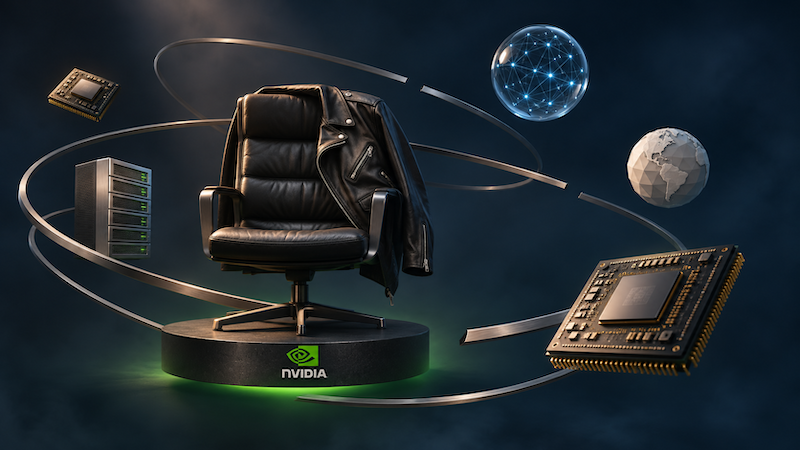
As of Thursday morning, none of those jobs has an owner.
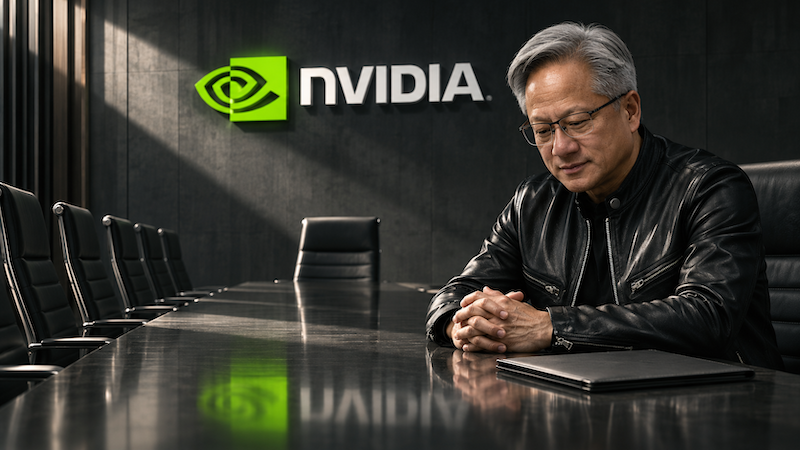
Nvidia's board said in a filing with the SEC that Huang had resigned as president, CEO and director, effective immediately. Colette Kress, CFO since 2013, will run the company on an interim basis while keeping her finance job. Harvey Jones, the former Synopsys chief, becomes the first board chair Nvidia has ever had. The board says it will consider internal and external candidates and offered no timeline.
The exit caps weeks of reporting on Huang's personal life, including a relationship with a woman U.S. intelligence agencies suspect of spying for China. Shares dropped more than 13% at the open, Euronews reported, before clawing some of it back. Bernstein halved its price target to $200 from $400.
The scandal will get plenty of coverage elsewhere. What matters for everyone else in AI is what Huang was actually doing, and who does it now.
The kingmaker problem
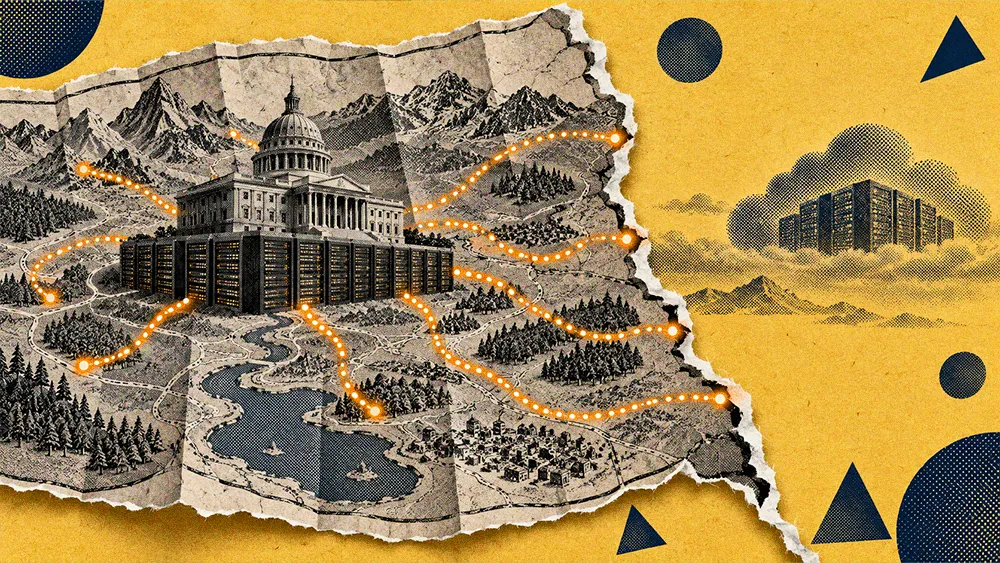
Nvidia never really built a management layer. It has no chief operating officer, and Huang had about 60 direct reports, according to Fortune, which ran nearly every strategic call through his office. When GPUs were scarce, that arrangement mattered far beyond Santa Clara. Whoever decided which hyperscaler, neocloud or sovereign fund got the next shipment was deciding who got to compete in AI at all.
That authority belonged to Huang personally. Kress is a respected operator, but she is also the CFO, and a CFO running a company in crisis tends to prize margins and predictability. Kingmaking is a hard habit to keep up when your stock is trading 35% below its October 6 record.
Analysts canvassed by Reuters floated two internal names, Kress and Ian Buck, the engineer behind CUDA, while conceding that neither has Huang's public profile or his Rolodex of world leaders. Axios reported this week that analysts don't see Kress, a career finance executive, as the natural heir to a product visionary. Huang always said he hoped his successor would come from inside the building. Installing an outside chair suggests the board plans to have a much bigger say in that choice than it ever has.
Nvidia, lender of last resort
Reuters' analysis calls Nvidia both the boom's torchbearer and its financier, and the numbers back up the second half. The company's latest earnings listed roughly $164.5 billion in financial commitments, including an obligation of up to $105 billion tied to an OpenAI data center in Ohio and more than $50 billion in lease and capacity guarantees. On top of that sit the equity checks: $30 billion into OpenAI and $10 billion into Anthropic, both of which Huang said in March were probably the last.
Huang sold all this as ecosystem building. Skeptics called it vendor financing with a better publicist. Either way it ran on his credibility with shareholders, and that credibility walked out the door on Thursday. One fund manager told Reuters the fear is that "the music might stop."
Put yourself in the next CEO's chair. You inherit a falling stock, shareholders who just watched key-person risk play out in real time, and $164.5 billion in commitments that look a lot like contingent liabilities once the founder isn't around to defend them. Pulling back would be the easy call. It would also raise the cost of capital for every neocloud that has been borrowing against Nvidia's goodwill, and the weakest of them would feel it first. We have spent three years treating the AI buildout as a chip story. It may turn out to have been a credit story.
The China file reopens
Huang was also the industry's unofficial envoy on export controls, one of the few executives who could argue his case credibly in both capitals. The scandal lands squarely on that role. Alice Huang, an executive at Singapore's Megaspeed, is under U.S. investigation over allegations that the firm helped move restricted Nvidia chips into China, The Week reported. Megaspeed told DatacenterDynamics that government reviews found no evidence of illicit transfers. Jensen Huang has said Nvidia found no sign its chips were illegally shipped, and U.S. officials reportedly don't believe he knew of any intelligence activity.
Markets didn't wait for investigators. Shares of Chinese GPU makers Moore Threads, MetaX and Cambricon jumped nearly 10% on bets that domestic suppliers would pick up share.
Whoever runs Nvidia next will have every reason to go quiet on China: tighter compliance, fewer license requests, no more trips to Beijing. That's the sensible move for the company. For the industry, it could be the moment the hardware stack splits for good, with CUDA on one side and chips Washington can't touch on the other.
Five trading days to Anthropic
The calendar could hardly be worse. Nvidia reports quarterly results on Tuesday, Nov. 17, the company said. Bloomberg expects Anthropic to start trading on Nasdaq two days later. The offering, under the ticker ANT, is marketing 825 million shares at $70 to $78 apiece, per TradingView, for a valuation of up to about $1.4 trillion.
On paper, Anthropic is the frontier lab best insulated from an Nvidia wobble. Its S-1 says Claude runs on four chip families, Amazon's Trainium, Google's TPUs and GPUs from both Nvidia and AMD, with compute treated as one interchangeable pool. A TradingKey breakdown of the filing puts Nvidia at about 42% of an 11-gigawatt footprint, with Google's TPUs close behind. Nvidia is still on the cap table, buying $10 billion of a $26 billion private placement at the IPO price, Trefis noted.
Investors have already started pricing that in. From the Nov. 6 close to Thursday's premarket, Nvidia fell 16.5% while Broadcom, which supplies and leases accelerators to Anthropic, rose 20.6%, by Trefis's count. Alphabet and Amazon each gained more than 2%.
The near-term danger to the deal is sentiment, not supply. The funds that would buy ANT also own a lot of Nvidia, and Trefis argues the realistic downside is a lower price, a smaller raise or a short delay rather than a pulled offering. The longer-term exposure is bigger. Anthropic has signed up for at least $518 billion in compute and cloud commitments, according to its risk disclosures, a wager that money keeps pouring into AI infrastructure. It is placing that wager the same week the industry's biggest corporate financier lost its CEO.
Floodlines Research founder Anna Wu told Reuters that the AI trade rests on demand rather than on any single person. Anthropic's debut is about to test that in public. A strong pricing in a week when Nvidia is bleeding would say value is moving from the companies that make chips to the companies that make models. A weak one would say AI is still a single trade with a single point of failure.
The labs should take a lesson from this too. Public investors just sat through the most vivid key-person-risk seminar in tech history, days before being asked to buy a frontier AI company. Anyone on a roadshow should expect governance and succession questions on every call, Anthropic this week and OpenAI later. Greg Brockman said this month that OpenAI could be IPO-ready in 2027. It will go public into whatever expectations get set over the next seven days.
What Nvidia never built
Microsoft survived Bill Gates giving up the CEO job. Apple survived Steve Jobs. Both had a bench and enough institutional machinery to carry a strategy without its author. Nvidia spent 33 years optimizing for speed instead, and the speed came from routing everything through one desk.
Tuesday's earnings call and Thursday's listing will give the market its first look at the AI economy without that desk in the middle. Watch whether Kress recommits to the financing book or starts describing it as a risk, where ANT prices inside its range, and whether the board reaches for an insider or an outsider. The AI boom has always been sold as a platform shift. Next week we start finding out whether it was a platform or a person.