McKinsey Says a Third of Companies Are Building Software Instead of Buying It.
McKinsey says a third of companies now build software instead of buying it. The real story isn't build-vs-buy. It's the software bundle coming apart.


If this caught your attention, that’s not accidental.

The best editorial systems don’t happen by accident. Outlever builds them.

Every enterprise software conversation this year keeps getting forced into the same tired frame: build or buy. McKinsey's latest survey looked like fresh ammunition for it. In The state of AI in 2026: On the road to ROI, nearly a third of organizations, 32 percent, said they had passed on buying at least one software product or feature because they could build the thing themselves with agentic coding tools. Among the companies McKinsey labels high performers, it was closer to half. Technology led at 41 percent, with healthcare and professional services not far behind. The obvious read wrote itself: SaaS is in trouble, in-house is winning.
The obvious read is wrong, and McKinsey all but says so in the fine print. The number counts something narrower than it sounds. To land in that 32 percent, a respondent had to decline one product or feature, one time. A company that built a single reporting dashboard instead of paying for a seat license sits in the same bucket as one that ripped out its entire customer platform. So the figure doesn't measure how much enterprises are building. It measures how many of them have started saying a particular sentence in the procurement meeting: we could just build that.
Once that sentence is on the table, build-versus-buy stops being the question that matters. What matters is what's left worth owning.
The bundle only ever existed because unbundling was hard
For thirty years, enterprise software came in bundles because bundling was the only way to sell it at a profit. You didn't buy a report, you bought the analytics suite. You didn't buy a workflow, you bought the platform. Much of what the vendor was really selling was the assembly: the integration work, the engineers you'd otherwise have to hire, the months you couldn't spare. Paying to skip all of that made sense.
Agentic coding tools go straight at that math. When a competent engineer with an AI harness can stand up the one capability you were after by the end of the week, the other ninety features in the bundle stop reading as value and start reading as overhead. Companies aren't deciding to become software shops. They're noticing that the feature, not the platform, is now the unit they can pick up and hold, and they're declining to keep paying for everything wrapped around it.
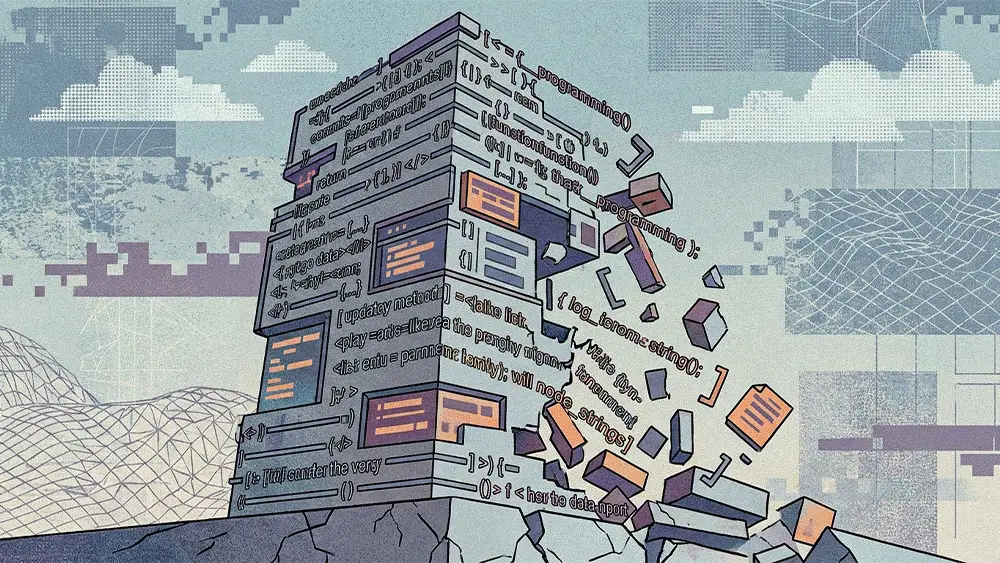
That is the real story here, and it isn't a contest between two products. It's the product coming apart into pieces while buyers take only the pieces they want. They build the easy things, pay for the hard ones, and leave the padding on the shelf.
The buying decision is moving from finance to engineering
Follow the logic one step and something moves in the org chart. If the question is no longer which vendor but whether a given capability is cheaper to rebuild than to license, the person answering it can't be a procurement generalist working off an analyst's quadrant. It has to be someone who can look at a feature and put a credible number on what building and running it would actually cost. That number has to include the parts no demo ever shows you: the security work, the upkeep, the pager that goes off at two in the morning, and the odd new liability of owning code an AI wrote that nobody on staff fully understands.
That is an engineering judgment wearing a procurement badge, and it is already pulling the buying decision out of finance. Build-versus-buy has become a technical estimate, made before it is ever a budget line. The companies getting this right have turned "should we build this?" into a genuine evaluation, with standards for maintainability and ownership, rather than a mood that a fired-up team acts on because the first prototype came together fast.
What you can't rebuild is what you'll pay for
The vendors in trouble are the ones whose product was mostly the hassle of doing it yourself. Middleware. Connectors. The tools that turn one format into another. Their moat was inconvenience, and the inconvenience is draining away.
The vendors who hold up sell things an agent can't cheaply reproduce. Proprietary data you have no way to gather on your own. Compliance in a regulated field, where being wrong is a legal event rather than a bug ticket. And straightforward liability transfer, a contract that moves risk off your balance sheet and onto someone whose whole job is to carry it. What those have in common is that none of them is a feature. They are forms of ownership a buyer would rather not hold, which is precisely why buyers will keep paying someone else to hold them. That, and not the length of a feature list, is what a durable software business sells now.
So the fight was never build versus buy. That framing was always standing in for the thing that was really happening: the bundle is dissolving, and the feature has become the smallest unit that counts. The question worth putting to your team this quarter isn't what to build or what to buy. It's the one the McKinsey headline stepped right over. Out of everything you are paying for today, what is actually worth owning?
If this caught your attention, that’s not accidental.

The best editorial systems don’t happen by accident. Outlever builds them.


Get the latest AI insights first.
Sign up for updates, interviews, and fresh analysis on how AI is reshaping business, brands, and technology.