IKEA Really Did Retrain 8,500 Workers Instead of Firing Them. The Reason It Worked Wasn't the AI.
The most-shared corporate AI story on the internet holds up in outline. The filings show what actually did the work, and why almost nobody can copy it.


If this caught your attention, that’s not accidental.

The best editorial systems don’t happen by accident. Outlever builds them.

There's a post going around LinkedIn, rewritten a dozen ways by now, that runs roughly like this: IKEA handed 8,500 customer service jobs to an AI chatbot, refused to fire anyone, retrained the whole group as interior designers, and unlocked $1.4 billion in new revenue. Automation as a growth strategy. Humanity as competitive advantage. Share with someone navigating AI at work.
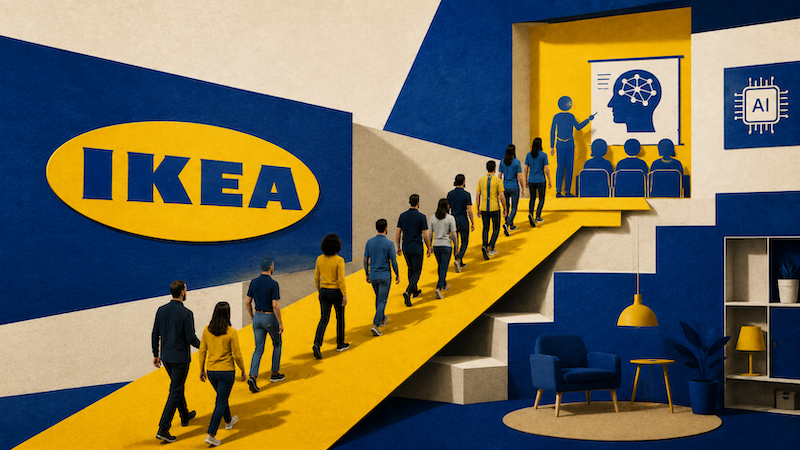
Most of that is true. Ingka Group, the franchisee that operates the large majority of IKEA stores worldwide, deployed a chatbot called Billie in 2021 and reskilled roughly 8,500 call centre workers instead of cutting them. Reuters broke the story in June 2023 and Ingka confirmed the details two weeks later. It remains one of the very few documented cases of a large employer redeploying automated workers at scale.
The $1.4 billion is where it comes apart. It's a dollar conversion of Ingka's own figure, €1.3 billion, and it covers fiscal year 2022, which ended on 31 August 2022. The number appears in one place, that same June 2023 press release, and it has been recirculating as current evidence for three years, including in posts written this month.
The filings tell a slower story
Ingka's release says sales through its remote customer meeting points reached €1.3 billion by the end of FY22, accounting for 3.3% of total sales, against a stated ambition of 10%.
Fortune's Claire Zillman reported from inside the Helsingborg sales centre in July 2026 and put the channel at €1.25 billion in the most recent fiscal year, up from €1.08 billion the year before, describing it as IKEA's fastest-growing sales channel over the past three years at 15% to 20% annual growth.
Both accounts can't be describing the same thing. Three years of compounding at that rate would take €1.3 billion somewhere near €2 billion, not down to €1.25 billion. The likeliest explanation is a definitional change, where "remote customer meeting points" in 2023 covered a wider set of touchpoints than "remote-sales centres" in 2026.
The share of the business is the part worth sitting with. Ingka's FY25 group revenue came in at €41.5 billion, down 0.9% on the year. Against that base, €1.25 billion works out to roughly 3% of sales. In FY22 the company reported 3.3%.
Five years in, on Ingka's own published numbers, the channel occupies about the share of the business it occupied at the start. Reaching 10% would mean nearly tripling it while group revenue contracts. None of the posts I've read mention that the target exists.
The thirteen million nobody quotes
Ingka's release also gives Billie's own contribution. The bot resolved approximately 47% of the enquiries it received between 2021 and 2023, around 3.2 million interactions, worth close to €13 million in savings, or about $14 million.
Thirteen million sits four paragraphs above 1.3 billion in the same document, and the proximity is almost certainly how the two got welded together. One figure is the saving from the automation. The other is turnover through a sales channel with its own separate history, of which the chatbot represents about one percent.
Ingka never claimed the two were connected. That inference got added downstream, by people reading a press release for a punchline.
What actually made the redeployment possible
Ingka could move 8,500 people because it had somewhere to move them to, and that had more to do with timing than with courage.
Zillman's reporting traces the chain back to COVID rather than to AI. IKEA came late to e-commerce, having built its business around getting people into warehouse stores for hours at a time. The pandemic closed those stores and forced the digital operation to scale overnight. Digital channels went from negligible to roughly 30% of sales, and the call centres found themselves fielding up to three times their usual volume, most of it order tracking and delivery questions. Billie arrived to absorb a spike, not to replace a stable workload.
That distinction decides whether the playbook transfers anywhere else. When contact volume triples and half the increase is automatable, what the automation produces is surplus hours inside a workforce that was already drowning, at a company that happened to be standing up a new sales channel and needed staff for it. Demand was moving toward precisely the work the bot couldn't do.
Most companies putting AI into customer service in 2026 are working against flat or falling volume. Run the same playbook there and what you get is a slower layoff with a training budget attached to it.
The consultations are free
It's worth being precise about what these 8,500 people were retrained to do. The core design advisory service costs customers nothing. Extended sessions in the UK carried fees when the service launched, £25 for a video consultation with a recommended product list and £125 for three workspace sessions with a floorplan, but the advice itself is free.
So the €1.25 billion is furniture revenue rather than consulting revenue. What Ingka built was a remote sales floor staffed by people who used to answer the phone. Zillman watched a sales rep in Helsingborg work a customer's awkward hexagonal countertop problem up the chain to a kitchen specialist, find a fix, and rescue an order that would otherwise have been lost.
There's nothing cynical in that description, and it's the part worth copying. The redeployment has survived five years and at least one round of corporate cost-cutting because it lands on a revenue line. Reskilling that produces goodwill gets cut in the next downturn. Reskilling that produces booked sales gets defended by whoever owns the number.
Prasanna Tambe, the Wharton professor Zillman quotes, names the mechanism as skill adjacency, and frames the shift as moving people from serving what customers need to serving what they want. Call centre workers already knew the catalogue, the delivery system and the customer. Room planning was a training course away rather than a career away. Trainees learned Ingka's digital planning tools and how to run a design conversation, down to asking what isn't working in the room. Rolling that out across the workforce took two years. New hires now get five to six weeks of it.
Where the retelling drifts
The 8,500 figure does more work in the viral version than it can support. Billie resolved 47% of the enquiries it received, which is a share of contact volume rather than a headcount equivalent, and Fortune is careful to note the bot took those jobs over only partly. The retraining also ran alongside the bot's improvement across two years, so what happened looks less like a rescue mounted after a displacement event and more like a gradual reallocation.
The company is misnamed too. Ingka Group is one of twelve IKEA franchisees, albeit the one running most of the stores, while Inter IKEA owns and franchises the brand and keeps separate accounts. Crediting the programme to "IKEA" collapses two companies with different owners and different books.
The claim of zero layoffs is also wrong as of this spring. Ingka and Inter IKEA both cut hundreds of corporate roles in 2026. None of those hit the remote-sales centres and none were attributed to AI, which is worth saying clearly, but "IKEA didn't lay anyone off" isn't what the record shows. Ingka's chief digital officer declined to rule out future cuts, while indicating that any would likely trace to the macro picture rather than to automation.
Then there's Billie itself, which has kept improving. The bot assisted 47% of the customers who used it in its first two years, and Fortune reports the figure now sits at 74%. Whatever the reskilling bought these workers, it was a lead measured in years rather than permanent cover, and the gap is closing.
The part that doesn't travel
There's one more precondition, and Zillman states it plainly. Ingka and Inter IKEA are private, foundation-owned companies. That structure lets them run price and people experiments that would be punished quickly at a listed competitor.
It's also the precondition least available to anyone else. A public company that spends two years and real money retraining 8,500 workers into a channel still sitting at 3% of revenue will be asked on an earnings call why it didn't simply take the €13 million and the headcount reduction. Ingka never has to answer that question. Its ownership structure absorbs the patience the strategy requires. If you're borrowing the playbook, borrow the constraint with it.
What to ask instead
The LinkedIn version signs off by asking what you'd do if AI handed back 30% of your team's time tomorrow.
It's the wrong question, because it treats the capacity as the hard part. Capacity shows up whether or not anyone planned for it.
The question Ingka actually answered is narrower: can you name the revenue line those hours will land on, and does that line already exist? Ingka could. It had a remote channel that COVID had made urgent, a catalogue too large for customers to navigate alone, and a workforce already fluent in both. The chatbot freed up hours to serve an opportunity that was already sitting there, saved about €13 million along the way, and has been credited ever since with a billion it had almost nothing to do with.
If you can't name the line, the capacity turns into a cost saving. The reason has less to do with nerve than with accounting, in that a cost saving is the only outcome that books itself without someone having to build something first.
That's harder to fit on a LinkedIn card, and it's the version that survives a fact-check.
If this caught your attention, that’s not accidental.

The best editorial systems don’t happen by accident. Outlever builds them.


Get the latest AI insights first.
Sign up for updates, interviews, and fresh analysis on how AI is reshaping business, brands, and technology.