HubSpot Now Charges You Every Time Its AI Does the Work
HubSpot just started billing your AI agents by the task. It's a preview of how every software company is about to charge you.


If this caught your attention, that’s not accidental.

The best editorial systems don’t happen by accident. Outlever builds them.

In the space of a day this week, HubSpot got described two completely different ways on LinkedIn.
A critic put up a post that took off. His point was simple. HubSpot named its big conference Unbound, then spent the keynote locking your AI inside HubSpot. You build the agents in HubSpot. You feed them HubSpot data. You manage them in HubSpot. And you pay HubSpot every time one of them does anything. The way he put it, your AI needs a hall pass from HubSpot to do its job.
The company told a different story. CEO Yamini Rangan used her keynote posts to talk up how much of your data HubSpot is now sending out of HubSpot and into ChatGPT. The HubSpot connector is the most popular CRM connector in ChatGPT, with weekly users up 250%. HubSpot is the first CRM to plug into ChatGPT Ads. And it is now selling ChatGPT itself, in a bundle with OpenAI that includes a free ChatGPT Business seat and up to $750 of ad spend.
So which version is right? Is HubSpot walling your AI in, or is it handing your data to a chatbot it doesn't even own?
Both, on purpose. And the reason is the actual story here.
Why the name changed
For fifteen years the conference was called Inbound, after the marketing method HubSpot came up with and more or less owned. Inbound was a moat. It was a way of working that kept HubSpot at the center of things. Renaming it Unbound tells you the old moat is running dry.
Every software company is now facing the same threat. If people start their research inside a chatbot, and AI agents can reach across your tools to get things done, then the screen where work actually happens might not be your product anymore. It might be ChatGPT. The software itself, the thing HubSpot sells, is at risk of becoming a commodity that some AI model drives from the outside. That fear sits behind almost everything HubSpot put on stage.
Its answer runs on two tracks, and the two LinkedIn posts each describe one of them.
Part one: go where the buyers already are
You can't lose the customer to the chatbot if you're already in the chatbot. So HubSpot is running toward ChatGPT instead of trying to keep people in its own browser tabs. The updated connector lets people run campaigns, build landing pages, and see which deals are moving without ever leaving ChatGPT. The ChatGPT Ads integration, plus a similar Microsoft deal covering Bing, Copilot, and Outlook, lets you buy attention inside answer engines and trace a closed deal back to the ad that started it. The AI Growth Bundle even helps pay for your ChatGPT subscription.
This is the Unbound side of the story. Go to the customer instead of making the customer come to you. Read on its own, it makes HubSpot sound almost generous about letting your data travel.
Part two: own the data
Distribution doesn't pay the bills, though, and HubSpot knows that. The second track is quieter and matters more. It's about owning your data.
The real centerpiece of the keynote wasn't the OpenAI deal. It was a rebuilt platform organized around what HubSpot calls Growth Context. There's a Smart CRM that updates itself by pulling details out of calls, emails, and meetings. There's a Context Home that scores how complete your data is and points out the gaps that would make your AI worse. Breeze, the built-in assistant, went from a chatbot that answers questions to a place where you describe an outcome and it sends specialized agents to go do it. There's a new Marketing Studio, a stronger Prospecting Agent that watches more than 40 buying signals, and a sixth product line called Revenue Hub that turns deal data into quotes.
The logic is straightforward. If AI models are becoming interchangeable and nobody can count on owning the screen, then the thing worth owning is your data: the running record of who your customers are and what has happened with them. HubSpot is betting that whoever holds that data wins, no matter whose model or chatbot sits on top. That's also why it's happy to let your data visit ChatGPT. The data still lives in HubSpot. ChatGPT is only borrowing it.
About those credits
That brings up the part of the critic's post that got the biggest laugh: you pay HubSpot credits whenever the agents do anything. He meant it as a petty detail. It's closer to the entire plan.
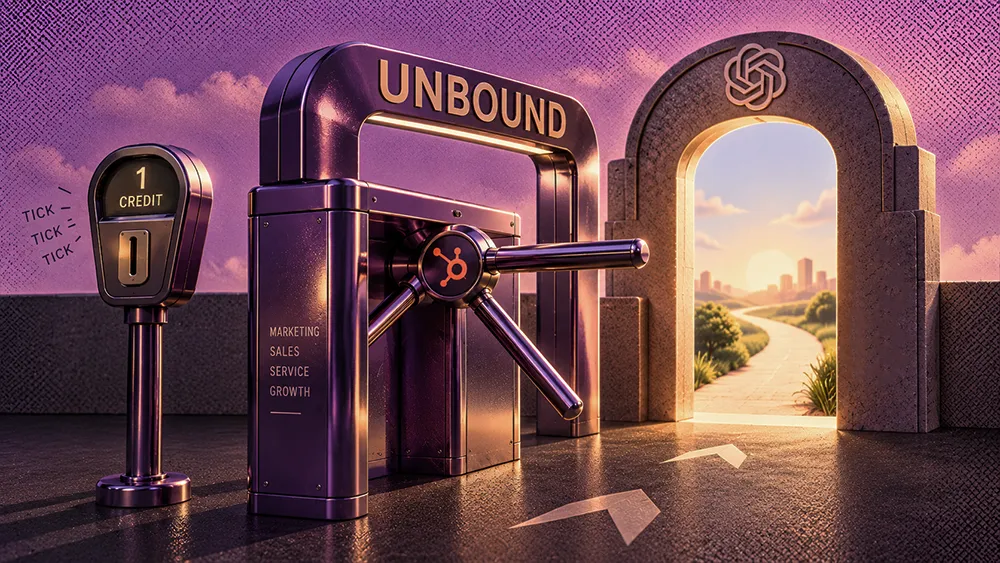
When Agent Hub and Agent Builder went into beta in July, every agent started spending HubSpot Credits each time it runs. A credit is worth about a cent, sold at $10 per thousand. A resolved support conversation costs around 50 cents. A recommended sales lead costs about a dollar. Earlier this year HubSpot switched its main agents to outcome pricing, so you pay when the task actually lands rather than when it's attempted.
Forget the rate card for a second and look at what's happening to the business model. For about thirty years, software as a service meant renting a seat. You paid a set price for access whether you used it or not. The credit meter breaks that link. HubSpot's revenue stops tracking how many people you employ and starts tracking how much the software does for them. As agents take over more of the work, the bill follows the work, not the headcount. HubSpot isn't alone in this. Salesforce is moving its Agentforce product the same way. The whole CRM industry is rebuilding its prices for a world where a lot of the users are software.
This is the real news out of Unbound, and it explains why the stock barely moved. Investors already saw it coming. The people still arguing are the ones stuck on the conference name.
What this means for everyone else
A few things are worth taking away from this week, whether or not you use HubSpot.
The screen is up for grabs, so big software companies will pay to live inside chatbots. Expect more deals like the HubSpot and OpenAI one, and not as feel-good press releases. Being inside ChatGPT is turning into what being on the first page of Google used to be.
The advantage is shifting from features to data. HubSpot said this out loud to its own partners: stop selling AI projects, start owning the data and the context that make the AI worth trusting. When every platform has the same AI features, the money moves to whoever curates the information underneath. That changes where the profit sits across the whole software channel.
Software is being repriced from seats to outcomes, and that cuts both ways. Outcome pricing can be fairer, since you're not charged for a support chat the bot never finishes. But your bill now rides on volume you don't fully control, and people are already warning about surprise "credit burn" at the end of the month. The cost of running your business now depends on the cost of running someone's AI agents.
So, is it a prison?
Here's the part the company won't say and the critic only half caught. The lock-in is real. If your data lives in HubSpot's Smart CRM and every agent action runs down HubSpot's meter, leaving gets more expensive with every conversation, every lead, every quote. Unbound is the marketing. The money still rewards the walls. Letting your data visit ChatGPT isn't the same as letting you walk out the door, because the data, and the meter, stay put.
Still, prison is the wrong word, because it suggests HubSpot did something clumsy or greedy by accident. It didn't. HubSpot looked at a future where AI could hollow out the software it sells, and it made a clear, aggressive choice. It gave up the screen, held onto the data, and put a turnstile on the results. Whether that feels like freedom or a nicer cage comes down to one question you should be asking every vendor now, not just this one.
Do you own your data on your own, or only inside the platform that charges you to use it?
If you own it, Unbound is a genuinely useful set of tools and you can come and go as you like. If you don't, the critic had it right about the walls. He just missed that the walls were the point.
HubSpot named its conference Unbound while quietly making it harder to leave. If you want to know what any software company really thinks about your freedom, skip the keynote and read the invoice.
If this caught your attention, that’s not accidental.

The best editorial systems don’t happen by accident. Outlever builds them.


Get the latest AI insights first.
Sign up for updates, interviews, and fresh analysis on how AI is reshaping business, brands, and technology.