There was a time, roughly eleven minutes ago, when a funding announcement told you something. A Series A meant a team had convinced professionally skeptical people that a thing existed and that other people wanted it. A Series B meant the thing was working. The number attached to the round was a rough proxy for conviction, and conviction was a rough proxy for evidence.
That chain has snapped at every link. Today a company can raise nine or ten figures before it has a product, before it has users, before it has decided what it is. This is not an exaggeration for effect. It is the base case at the top of the market. The announcement arrives fully formed: the TechCrunch exclusive, the investor quote about a generational team, the founder thread that begins with "some personal news" and ends with "we're hiring." It communicates one verifiable fact. Money moved from one account to another. Everything else is vibes with a term sheet.
The numbers, since you asked
Skeptical? Fine. Here is what the last twelve to eighteen months actually produced.
The record seed round belongs to a company that had nothing to sell. In July 2025, Thinking Machines Lab, founded by former OpenAI CTO Mira Murati, closed a $2 billion seed round at a $12 billion post-money valuation, per TechCrunch. The company was about six months old and had no product, no revenue, and no public roadmap. Crunchbase noted at the time that the largest prior U.S. seed rounds topped out around $450 million, a record held since 2022 by Yuga Labs, the Bored Ape company. Thinking Machines did not edge past the old record. It roughly quadrupled it, on the strength of a founder's resume and a stealth-mode website.
And it was not an outlier. It was a category. Per Crunchbase data, 27 seed rounds of $100 million or more have been announced globally since the start of 2025, and seed rounds of $10 million and up have grown from about 2 percent of all seed deals in 2018 to roughly 9 percent. The recent entries in the giant-seed club read like a genre exercise: a Paris lab building "world models" raised just over $1 billion in a March seed round, the largest in European history, pre-product. A company called Humans& raised a $480 million seed at a $4.48 billion valuation to build a "human-centric AI lab," whatever a valuation is measuring in that sentence. Unconventional AI took $475 million in seed money in December to develop brain-inspired chips that do not exist yet.
The stage labels have stopped meaning anything. Safe Superintelligence, Ilya Sutskever's lab, raised $2 billion at a $32 billion valuation, per the Financial Times by way of TechCrunch, with no product, no revenue, and a website that is essentially a mission statement; the company has said its first product will be the superintelligence itself, and nothing before that. Meanwhile, down at the merely enormous end, Carta data shows the median seed post-money valuation hit an all-time high of about $24 million in 2025, dragged upward almost entirely by AI rounds, with AI companies commanding roughly a 42 percent premium over everyone else at seed. Analysts now describe a class of rounds that are structurally Series As, $10 to $20 million on $60 to $100 million pre-money, but are functionally pre-product bets on a founding team. The industry kept the old vocabulary and quietly deleted the definitions.
The pool itself has gone vertical. AI companies absorbed roughly $202 billion in venture capital in 2025 by Crunchbase's count, close to half of all global VC and up about 75 percent from the year before, with a handful of foundation model labs taking most of it. When one sector is inhaling half the world's venture money, a raise within that sector is not a mark of distinction. It is weather.
And the market has already demonstrated what these numbers are made of. Four months after its record seed, Thinking Machines went back out seeking a valuation as high as $50 billion, roughly a quadrupling in under half a year, at a point when it had shipped one product. By January 2026, per Bloomberg's reporting, those talks had collapsed and the company sat back at its original $12 billion. Nothing about the underlying business changed in either direction. The number went up because other numbers were going up, and it stopped because the music paused. That is not a valuation. That is a mood ring.
We have inverted the order of operations
The SaaS era, whatever its sins, at least pretended to a sequence. Build something. Find some users. Show a curve. Raise against the curve. The curve could be juiced and the metrics could be creative, but the ritual demanded that something precede the money. Product-market fit was the altar. The raise was the offering.
The current era has dispensed with the altar. The raise now precedes the product the way a trailer precedes the movie, except increasingly there is no movie, just a longer trailer, financed at a higher valuation, promising a movie. SaaS-era froth stretched the multiple between evidence and price. This era has removed the evidence from the equation. You cannot stretch a multiple of zero. You can only assert a number and see if anyone laughs.
The signal has eaten itself
Here is the uncomfortable part for those of us who read these announcements professionally. Even as a signal, the raise is nearly dead.
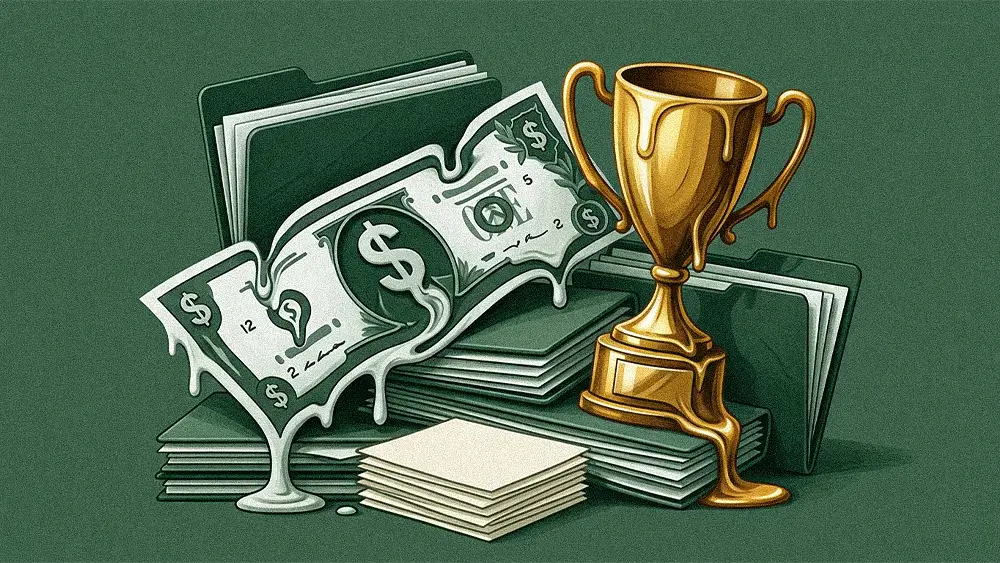
Signals work through scarcity. "They raised from a top-tier fund" meant something when top-tier funds said no. But when every fund is deploying at maximum velocity, because the career-ending mistake is now missing the winner rather than backing a loser, the raise stops discriminating. When everyone gets the medal, the medal is a participation trophy with a wire transfer attached.
Consider what a funding announcement can no longer tell you. It cannot tell you the product works, because there may be no product. It cannot tell you customers want it, because there may be no customers. It cannot tell you sophisticated investors did diligence, because the diligence window in a hot round is now measured in days, and diligence at that speed is a formality performed for the memo. It cannot even tell you the company will exist in two years, because the burn implied by these rounds assumes a follow-on environment that history suggests is not a permanent feature of the universe. Carta counted about one in ten priced rounds in late 2025 as down rounds, and that figure was celebrated as an improvement.
What the announcement can tell you: the founders are good at raising money. Which is a skill. It is just not the skill the announcement wants you to believe it certifies.
The announcement as pure genre
At this point the funding announcement should be understood not as news but as a literary form, closer to the wedding announcement than the earnings report. It has fixed conventions: the round size, the valuation "sources say," the investor quote, the mission restatement. It has a fixed emotional register, triumphant humility. And it has a fixed function, which is to signal social position within a community that has agreed to treat the signal as meaningful because everyone's position depends on the agreement holding.
The dollar figure is the load-bearing element and the least informative part. A $2 billion round for a pre-product company is not a data point about the company. It is a data point about the market's appetite for the story of the company, which is a data point about the market, which is mostly a data point about how many other rounds like it were announced recently. The funding announcement now primarily measures the frequency of funding announcements.
What to read instead
If you insist on extracting information from this genre, read it against the grain. The interesting content is never the number. It is who did not participate from the last round. It is whether the valuation step-up outpaced any conceivable change in the underlying business, the way a quadrupling in four months on one shipped product might. It is whether the announcement names a single customer. It is whether "revenue" appears anywhere, and if it does, whether it was annualized from a month, a week, or one particularly good afternoon.
Or skip the announcement and wait for the product. In an era when capital is the most abundant input in the entire system, the scarce and therefore informative event is no longer someone writing a check. It is someone shipping something that a stranger pays for twice.
That announcement rarely gets the TechCrunch exclusive. Which is exactly how you know it's the real one.