For all the noise around enterprise AI adoption, most large companies are still renting their intelligence. They lease cloud GPUs, call frontier models through APIs, and hope the economics work out. Bristol Myers Squibb is taking a different path, and this week it made that path very hard to ignore.
The announcement
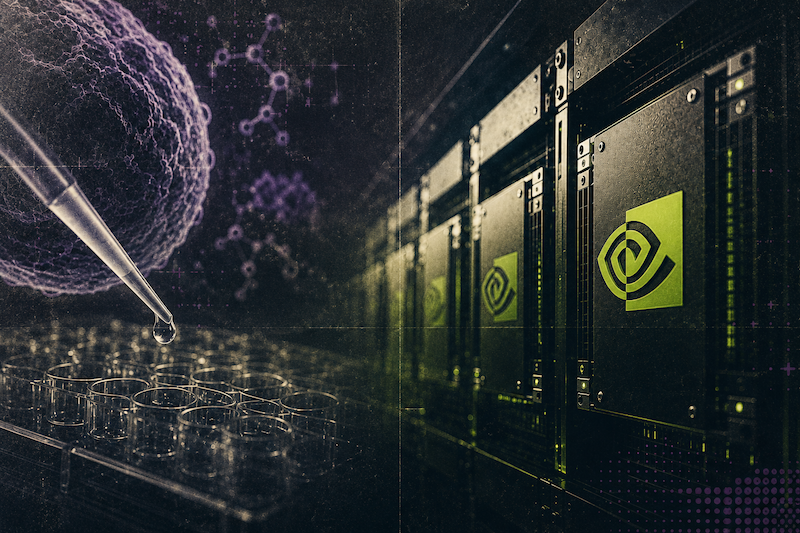
BMS announced a major expansion of its collaboration with NVIDIA. The company will deploy a DGX SuperPOD built on DGX Vera Rubin NVL72 systems, which the two companies describe as the most powerful and energy-efficient single-owned NVIDIA infrastructure in life sciences. According to the official announcement, the Vera Rubin architecture delivers up to ten times the performance per megawatt of its predecessor, letting BMS scale its AI workloads without a proportional jump in energy consumption. That efficiency figure matters at a moment when the power demands of AI have become a board-level and public-policy concern.
The expansion builds on nearly three years of collaboration, dating back to BMS's first DGX SuperPOD deployment, and will support AI-driven research across oncology, hematology, cardiovascular disease, immunology and neuroscience, per the company's release.
The hardware is only half the story, though. The other half is the architecture of the bet.
"Different problems, same bet"
Greg Meyers, BMS's Chief Digital and Technology Officer, framed the deal on LinkedIn not as a procurement win but as the physical layer of a full-stack AI strategy.
"This agreement expands the physical backbone behind BMS's AI strategy," Meyers wrote, adding that more compute gives BMS researchers "the scale they need to pursue even more complex scientific projects with AI."
The stack he described has two distinct layers. Earlier this summer, BMS signed a strategic agreement with Anthropic, which Meyers called "a shared, single pane of glass" for the company's AI projects, a hub connecting the data and systems scattered across an enterprise of BMS's size. NVIDIA sits underneath as the engine. It supplies, in his words, "the computational horsepower to run the science behind it," from molecule and trial design in R&D, to manufacturing gains, to sharper engagement with providers and patients on the commercial side.
Then came the line that captures the entire thesis: "Different problems, same bet: the faster we can close the gap between a question and an answer in the lab, the faster that turns into a medicine for a patient waiting on it."
This is what a mature enterprise AI strategy looks like in 2026. Not a chatbot pilot, not a scattering of proofs of concept, but an orchestration layer for reasoning and workflow paired with owned compute for training and inference at scale. Anthropic for the interface to the enterprise, NVIDIA for the physics underneath it.
"Predict First" and the case for owned compute
The deeper story is BMS's "Predict First" approach, which Meyers says has already changed how the company does science. Through it, he wrote, AI has enabled BMS researchers "to validate the design of every small molecule program," along with most large molecule programs, before anyone even steps into a lab.
Consider what that claim actually says. Every small molecule program, validated computationally before wet-lab work begins. That isn't a pilot metric. It's a statement about the company's default operating mode, and it explains why BMS is buying more compute rather than experimenting with less. As Meyers put it, early results are "giving us the confidence to dig even deeper," with the new systems enabling "more computing power, more sophisticated models and a system that gets smarter with every experiment and clinical readout."
That last phrase describes a data flywheel, and it's the strongest argument for owning infrastructure rather than renting it. Proprietary experimental data and clinical readouts are the scarcest assets in pharma AI. Training on them inside your own walls, on hardware you control, keeps the compounding advantage in-house.
What they plan to do with it
Strip away the framing and the roadmap is unusually concrete.
BMS intends to train larger proprietary models on its own compute, keeping sensitive scientific data inside the company. It plans to compress discovery timelines; the company has pointed to AI-powered target identification dropping from weeks to days. It's pursuing what it calls hybrid intelligence, a model where AI "co-scientists" handle data-intensive execution while human researchers focus on direction, interpretation and judgment, as detailed in Contract Pharma's coverage. And, notably, BMS says it's opening the supercomputer to every scientist rather than a privileged computational few, with researchers eventually able to launch complex predictions in plain English, according to NVIDIA's own account of the deployment.
Meyers's own summary ties the two partnerships into a single thesis: an AI ecosystem built to "unleash data, unlock speed and efficiency across R&D, and ultimately get the right medicine to the right patient faster."
The takeaway
There are three lessons here for anyone tracking where enterprise AI is actually headed.
Owned compute is becoming a competitive moat. In a sector where every company says "AI-driven," a single-owned SuperPOD is proof rather than promise. It signals that AI has moved from the innovation budget to core infrastructure spend.
The stack is settling into layers. Frontier model partnerships for reasoning and orchestration, dedicated silicon for training and simulation, proprietary data as the differentiator. BMS pairing Anthropic and NVIDIA in the same strategy is an early template other regulated industries will study closely.
Confidence is the leading indicator. Meyers closed his post with a line most corporate communications teams would have sanded down: "The science has always been extraordinary. Now we have the technology to match our ambition, and no one is better positioned to lead than BMS."
Companies don't talk like that about experiments. They talk like that about strategies that are working. The firms that win the AI-in-drug-discovery race won't be the ones that talk about AI the loudest. They'll be the ones, like BMS, that can point to the machines, the models and the pipeline, and say: same bet, and we're doubling it.