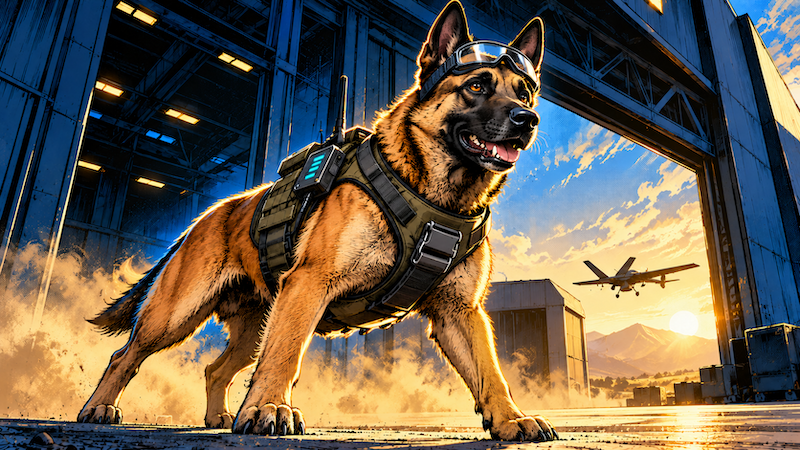
Anduril founder Palmer Luckey and Colossal CEO Ben Lamm launched Warhound to clone and gene-edit military working dogs, then pair them with Anduril's AI headgear rather than replace them with robots.
The Pentagon already has robot dogs. On Thursday, two of defense tech's best-known founders put $200 million behind real ones.
Warhound, a Texas startup conceived by Colossal Biosciences CEO Ben Lamm and Anduril founder Palmer Luckey, emerged from stealth with $200 million in seed funding at a $1.2 billion valuation. It plans to clone and genetically edit elite working dogs, mainly Belgian Malinois and German Shepherds, for the U.S. military, law enforcement and emergency responders.
Investors include In-Q-Tel, Sequoia Capital, ARK Invest, Franklin Templeton, Lux Capital and 8VC, among others. Marine Corps veteran David Spirk is CEO.
Several of those backers have spent years funding machines built to take over dangerous battlefield work. With Warhound, they're wagering that for at least one of those jobs, a dog still does it better.
A supply chain problem with four legs
Warhound's pitch starts with a procurement number. The company says more than 80% of the military's 2,200-plus working dog teams come from European breeders. After about three years of acquisition and training, fewer than half of those dogs qualify for service. In effect, the Pentagon buys roughly 200 dogs to field 100.
Warhound wants to shrink that washout rate with genetics. It has already biobanked samples from top-performing working dogs. Colossal subsidiary ViaGen will clone them, and early gene edits will target health problems common in working breeds, starting with hip dysplasia. The first puppies are due in early 2027, with dogs in service about two years later.
The animal welfare group American Humane will certify Warhound's training programs and help reunite retired dogs with their handlers.
The robot dogs are already here
The military already has a machine option. Ghost Robotics' Vision 60 quadruped has patrolled U.S. Air Force bases since late 2020, starting at Tyndall in Florida. It is used mainly for chemical, biological, radiological, nuclear and explosives detection, plus reconnaissance and mapping. The Department of Homeland Security has trialed it on the southern border, and the British Army is building it into an air assault brigade.
A military Vision 60 reportedly costs about $165,000. If one is destroyed, it can be replaced, and it doesn't need three years of training first.
But most of today's robot dogs carry sensors and cameras and rely on a person to drive them. The British Army's units are steered at all times by an operator holding a gamepad-style controller. A working dog picks up a scent and follows it on its own.
Why the nose still wins
Detection is where machines have had the hardest time catching up. Researchers have spent more than two decades trying to build electronic noses that match trained canines, which a 2004 SPIE paper called the gold standard for vapor detection.
The machines have gotten close in controlled tests. In mid-2000s field trials, the FIDO explosives sensor matched trained dogs at finding buried mines and could flag more explosive types. Academic work now pairs gas-sensor arrays with machine learning classifiers to mimic sniffer dogs.
Dogs stayed on the job anyway, and handlers say lab comparisons leave a lot out. A dog does gradient detection, tracking a scent to its source rather than just registering it. It is highly portable for its sensitivity and works anywhere a soldier can walk. Collin Singer, managing director of Wagtail UK, which supplies cargo-screening dogs to Heathrow, Manchester and Belfast airports, has said dogs will stay the best option until someone builds a sniffing machine that's as mobile, quick and efficient.
Warhound's longer-term plans lean into that advantage. Lamm has floated modifying the dogs' olfactory biology, possibly with genes associated with wolves, to sharpen detection.
Where the AI actually goes
The AI comes in through Anduril.
Anduril's role is to design gear for the dogs and their handlers: body armor, ear and eye protection, and situational-awareness technology. The dogs are slated to connect to Anduril's AI and augmented reality Eagle Eye headgear, giving handlers a live view of what the dog encounters in the field. Lamm summed up the split: the technology goes "on top of the dog, not in the dog."
In practice, the dog would work as a sensor on a networked battlefield, with Anduril's software relaying what it finds to the handler and possibly the rest of the unit.
Anduril's involvement is also more limited than many headlines suggest. Luckey is a partner in the venture, but neither he nor Anduril holds equity in Warhound. Colossal owns a stake and licenses its genetics and cloning technology to the startup.
What's still unproven
For now, Warhound is a $1.2 billion company with no dogs. The first puppies won't be born until early 2027, and the Anduril gear remains a plan.
Public reporting doesn't document gene-editing results in working dogs, or a regulatory pathway for deploying gene-edited animals in military operations. Warhound hasn't disclosed pricing or how many dogs it can deliver. Asked about civilian safety, Lamm said the dogs will be trained like any military working dog and managed by whoever buys them.
Investors can at least see the business case. One researcher told Scientific American the concept is a "slam dunk" for a biotech company, given guaranteed military contracts and a use most people agree matters.
Why it matters
Defense tech's AI pitch has mostly been about substitution, with drones flying missions pilots used to fly and robots walking point. For detection work, Warhound's founders and backers are funding a different approach: keep the animal and build software around it.
Enterprise AI teams face a version of the same choice. Some work is still hard to automate well, and the more useful project may be one that supports the people already doing it.
Warhound's first dogs aren't expected in service until around 2029, so it will be years before anyone knows whether the bet pays off.