Virgin Media Hung Up on Customers Trying to Cancel. AI Firms Think That's a Software Problem.
A £28m fine, a switching process that made it moot, and a retention-AI market walking into European regulation it hasn't priced in.


If this caught your attention, that’s not accidental.

The best editorial systems don’t happen by accident. Outlever builds them.

Anthony from Brighton, who described his experience to the BBC, had been a Virgin Media customer for ten years when he rang to cancel his TV package. He got a run of automated messages he described as "garbled," then the line went dead. He never spoke to anyone. He gave up. The subscription renewed itself and he now pays £90 a month more than he did the year before, for a package Sky would sell him for about eighty.
That call was in August 2025.
In July of this year, Ofcom fined Virgin Media £28m for doing to other customers what it did to Anthony. It's the largest penalty the regulator has ever issued under its consumer protection rules. Unnecessary transfers. Holds for no reason. Agents ending calls on purpose. A two-tier retention structure in which only the second tier could actually process a cancellation, so more than a million people had to ask twice. The commission scheme, Ofcom found, paid agents for behaving this way. Ofcom also found the company had no proper oversight of its third-party call centers, and that its quality assurance was inadequate enough that the behaviour went largely unnoticed in-house.
The findings run from January 2022 to September 2024. Anthony's call falls eleven months outside them.
The coverage that followed was near-unanimous on the diagnosis. This was a call center that had gone wrong and needed fixing: better training, better monitoring, better systems. The Register called Virgin "clingy." Everyone reached, reasonably enough, for the contact center.
Two outlets did clock the timing. MoneySavingExpert noted that the investigation covered calls made before One Touch Switch launched, and Choose observed that the switching process had closed off the route Virgin exploited. Both then moved on to the compensation details. They were onto something, and it goes further than either of them took it. The £28m is not the most interesting part of the story.
Ofcom already fixed this, two years ago
Since September of 2024, UK broadband and landline switching has run on One Touch Switch. You ring the provider you want to join. They handle the rest through a central messaging hub, and your existing provider has to respond electronically with your termination details. Ofcom counted 1.6 million switches in the first year.
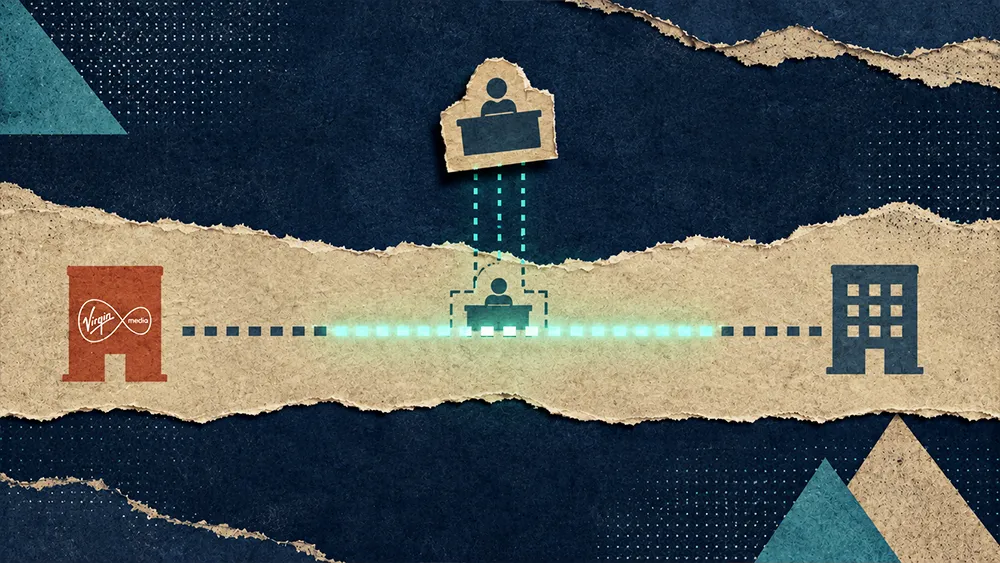
Nobody rings Virgin Media to switch their broadband. There is no call. No retention agent, no objection handler, no tier-two transfer, no commission, and no opportunity to hang up on anybody, because the customer is talking to a competitor and Virgin finds out through a message on a hub.
But the process has limits. One Touch Switch moves customers between providers. It does not cover a customer cancelling outright and buying nothing. Someone moving abroad, moving in with a partner, or going mobile-only still has to pick up the phone. Ofcom confirmed in January that it doesn't apply to business or mobile broadband, either. But switchers are the commercial heart of any save desk, because they're the customers a competitor is actively trying to take, and they're the ones the £28m was about. Ofcom counted 1.6 million of them in the first year alone.
Now look at the dates on the fine. Ofcom's findings run from January 2022 to September 2024, and the regulator explains the end date in footnote four of its own announcement: it ended the day before One Touch Switch came into effect. The investigation stops the day the mechanism stopped existing.
Natalie Black, Ofcom's group director for infrastructure and connectivity, put it plainly in the same announcement. After the line about sending a clear message to any provider that wilfully acts against its customers' interests, she said that introducing One Touch Switch was how the regulator had put safeguards in place to prevent this happening again. The £28m is the punishment. The switching process was the fix, and it shipped two years ago.
Mobile went the same way years earlier with text-to-switch: send a text, get a PAC code, leave. Across a decade of telecoms policy the regulator's revealed preference is consistent, which is that the cancellation conversation is itself the hazard, and the remedy is to make it unnecessary rather than to make it nicer.
You can't save a customer who never calls
The contact center AI market has spent three years learning to sell on revenue rather than cost, because cost savings are a one-time story and revenue is a recurring one. That means retention, save rate, and what the category calls 'service-to-sales': catching the customer who rang to complain and sending them away with an upgrade.
Cresta is the useful example here, because it's the most explicit in the category about retention as a use case, and because it entered EMEA at the moment the ground moved. Spun out of the Stanford AI Lab in 2017, run since 2023 by Ping Wu, who co-founded Google's Contact Center AI. Around $280m raised, a $125m Series D in late 2024, and an April 2025 announcement of APAC and EMEA expansion with a Melbourne office and London to follow. Telecoms sits at the top of its named verticals. That expansion release led with three numbers: 20% revenue increase, 40% increase in span of control, and a 56% increase in save rate. A customer story in home services leads with a 46% save rate and $2.37m unlocked.
Those are global customer figures rather than a British telco claim, and Cresta has never presented them otherwise. But a company chooses what to put at the top when it announces a European expansion, and Cresta chose retention.
A save rate is the proportion of customers who rang to leave and didn't. In American telecoms, that's a legitimate and enormous business. In British broadband, it's a metric describing a conversation that regulation has largely abolished. You can't lift a save rate on calls that no longer arrive.
Mark Meghezzi, who runs Cresta's EMEA business from London and came up in telco before moving into high-growth software, puts it this way: "Save rate is a US number and it travels badly. In a market where the regulator has taken the cancellation call away from you, it tells you nothing at all. What we can tell an operator is what their agents actually did on the calls they still take. Most of them find something they'd rather not have found. It's a harder sell and a better one."
But the save desk hasn't vanished entirely. One Touch Switch covers broadband and landline. It does not cover pay TV. Which is what Anthony was cancelling, in August 2025, eleven months after the conduct Ofcom fined and eleven months after the switching process that was supposed to make it impossible. He had to ring, because for a TV package there's still no other way out. Ofcom built an exit and put it on one product line. One customer's bad afternoon is not a finding, and Virgin Media would fairly point out that it has rebuilt the operation since. But it's a useful illustration of where the retention conversation went rather than whether it ended.
Ofcom's own complaints data complicates this. In the first quarter of 2026, pay-TV complaints sat at three per 100,000 customers, unchanged on the previous quarter and level with the lowest figure Ofcom has ever published. If cancellation friction had simply relocated to television, it should be visible there, and it isn't. What the scope gap gives you is a structural argument rather than an empirical one: the exit Ofcom built covers part of the market, and for the rest the phone call is still the only way out.
It didn't stop at television. One Touch Switch doesn't reach insurance, gyms, energy, streaming, handset finance, or the broad subscription economy that has roughly tripled since 2017 on the European Commission's own figures. The retention call is now concentrated in the sectors that haven't yet been handed a structural exit.
And the Commission is coming for those next.
The Commission is coming for the rest
The Digital Fairness Act lands as a legislative proposal in the fourth quarter of this year. Adoption realistically runs into late 2027 with obligations staggered towards 2030, so nobody needs to panic, but the target list is already public and it's specific. The Commission's fitness check names convoluted cancellation processes and something it calls "confirmshaming": repeated emotional prompts that pressure a consumer into reconsidering. Existing UCPD guidance already says cancelling should be as easy as subscribing.
An AI system feeding a human agent successive objection handlers, ranked by predicted effectiveness against this particular customer's profile, while the customer is trying to leave, does not sit near that definition. It answers to it.
There's a second European complication that most buyers haven't priced in. Since February 2025, Article 5(1)(f) of the AI Act has prohibited inferring emotions from biometric data in the workplace, and Commission guidance is explicit that voice counts and that general stress monitoring doesn't qualify for the medical-or-safety carve-out. Reading a customer's frustration is fine and the guidance says so directly. Reading your own agent's is a prohibited practice carrying exposure up to €35m or 7% of global turnover. A lot of products in this category ship both under one heading called 'sentiment.' The Commission looked at softening the prohibited list in its November 2025 review and declined.
Meanwhile, the transparency obligations went live on August 2nd. The Digital Omnibus pushed most of the high-risk regime out to December 2027 but deliberately left Article 50 where it was, so a voice agent taking a cancellation call in the EU has to say what it is.
The boring product that actually travels
"I came up in telco, so I watched this land from the inside," Meghezzi said. "Once One Touch Switch went live the cancellation call didn't get better, it stopped happening. Anyone walking into a UK broadband operator today with save rate on slide three is going to have a short meeting. What European operators ask us instead is duller and much harder to answer: can you tell me what was actually said on every call, not the two per cent somebody sampled last month? That's the conversation I'm having in London and Amsterdam. It's a different product to the one that sells in Atlanta."
Strip out retention uplift and you're left with something less thrilling and more durable: full-coverage quality assurance.
This is the one part of the vendor case that survives contact with the Virgin Media file intact. Read the finding and the operative word is likely: calls were "likely" mishandled. Ofcom had 1,881 complaints, of which at least 649 matched the two-tier pattern, and from those inferred a population in the millions. Footnote three shows the working. The regulator estimated the likely proportion of callers transferred mid-call, callers who rang back, and calls that ended without a clear action being logged. That's a regulator reconstructing a population from proxies, because the evidence to settle it directly didn't exist.
Ofcom said as much outright. It found that inadequate quality assurance and monitoring meant these behaviours were often overlooked, and that Virgin Media didn't have proper oversight of its third-party call centers or their quality monitoring. That second clause deserves more attention than it got. Conventional QA samples somewhere between one and three per cent of interactions and scores them weeks after the fact; push the calls out to an outsourcer and even that thins. A profitable, incentivised, distributed pattern can run for thirty-two months inside that gap. Score every call instead of forty of them and it surfaces on an operations dashboard long before it surfaces in an enforcement notice.
The case against all of this
One Touch Switch covers two product lines in one country. Cresta sells across a region containing forty-odd national regulators, most of which have done nothing structural about cancellation at all. The save desk in German insurance or Italian energy is not going anywhere this year. The Digital Fairness Act is a proposal that hasn't been published yet, will be negotiated for two years, and may arrive with obligations staggered into 2030. That's three or four sales cycles away, which in this market is a geological epoch.
A save rate isn't automatically coercive, either. A customer who rings because their bill jumped, and stays because someone offered a tariff they didn't know existed, has been served rather than trapped. Ofcom didn't fine Virgin Media for retaining people. It fined them for the transfers, the hold music, and the dropped calls.
If that reading is right, the EMEA retention business is fine for years and all this piece has established is that one product line in one country closed early.
So what's left?
Ofcom's penalty reasoning is worth reading on this point. Among the factors it lists for setting the amount are the financial gain Virgin Media is likely to have made, and the fact that the company had already been fined for breaching the same rule in 2018. The regulator priced the profitability of the save desk, and noted that Virgin had been told about it once before.
Virgin Media says complaints about difficulties leaving fell 89% against 2023. The overhaul behind that, on the company's account and on subsequent reporting, ran to expanded UK-based specialist teams, more training, a revised commission scheme, rebuilt quality assurance, and AI-assisted support tools. The technology was in the mix.
Then look at the most recent quarter. Between January and March 2026, Virgin Media was the only major broadband provider whose complaints went up, from five per 100,000 customers to six, ending the run that had taken it to joint least complained-about at the end of 2025. On its own that proves nothing. The entire industry now sits within six complaints per 100,000 of itself and a movement of one is close to noise.
What it does dispose of is the tidy version of this story. Virgin changed what it paid people to do and it bought software, and only one of those is the thing Ofcom fined it for. No vendor in this market has yet explained why their product would have stopped a system that was working exactly as its owners intended.
If this caught your attention, that’s not accidental.

The best editorial systems don’t happen by accident. Outlever builds them.
Get the latest AI insights first.
Sign up for updates, interviews, and fresh analysis on how AI is reshaping business, brands, and technology.