Everyone Quoted Target's New AI Chief. Nobody Checked Who He Reports To.
Target named Chandhu Nair its first chief AI officer this week, a role that will report into the company's chief information and product officer rather than to the CEO.


If this caught your attention, that’s not accidental.

The best editorial systems don’t happen by accident. Outlever builds them.

Target announced on Tuesday that Chandhu Nair will join on August 24 as senior vice president and its first chief artificial intelligence officer, according to CNBC. He arrives from Lowe's, where he spent more than six years and was most recently senior vice president of stores, data, AI and innovation. Before that he held roles at Staples and Gap, and co-founded two companies, a retail analytics software firm and a strategy consultancy, per PYMNTS. Target also promoted Purvi Shah to senior vice president of user experience.
Nair said his focus would be a more coordinated approach to AI across the company, covering inventory management and faster business decisions. "The most meaningful AI stories won't be about what happens in a lab," he said in a statement.
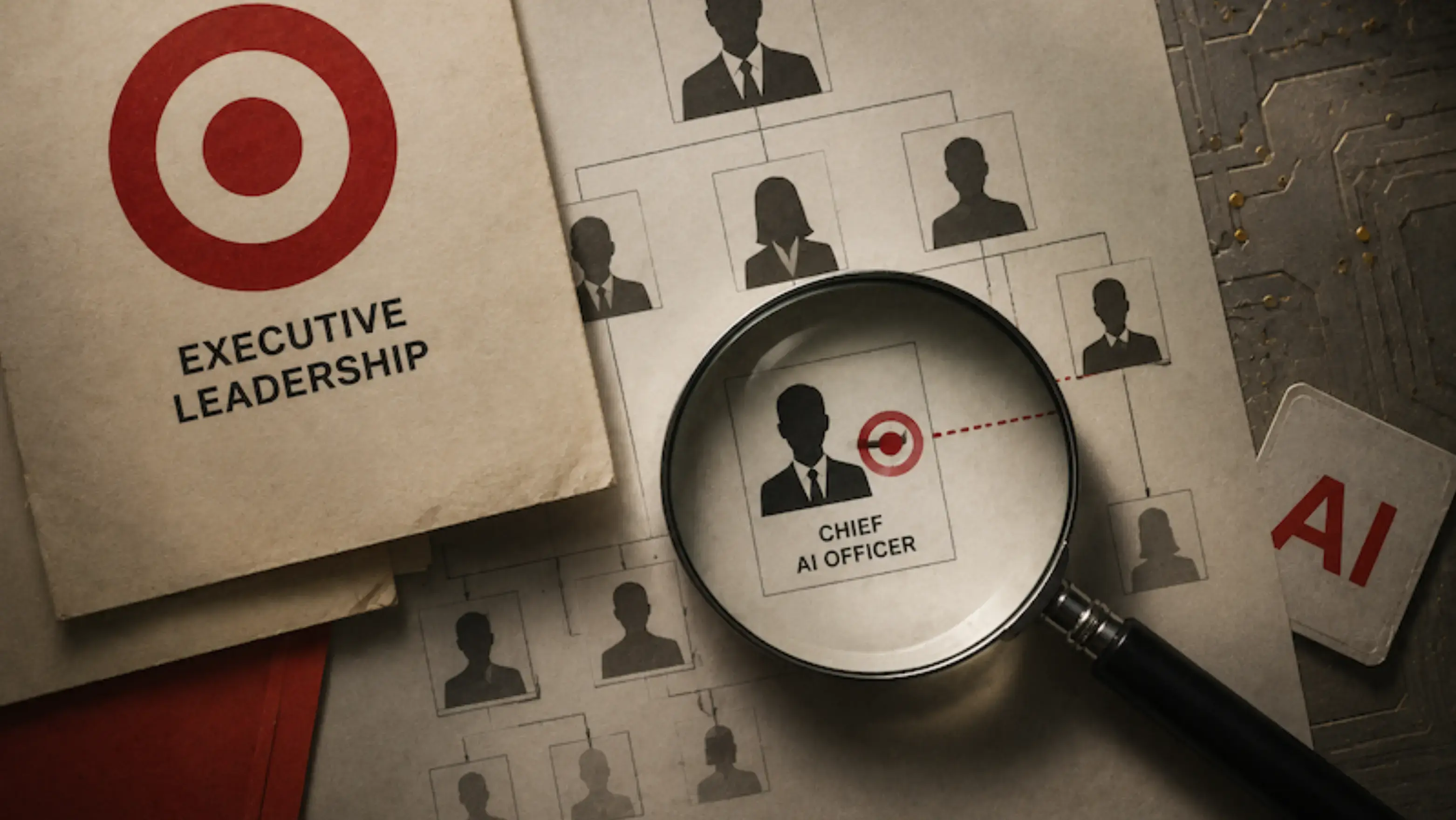
That quote ran nearly everywhere. The detail that ran almost nowhere came from CIO Dive, which reported that Nair and Shah both report to Prat Vemana, Target's chief information and product officer. Not to CEO Michael Fiddelke. Not to the board.
Why the reporting line is the part that matters
Every AI leadership announcement this year has contained roughly the same sentences. Coordinated approach. Enterprise-wide. Business outcomes rather than experiments. The language commits a company to nothing and can be drafted by someone who has never held a budget.
The reporting line is harder to fake, because it decides who can say no.
IBM has studied this directly. A global survey of more than 600 chief AI officers across 22 countries, run with the Dubai Future Foundation, found that organizations with a CAIO saw about 10 percent higher return on AI spend, and that the figure rose to 36 percent where the CAIO ran a centralized or hub-and-spoke operating model rather than a decentralized one. IBM's own writeup of the research makes the structural point plainly: the need for central authority is part of why many chief AI officers do not report to technology leadership.
More than half report to the CEO or the board, and roughly 60 percent control their organization's AI budget, according to industry analyst Jeff Winter's reading of the IBM data. Winter's framing of the design question is to match the reporting line to the mission: the CEO when AI is meant to be a competitive differentiator, technology or operations when AI is meant to make the existing business run better.
Other large incumbents have gone the first way. When HSBC named David Rice its first chief AI officer in April, the bank framed the job as enterprise leadership for AI adoption and separately expanded its CTO's remit to handle platforms, deliberately splitting the two.
By that standard, Target has told the market something fairly specific. It has classified AI as an enablement problem.
The case for putting the role under technology
There is a version of this story where that placement is a mistake, and it would be the easier one to write. It is probably wrong.
Chief digital officers spent the 2010s learning that a direct line to the CEO is not the same as authority. PwC's Strategy& tracking of the world's 2,500 largest listed companies found new CDO appointments peaked at about 160 in 2016 and fell to 54 by 2018. The role did not fade because digital stopped mattering. It faded because plenty of those executives had the title and the mandate to transform everything, and no engineers, no roadmap and no money underneath any of it.
Vemana controls technology spend, the product roadmap and the people who build things. Nair sitting inside that organization may give him more usable leverage than a line to Fiddelke with nothing beneath it. Winter describes a phased pattern that fits Target closely: place the AI leader under a technology executive first, then move the role up once it proves central to competitive strategy.
The placement also fits the company's situation. Fiddelke's turnaround plan, introduced in March, committed about $2 billion in incremental operational and capital investment this year. First-quarter net sales came in at $25.4 billion, up 6.7 percent year over year, per Retail TouchPoints. A retailer in that position needs inventory accuracy and faster decisions more than it needs a moonshot.
Retail is a difficult place to bet on enablement
The complication is that retail is currently the industry where AI looks least like enablement.
Walmart opened shopping inside ChatGPT last October and announced a Gemini integration with Google at NRF in January, with executives making clear the company was not committing to either platform exclusively. Gap became the first major fashion retailer to let shoppers complete a purchase entirely inside a chat window in March, Axios reported, and Ulta Beauty followed in April. Best Buy has arrangements with both OpenAI and Google, per Quartz.
Underneath the partnerships is a standards fight. OpenAI and Stripe built the Agentic Commerce Protocol and open-sourced it. Google and Shopify countered in January with the Universal Commerce Protocol, backed by a coalition that includes Etsy, Wayfair, Visa, Mastercard, Walmart and Target itself, according to Fast Company. Salesforce estimated AI touched about $272 billion of global retail sales over the holiday season, roughly a fifth of the total.
When another company's agent can broker a retailer's assortment, pricing, inventory signal and checkout, questions that used to sit separately in merchandising, e-commerce, supply chain and payments turn into one question about who owns the customer. That is not a technology enablement question. Whether an executive two levels below the CEO can answer it is the open issue in Target's design, and it has nothing to do with how good Nair is at the job.
The title count has stopped meaning anything
There is a second reason to read org charts instead of headlines, which is that the headline numbers no longer agree with each other.
IBM's Institute for Business Value surveyed 2,000 CEOs across 33 geographies and found that 76 percent of organizations now have a chief AI officer, up from 26 percent in 2025. That figure has anchored most coverage of the trend since May.
The 2026 AI & Data Leadership Executive Benchmark Survey, drawn from about 110 large companies with a nearly all C-level respondent base, put the same figure at 38.5 percent, up from 33.1 percent the year before. The State of the CIO survey found just 14 percent the previous year.
Three counts of the same role in the same period, and the highest is more than five times the lowest. The spread exists because the title does not describe a consistent job. Some chief AI officers run governance. Some own a product roadmap. Some are a coordination function with a good business card. Constellation Research analyst Ray Wang has argued the position is transitional in the first place, giving it three to five years before it gets absorbed back into the CIO's remit.
What the appointments have not done is close the gap they were created to address. A separate IBM study in June found that 77 percent of organizations say AI adoption has already outrun their governance capabilities, and 70 percent say business teams are deploying technology faster than IT can track, as reported by MarketScale.
Three questions for anyone reading their own announcement
The useful diagnostic is short. Who does the AI leader report to, and was that placement chosen deliberately or was it wherever there happened to be room? Do they control the AI budget, given that only about 60 percent of their peers do? And can they stop a project, including a well-liked pilot inside a powerful business unit that does not want to hear it?
An executive who can convene meetings but cannot fund or cancel work is accountable for outcomes without control of the mechanisms. That arrangement has broken coordinating roles in government and in business for decades, and a new title does not change the arithmetic.
What to watch at Target
Nair's record suggests he understands the operating problem better than most people hired into these jobs. He has run stores rather than labs, and Target's own framing paired the AI hire with the UX promotion specifically to shorten the distance between insight and action.
The structure is the variable. If the enablement bet works and the scope grows past what the technology organization can absorb, the role moves up and the reporting line changes within about two years. If the job really was coordination inside IT, it quietly folds back into Vemana's organization and the announcement will have been the extent of it.
Either outcome shows up on the org chart well before it shows up in a press release, which is the more general lesson for anyone tracking these appointments across the rest of the year.
If this caught your attention, that’s not accidental.

The best editorial systems don’t happen by accident. Outlever builds them.


Get the latest AI insights first.
Sign up for updates, interviews, and fresh analysis on how AI is reshaping business, brands, and technology.