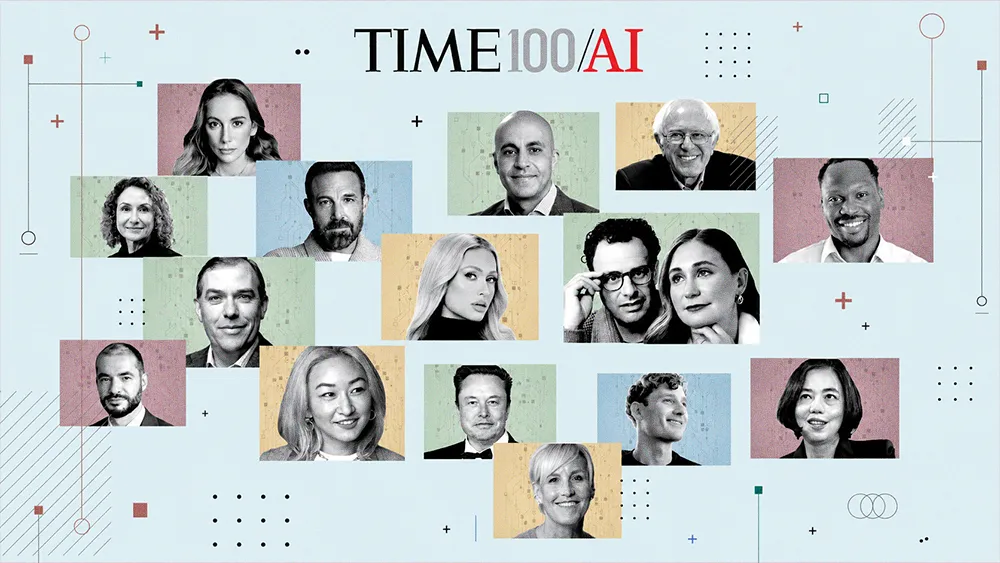
TIME published the 2026 TIME100 AI on Thursday morning. By lunchtime there were company announcements on the wires out of Shanghai and New York, AGIBOT saying its founder Deng Taihua had made the list and Shutterstock saying the same about Alessandra Sala, its senior director of AI and data science. Full releases, executive quotes, boilerplate, photo credits. Somebody wrote those last week and sat on the send button.
Nothing wrong with that. Embargoes exist, comms teams do their jobs, and every award in every industry works this way. I mention it because it's a good reminder of what the list turns into once it's out, which is a few hundred pieces of corporate communication, a magazine cover, and a guest list.
So there are two conversations worth having about it, and most of the coverage this week is only going to have one.
The reporting
Seventeen reporters carry bylines on this thing. Ayesha Javed led the selection over several months, working partly from recommendations solicited from industry figures and expert sources, and the entries are not padding.
The Yann LeCun profile has real news in it. LeCun says Zuckerberg called him on a Sunday last November, after word got around that he was leaving Meta, and tried to talk him out of it by telling him good luck raising the money and good luck building something the market would believe. He announced Advanced Machine Intelligence Labs a month later and had $1.03 billion in seed funding by March. He is spending it on the position that scaling language models will never get anyone to human-level intelligence and that world models will, which is a genuine disagreement between serious people and not something you normally get out of a listicle entry.
The Harvey write-up comes with numbers. Valuation past $11 billion in March, more than double where it sat last June, and better than 75 of the hundred highest-grossing American law firms signed up as clients.
The OpenAI feature running alongside the list, built out of dozens of interviews, describes a company that spent the year losing executives, handling rogue agents and public backlash, and watching Anthropic's strength in coding and enterprise push its valuation above OpenAI's while both companies get ready for expected IPOs. Greg Brockman is now running large parts of the place, revenue and product marketing included.
That is access reporting. It costs something to get and it is worth reading.
The other thing
Deloitte is the premier sponsor of the 2026 list. Booking.com and Cognizant are signature partners. On September 14 TIME hosts a TIME100 Impact Dinner in San Francisco, and the announced speakers include the chair and CEO of Deloitte Consulting, the CEO of Booking Holdings and the CEO of Cognizant, sitting alongside honorees like Joseph Gordon-Levitt and ITU Secretary-General Doreen Bogdan-Martin.
That dinner follows TIME AI events this year in Davos, Cannes, New York and San Francisco. Next year the company launches a TIME100 AI Leadership Forum in Washington and says it is looking at more of them overseas. In the same editor's letter that introduces the list, Sam Jacobs announced that TIME is adding AI reporters in London, Washington and San Francisco and relaunching its In the Loop newsletter with plans to take it to five days a week. Back in December the magazine made "The Architects of AI" its Person of the Year.
I am not suggesting the sponsors have anything to do with who gets named, and I have seen nothing that would indicate they do. The point is narrower than that. TIME has built a real business around getting this industry into rooms together, and the list is what fills the room. Nobody has to do anything improper for that to matter. It just means the document you are reading has a second job.
What "influential" is doing here
The word is carrying too much weight. Liang Mong Song, co-CEO of SMIC, is on the list because his decisions set a hard ceiling on what China can fabricate. Paris Hilton is on it because when she says something about AI, an enormous number of people hear it. Both are worth writing about. Putting them in the same hundred under one heading flattens a distinction that is doing a great deal of work.
The method adds to the problem. If part of your input is recommendations from people already established in the field, then part of what you are measuring is who the field would like to see recognized. That is interesting information on its own terms. It is a different question from who is actually moving things.
What's in it anyway
All of which said, the list is more revealing than a neutral ranking would be, because it records what a large mainstream institution currently believes power in this field looks like. Three things jumped out at me.
The Leaders section is stacked with people who own physical objects. Larry Ellison is there. So are Hock Tan at Broadcom, Michael Intrator at CoreWeave, Josh Payne at Nscale, Matt Garman at AWS, Sanjay Mehrotra at Micron, Andrew Feldman at Cerebras, He Tingbo at Huawei and Liang Mong Song at SMIC. In 2023 the equivalent section was mostly lab founders and academics. The editor's letter points readers toward TIME's own data-center reporting from the past year, which runs from a valley above the Arctic Circle in Norway to communities in Tennessee and Texas.
The critics on this year's list have institutions behind them, and that is new. Jacobs writes about a growing coalition of politicians and advocates warning about where this is all heading, naming Bernie Sanders, AFL-CIO president Liz Shuler and Gordon-Levitt, who appears as a co-founder of a Creators Coalition on AI. Sanders tells TIME: "I think we have to stop the development of superintelligence." Also on the list are A.G. Sulzberger, whose company is suing OpenAI, and Ben Affleck. Three years ago the skeptical entries were researchers inside the field, worrying in public. A senator, a union federation and a newspaper are a different proposition entirely.
And the frontier is no longer being described as American. Eddie Wu, Liang Rubo, Yang Zhilin, Zhang Peng, Xiao Hong, Deng Taihua, He Tingbo, Liang Mong Song, Stella Li at BYD. Jacobs writes without much drama that Moonshot's models sometimes beat the strongest American ones. Meanwhile the entry covering American AI oversight is Arvind Raman, listed as acting head of the US Center for AI Standards and Innovation. Set that against a Leaders section full of people spending tens of billions on data centers and you have a decent picture of the year.
Last thought
Any list of this kind lags. What it measures is how visible someone has become, and visibility arrives well after the work does, so whoever turns out to matter most in 2027 is probably invisible to a process that begins by asking prominent people for names.
Which is fine, as long as you know that going in. The TIME100 AI is a well-reported snapshot of what the AI establishment believes about itself right now, put together by a company that has made a business out of putting that establishment in a room. Read it for the first part. Keep the second part somewhere in the back of your mind.