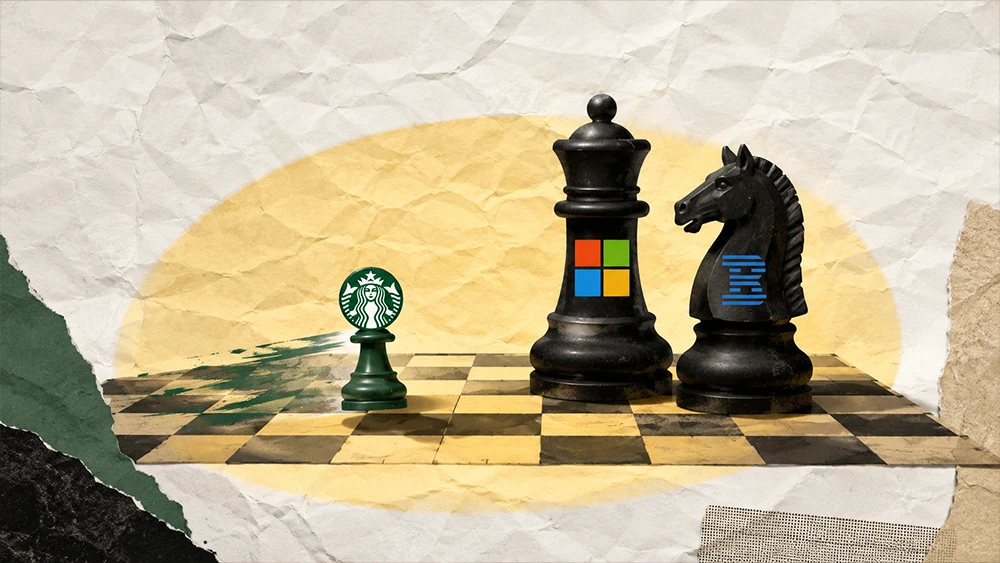
For years, the idea that AI would let big companies replace their enterprise software vendors was mostly theoretical. Last week it got a Starbucks logo on it.
According to an internal company presentation reviewed by Bloomberg News, Starbucks is developing in-house tools with the help of AI that could replace applications it currently licenses from Microsoft and IBM. The two named targets are a Microsoft system that tracks inventory and an IBM platform that manages equipment maintenance. Some of the internally built software could roll out by the end of 2027 if testing goes well.
The market noticed. As Fortune reported, Microsoft shares dropped about 1.5% and IBM sank roughly 4% in premarket trading on Thursday after the Bloomberg story ran, and the moves got worse after the open. That is a lot of market cap evaporating over a coffee company's internal tech roadmap.
The math behind the move
Why would Wall Street care what Starbucks does with its inventory software? Because of the number attached to it.
Starbucks spends about $400 million a year on software alone, Chief Technology Officer Anand Varadarajan told employees in an internal forum earlier this year. In a recording reviewed by Bloomberg, he added that "there's clear opportunities to reduce the spend in software."
This is part of a much bigger squeeze. Starbucks is hunting for $2 billion in cost savings under CEO Brian Niccol's turnaround plan, and the company is reportedly reviewing every technology contract and service it pays for. Its enterprise technology division alone is on track to cut roughly $30 million from its budget this fiscal year, including about $10 million in software spending and another $13 million largely from cutting back on outside contractors, according to reporting syndicated by Investing.com.
The AI angle is what separates this from ordinary belt-tightening. AI-assisted coding was reportedly central to building the platform that could replace the IBM maintenance tool. Starbucks has been pushing its technology workers to adopt AI so hard that AI usage now factors into bonus evaluations. The company has also spent several years building its own point-of-sale system to replace Oracle Simphony, so Oracle has reason to watch this too.
There is a human cost attached. Starbucks has cut around 2,300 jobs since February 2025, many of them in technology, while opening new tech hubs in Nashville and India alongside its Seattle headquarters.
Why vendors should be nervous
The historical logic of enterprise software was lock-in. Ripping out a vendor's system meant years of migration risk, armies of consultants, and a real chance of breaking your own business. So companies paid their licensing fees year after year, and vendors enjoyed some of the stickiest revenue in the economy.
AI-assisted development goes after that logic directly. If a mid-sized internal team armed with coding assistants can build a good-enough replacement for a licensed inventory system, tailored to the company's exact workflows and free of per-seat fees, the switching-cost moat starts to drain. That fear has already weighed on software stocks this year. Both Microsoft and IBM were trailing the S&P 500 before the Starbucks news even broke.
Starbucks will not be the last to run this math. Every Fortune 500 CFO staring at a nine-figure software line item is now watching this experiment. If a coffee retailer can pull it off, what stops a bank or an airline from trying the same thing?
The caveat: Starbucks' AI track record is mixed
Before anyone declares the death of enterprise software, Starbucks has stumbled here before. The company recently pulled an AI-powered inventory-tracking system from its stores and went back to manual counting, per Bloomberg's reporting. And the new in-house tools are not shipping tomorrow. The timeline stretches to late 2027 and depends on testing.
Building software is one thing. Maintaining, securing, and scaling it across tens of thousands of stores for a decade is another. The hidden cost of "build" has always been the long tail of ownership, and AI does not make that disappear. Plenty of people in the industry remain skeptical about how much of this work AI can actually automate, and how fast.
Where this goes from here
One internal presentation from one coffee company knocked billions off the market caps of two of the world's largest technology vendors. The market clearly believes the enterprise software moat is fragile in the AI era, and it did not take much to prove it.
Big companies are going to keep running the build-versus-buy math with AI on the build side of the ledger. The interesting part now is which vendor gets the first uncomfortable question about it on an earnings call.