
The trigger is the interesting part. Instead of a person asking AI to do something, something happening on the web becomes the trigger that automatically starts the workflow.
 Serge SalagerFounder and CEO @ Visualping
Refresh, wait, refresh. That has been the deal with the web since the first search box: it sits inert until you go poke it. This summer, within three weeks, two of the biggest companies in tech decided the poking should go the other way. At Google I/O, the company unveiled information agents that scan the web around the clock and ping you the moment something relevant moves. Three weeks later at WWDC, Apple shipped Notify Me, a Safari feature that watches a single page and tells you when it changes. Google and Apple do not accidentally build the same product in the same month. AI spent two years learning to answer on command. Its next act is watching the world and moving the instant it shifts.
Serge Salager is the Founder and CEO of Visualping, a page monitoring agent that has been watching web pages on users' behalf since 2017. A former venture capitalist and Harvard MBA who ran a publicly traded tech company before assembling Visualping from a handful of small monitoring tools, Salager has spent nearly a decade in a category that only now has the attention of Cupertino and Mountain View. He watched Google demo its version from a seat in the audience, and the experience clarified something he has been arguing for years.
"We call it the end of FOMO. When something important happens, you're alerted immediately, you stay in the know. That's incredibly valuable," Salager said. What began as a consumer tool for tracking restocks and price drops during the pandemic, when the company found unexpected traction among people hunting for vaccine appointments, has become an operational layer for enterprises that need to know things before anyone else does.
The Trigger Flips
Most agentic AI still assumes a human starts the clock: someone asks a model to check a contract or draft five emails, and it goes to work. Salager argued the more interesting version runs the other way, with the web itself as the starting gun. "The trigger is the interesting part. Instead of a person asking AI to do something, something happening on the web becomes the trigger that automatically starts the workflow," he said. He described a firm that sells post-merger integration services and scans thousands of press releases daily for M&A activity that fits its criteria. When a match lands, the system drafts the outreach automatically, pulls in the transaction details, and leaves a ready email waiting for a human to send. Some clients cut the human out of the loop and let the email send itself. As AI moves off the desktop and into workflows that run on their own, the web change is what pulls the trigger.
The trigger can also point inward, at a company's own exposure. Salager described insurance carriers using Visualping to watch the businesses they cover for risk signals, scanning the social feeds of insured bars and restaurants for photos of open flames, sparklers, or lit candles in crowded rooms. Catch a venue flouting fire codes the moment post goes up, and the insurer can call the owner before a claim ever materializes, turning monitoring into prevention rather than forensics. It is the same mechanism as the M&A example running in reverse: instead of a signal that opens a sales opportunity, a signal that closes off a liability.
What all of these share is a job no person could hold. "A human can't scan thousands of pages every day or check them every few minutes. That's exactly the kind of work machines should be doing," Salager said. He pointed to a lender whose product depends on maintaining an always-current database of university scholarships, tracking GPA requirements and application windows across every school in the country. The service only works because the underlying data never goes stale, and keeping it fresh is a monitoring problem no team could staff. Salager said Visualping counted more than 110,000 individual accounts setting up a new monitor in the first five months of 2026, a figure the company offers as evidence that the behavior is spreading well beyond early adopters.
Awareness As The Asset
Salager reached for a military term to describe what monitoring actually buys. "It's really about operational awareness. Having the right information at the right time allows you to make the right decision at the right moment," he said. Awareness, in his framing, is the product. Everything else is just the means of delivering it, and the faster money and information move, the more a head start is worth. Hedge funds have understood this long before online shopping was widespread; funds bought satellite images of retailer parking lots and counted cars to forecast a quarter before the earnings call. The signals have changed: app downloads, web traffic, and quiet pricing pages have replaced parking lots. When a software company raises prices without a press release, an investor who catches the change on the pricing page knows something the market has not yet priced in.
The value of that awareness scales with how fast it has to travel. Salager said some funds monitor pages at the highest frequencies his platform allows, watching for FDA recalls and trading on public information minutes before the wider market notices. For a legal team tracking regulatory changes, a weekly sweep is fine, since tax law does not move by the hour. For a trader, the gap between knowing now and knowing in an hour can be measured in millions. The same tool serves both, and Salager said many of Visualping's customers monitor at high frequency precisely because timing, for them, is the entire point.
That awareness also turns out to be unusually easy for enterprises to buy. Visualping monitors the web from the outside and does not ingest or process a company's internal data, which means security reviews tend to clear a low bar. That external-only posture stands in contrast to the broader fight over who controls the data agents actually need, a fight where SaaS vendors are locking down access to the proprietary information sitting inside their platforms. Monitoring sidesteps that fight by staying outside the walls entirely. A single analyst can start using it without a security review or a procurement cycle, and adoption spreads from there, one seat at a time.
Two Kinds Of Watchers
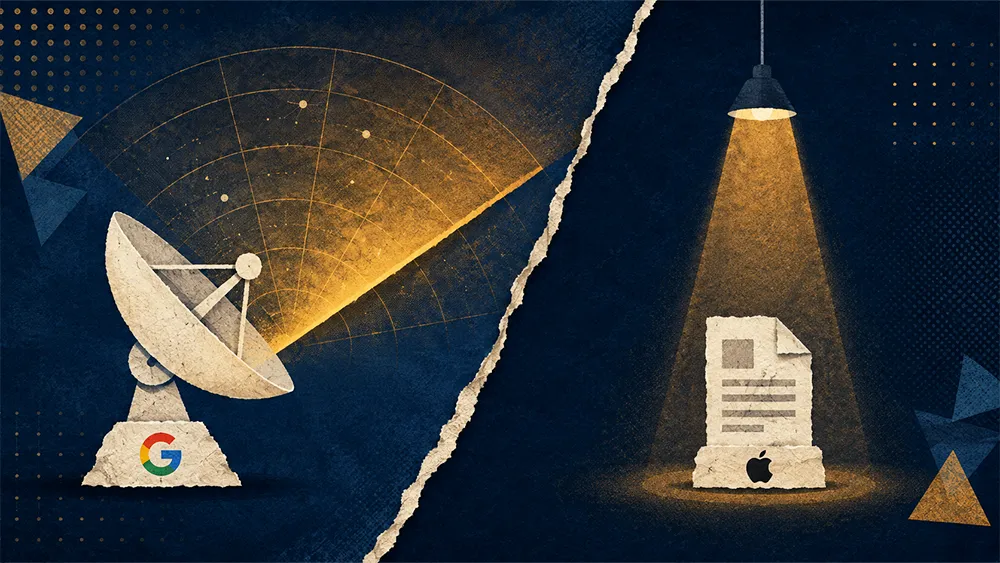
Google and Apple landed weeks apart, but they did not build the same thing. Google's information agents scan the open web broadly, closer to a radar plane sweeping wide, deciding for themselves what to surface across blogs, news, and real-time data. Apple's Notify Me and Visualping work at ground level, watching one specific page a user has chosen. Salager did not pretend his approach wins everywhere. Broad scanning struggles to know that a particular golden retriever just became available at one of three shelters in a specific neighborhood, the kind of narrow, high-specificity signal page monitoring is built to catch. What ground-level watching gives up in reach, it gains in precision. The two approaches solve different problems, and the harder question for users is often not what to watch but which pages are worth watching in the first place, a curation step Salager said his product tries to handle through conversation with the user.
The split also marks where each company will and won't go. Apple built Notify Me for the person sitting in front of a browser with a handful of tabs open, a consumer feature by design. Google is folding its agents into Gemini and the search box, part of the same proactive turn in Search reshaping how people find information at all. Neither is chasing the enterprise use cases: a luxury automaker's dealer network kept on-message when a new model launches, the insurer watching its own book of business, the hedge fund racing a recall, that Salager said make up the most valuable end of his market. He does not read the giants as competitors so much as a marketing department he never had to pay for, two of the most trusted brands in technology teaching two billion people that a browser can watch a page for them.
For years, the thing missing from the category was not the technology, Salager said, but awareness and an interface plain enough for anyone to use. Google and Apple hand the whole category the distribution and the plain-language interface it always lacked, and as monitoring becomes a built-in feature rather than a separate tool, watching a page stops being something users opt into and becomes something the software just does. It is the same shift now pushing AI off the desktop and into the background of everything. "As more of the world becomes automated, awareness becomes even more important. The faster everything moves, the more critical it is to know what's happening as it happens," Salager said. The refresh button had a good run. Its replacement will not wait for anyone to press it.