On Monday at the Computex trade show in Taiwan, Nvidia CEO Jensen Huang introduced a new chip called the RTX Spark. As CNBC reported, it will go into more than 30 laptops and 10 desktops this fall from Dell, HP, Lenovo, Asus, MSI, and Microsoft, including a new high-end Surface laptop. Huang told the audience this was as big a shift as the move from the old mobile phone to the smartphone, and described it as the first completely reengineered line of PCs in 40 years.
Every chip launch produces a line like that, so it is easy to wave off. It should not be waved off. To see why, you have to look past the laptop.
Nvidia already dominates the chips used to build and run artificial intelligence. According to its own filings and market trackers cited by The Motley Fool, the company earns about 91% of its revenue from data centers and holds roughly 86% of the market for AI chips, with Intel and AMD splitting most of the rest. The one place Nvidia did not have a foothold was the computer sitting in front of the employee. The RTX Spark changes that.
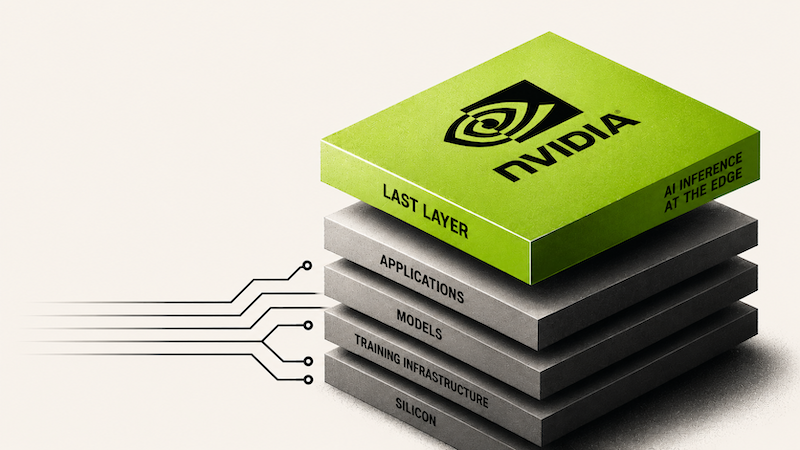
The reason this matters as strategy, beyond being a new product, comes down to software. Developers who want to use Nvidia chips have to build on the company's software platform, called CUDA. Once they do, switching to a rival's chip means rewriting their work, so they tend to stay. Tom's Hardware notes the new chip carries that same platform onto the laptop, pairing an Nvidia graphics processor with an Arm-based main processor built with Taiwan's MediaTek and 128 gigabytes of memory. That means developers can build their AI on Nvidia, run it on Nvidia, and now put it in front of employees on Nvidia. No competitor offers that full path.
What the stock market saw, and what it missed
Investors reacted fast. CNBC reported that in early Monday trading ServiceNow rose about 14%, chip designer Arm Holdings jumped between 12 and 16%, IBM gained around 12%, and Hewlett Packard climbed as well. Nvidia's rivals fell at the same time. Investing.com reported Intel down about 5%, AMD about 4.5%, and Qualcomm about 7%, while the PC makers building the new machines rose, with Asus leading on the Taiwan exchange.
Most of that buying was a bet on software companies rather than on the chip itself. As Invezz and others reported, Huang spent part of his speech pushing back on a fear that had weighed on software stocks all year, arguing that the rise of AI agents will increase demand for business software rather than wipe it out. That eased investor nerves, but it is a mood swing, and it may not last. AI Weekly flagged that the same software names could fall back just as quickly if pricing or availability disappoints.
The bigger story is simpler. Nvidia now has a clear path to put its software on everyday computers, with Microsoft building the flagship device to carry it. Stocktwits reported that in the same keynote, Huang confirmed Nvidia's next generation of data center chips, called Vera Rubin, is in full production, with early customers including Anthropic, OpenAI, Elon Musk's xAI, Oracle, and CoreWeave. Put those two announcements together and you see one company assembling a single chain of computing that runs from the largest data centers down to the laptop on a desk.
What it means for buying decisions
For almost every company, nothing about your purchasing changes this week. Notebookcheck reports the machines do not ship until fall, and early leaks pointed to a starting price near $1,400, roughly double a normal business laptop. There is also a real catch. These chips use a different design than the Intel and AMD chips that have run Windows for decades. Older Windows programs can still run on them, but through a translation step that, by independent hardware testing reported at OrdinaryTech and echoed across the trade press, slows performance by about 20 to 30%, and some hardware and specialized business software may not work cleanly at all.
So the buying decision is easy: do not replace your company's laptops with these yet.
The decision that does matter sits with your AI strategy rather than your laptop order. If you build your AI on Nvidia, run it on Nvidia, and now hand it to employees on Nvidia, you have put your whole AI supply chain in the hands of one company that already controls 86% of the market and can price accordingly. Plenty of companies will end up there without ever choosing to. That is a position worth deciding on deliberately rather than drifting into.
Who wins and who loses
The clear winners beyond Nvidia are Microsoft and Arm. For years Microsoft tied its battery-efficient version of Windows to a single chip supplier, Qualcomm. As TechTimes reported, that arrangement has now lapsed, opening the door to Nvidia, and the payoff is already showing: Adobe is rebuilding Photoshop and Premiere Pro to run natively on the new chips, something Qualcomm could not secure in two years on the platform. Wall Street is treating Arm as a winner too, with Stocktwits reporting that Mizuho raised its price target on Arm and analysts pointed to growing demand for Arm-based processors as AI agents take hold.
The losers are Intel, AMD, and Qualcomm. Qualcomm's 7% drop tells you the market no longer values its head start now that Nvidia has arrived with a far larger base of developers behind it. Industry analysis from Windows News argues Intel and AMD will lean on their one real advantage, which is that their chips run every existing Windows program at full speed, and for gaming and heavy engineering work that still wins. But the high-end, AI-focused part of the market is exactly where Nvidia is strongest.
The case against this view
The strongest argument against all of this goes like this. The RTX Spark is an expensive, niche product. Most companies buy cheaper laptops. The software compatibility problems are real. This is mainly a machine for designers and power users, and it will never become the corporate standard.
All of that is true today, and none of it settles the question. The same things were said about Apple's switch to its own chips a few years ago, a comparison PC Guide drew directly: Apple started with one premium laptop and made its chips the standard across every Mac within about three years, and the software industry followed. Microsoft's efficient version of Windows is moving the same direction. Industry figures compiled by GrowthHQ put shipments of these Windows-on-Arm machines at around 18 million units in 2025, heading toward a target of 30 million in 2026, with projections that Arm could reach half the Windows laptop market by 2027. Nvidia has not pinned this strategy on how many units sell this fall. The bet is that once its software and the major applications run well on these machines, the rest of the market follows. The premium product is just the opening move.
What to do now
For an enterprise leader, the practical steps are short:
Do not replace company laptops with first-generation RTX Spark machines. Treat them as something to test before they become any kind of standard.
Take stock of how much of your AI already depends on Nvidia, across building it, running it, and soon putting it on employee devices, and decide whether that concentration is a strength or a risk for your business.
Before any trial, confirm that your most important business applications will run on these chips without problems. Adobe's work is done; your internal software is not.
If you do test them, wait until they are widely available, buy a small batch, and measure how your own software actually performs instead of trusting published benchmark numbers.
What to watch over the next few months: the real selling price when the machines launch versus that leaked $1,400 figure, whether a cheaper version reaches mainstream prices (that, more than the expensive model, is what threatens Intel and AMD), how quickly other major software makers follow Adobe, and whether Microsoft's developer tools close enough of the performance gap to remove the compatibility excuse. If a cheaper model arrives at mainstream prices and runs older software with little slowdown, Nvidia's rivals are in far more trouble than their own forecasts assume, and the supply chain decision you make now will shape your AI costs for years.