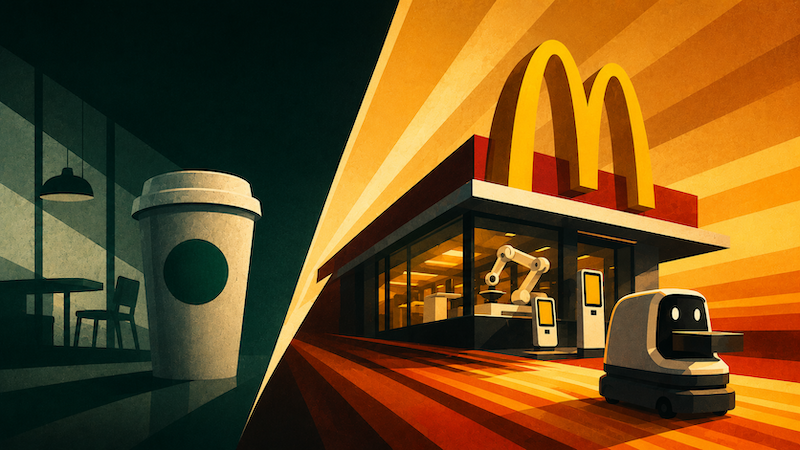
Three days ago on State of Brand we ran a piece on Starbucks pulling the plug on its inventory AI, the tool it had rolled out to 11,000 stores on the strength of a 99% accuracy number. An internal memo retired the whole thing in one line and sent baristas back to counting milk by hand. The argument we made then was that it was a brand story, not just an AI story: a tool that needs a human to check every output doesn't save labor, it adds a second job, and the gap between the number at launch and the reality in the backroom is where the credibility goes.
On Monday, McDonald's stepped onto the same stage and made a much bigger bet.
The company unveiled a new global strategy called McDonald's Next, and the centerpiece is an AI operating system for its restaurants named ArchIQ. There is a drive-thru voice assistant nicknamed Archy running in five U.S. pilot locations with Google. The system is also pitched as a way to flag equipment problems before they turn into a breakdown. There is an accuracy-checking layer meant to stop the wrong order from reaching the window. The framing from leadership was that all of it exists to free crews from unnecessary work. "We can't ask our customers to choose," the CEO said, between hospitality and speed.
Hold that next to what a Starbucks executive said nine months ago, when the inventory tool was supposed to free partners to focus on "crafting drinks and connecting with customers." Same promise, same logic, same brand language about technology lifting the drudgery so people can do the part that needs a person.
One of those promises just collapsed in public. The other was announced this week as the future.
McDonald's has stood here before, and lost.
This is not McDonald's first attempt at this. In 2024 the company pulled an AI drive-thru voice system built with IBM out of more than 100 restaurants after a run of order mix-ups went viral, including a customer who ended up with hundreds of dollars of chicken nuggets. The tech was billed as the future then, too.
So Archy is the second swing. New partner, Google instead of IBM, new branding, same job. That is not automatically a mistake. Plenty of products fail on the first build and work on the second. But it changes what the company is actually claiming. McDonald's isn't pitching a promising idea. It is telling the market it has already cracked a problem it failed at once before, and naming an entire operating system after that claim.
The risk is the exact one that just took down NomadGo.
This is where it is worth slowing down, because McDonald's is walking toward the same trap Starbucks did.
Automated Counting didn't die because the AI was useless. It died because the AI was almost right. Close enough to greenlight, wrong often enough that a person had to verify every output, which meant the store was doing the task twice. A 99% number measured on a clean shelf does not survive a backroom mid-rush.
A drive-thru is that backroom, louder. Regional accents, background noise, kids in the back seat, someone changing their order halfway through, a menu that shifts by market. If Archy gets the order almost right, a crew member has to catch it and fix it before the food goes out. That isn't removed labor. It's a verification step bolted onto the old job. Any equipment-monitoring feature carries the same risk. An alert a manager has to investigate is only a gain if the alert is usually real.
Why the brand exposure is larger here.
Starbucks made one tactical mistake we flagged at the time. It scaled to 11,000 stores in roughly a month and proved the tool fast instead of proving it slowly. When it broke, though, the damage was contained. Automated Counting was a back-of-house tool most customers never saw or heard about. The company could retire it in a one-line memo and keep moving, and its turnaround numbers barely flinched.
McDonald's has built the opposite exposure. ArchIQ is not a quiet inventory utility. It is the named technology pillar of an entire company strategy, announced from the main stage, attached to the CEO's vision for what the brand becomes next. Archy talks straight to the customer. If it underperforms, there is no quiet memo. There is a viral clip of a botched order, the exact failure that ended the IBM version. When you put the brand promise in the customer's ear, you lose the option of walking it back in private.
What to take from it.
The Starbucks lesson was about a single accuracy number and the conditions it was measured in. The McDonald's situation points at the layer above that. Before you name a strategy after a technology, ask whether the technology has earned the spot, or whether you are anchoring the brand to a bet that is still running in five stores.
There is a version of this that works. AI that takes the order, catches the mistake, and flags the broken fryer, with a miss rate low enough that nobody has to babysit it. If McDonald's has built that, ArchIQ is a real edge and the rest of the industry ends up following. Automation isn't the wrong move. The trouble is that the company has told the market it won before the evidence is in, and the gap between the announcement and the proof is the same gap Starbucks just fell through.
Worth naming the backdrop. McDonald's is leaning on this push partly because value perception has slipped, with the share of U.S. customers calling it a good value down from roughly 55% in 2020 to around 40% by 2024. That is a real problem and technology is a reasonable lever to pull. But a brand under value pressure is a brand that can least afford a public, customer-facing tech embarrassment. The last time McDonald's stood where it is standing now, the order came out wrong and the internet noticed.
Three days ago the question was whether Starbucks scaled too fast. The question now is whether McDonald's watched the right company fail and learned the wrong lesson from it.