Nobel Laureate John Jumper Leaves Google DeepMind For Anthropic
The AlphaFold co-creator's exit comes a day after Gemini co-lead Noam Shazeer left for OpenAI. Two senior departures in two days, and a sharp reminder that the AI talent war is now the main event.


If this caught your attention, that’s not accidental.

The best editorial systems don’t happen by accident. Outlever builds them.

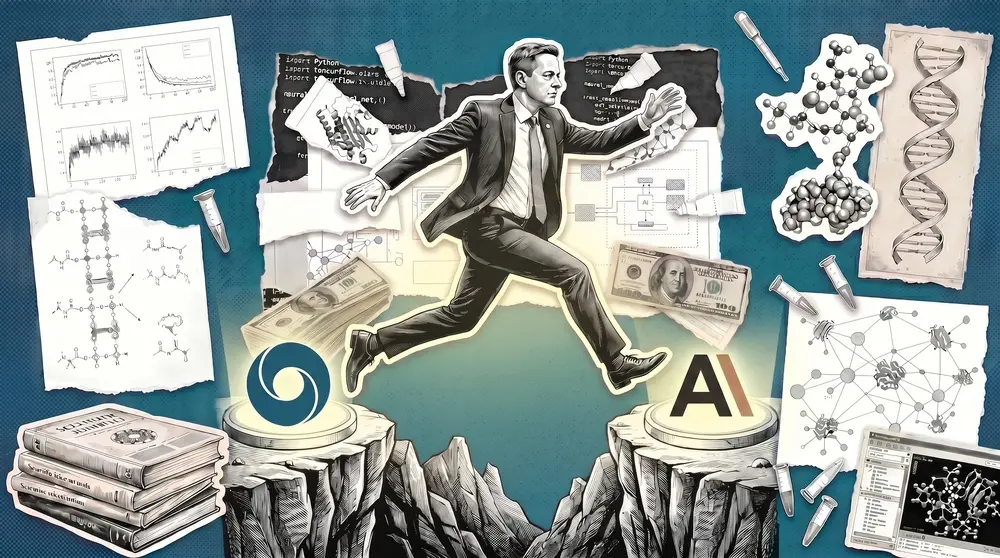
John Jumper, a vice president at Google DeepMind and one of the most decorated scientists in modern AI, is leaving the company to join Anthropic, he announced Friday. The move ends a tenure of nearly nine years and was first reported by Bloomberg.
Jumper is best known for leading the development of AlphaFold, the AI system that predicts the three-dimensional structure of proteins. The work is widely regarded as one of the most consequential scientific applications of machine learning so far, and it earned Jumper a share of the 2024 Nobel Prize in Chemistry alongside DeepMind CEO Demis Hassabis. More recently, he had become a key contributor to Google's AI coding efforts.
The terms of his new role are still unclear. Jumper has not said what he will do at Anthropic, and the company has not detailed his responsibilities. In his announcement he said he plans to take a short break before starting, and he thanked Hassabis for the early opportunity to lead the AlphaFold team shortly after he finished his PhD. Given his research record, most observers expect him to anchor a significant piece of Anthropic's scientific work.
A second blow to Google in 48 hours
The timing is striking. Jumper's exit comes a day after Gemini co-lead Noam Shazeer announced he was leaving Google for OpenAI, a move we covered in Google's Noam Shazeer moves to OpenAI. Shazeer, a co-author of the 2017 "Attention Is All You Need" paper that underpins virtually every frontier model, returned to Google less than two years ago in a deal reportedly worth around $2.7 billion. Losing him, and now Jumper, in back-to-back days shows how hard retention has become even at the very top of the field.
For Google, the departures arrive at an awkward moment. Gemini has closed meaningful ground on its rivals over the past year, and both exits remove senior figures closely associated with that progress.
The talent war is the strategy now
Step back from the two names and a clearer picture emerges. The frontier labs have concluded that the scarcest input in AI is not compute or data but the small number of people who can design and lead the systems at the edge of the field. With that pool so thin, poaching a rival's senior researchers does double duty. It adds capability, and it removes that same capability from a competitor.
OpenAI has been running this play hardest. It spent the past year hiring aggressively from rivals while expanding its commercial footprint, and Shazeer is the marquee result. Anthropic's counter is Jumper, a hire that signals scientific depth rather than raw model-architecture firepower. Both companies are reaching for the same thing: a roster that tells the rest of the industry where the gravity is.
The Shazeer case also reopens an uncomfortable question about whether enormous retention packages actually work. Google's reported $2.7 billion move to reacquire him was held up as proof that the giants would pay almost anything to keep the people who build frontier models. His exit, this soon, suggests money can buy presence but not permanence. When a researcher believes a rival sits closer to the frontier, a nine-figure reason to stay can lose to the pull of the work itself.
Why it matters
The backdrop is two of the most anticipated public listings in tech. OpenAI and Anthropic are both reported to be heading toward IPOs, with OpenAI said to be targeting a valuation as high as $1 trillion and Anthropic reportedly filing at around $965 billion. In that context, a high-profile hire is not only a research decision. It is a signal to the market about which company the field's best people want to be inside.
There is a cost to all of this. As the labs bid against each other for the same shrinking group of senior researchers, recruitment expenses climb across the sector, and that pressure eventually works its way toward the price of the products everyone uses. For now, though, the message of the past 48 hours is simpler. In the AI race, the people are the product, and they are moving.
If this caught your attention, that’s not accidental.

The best editorial systems don’t happen by accident. Outlever builds them.


Get the latest AI insights first.
Sign up for updates, interviews, and fresh analysis on how AI is reshaping business, brands, and technology.