Google's Noam Shazeer Defects to OpenAI as the AI Talent War Heats Up
The researcher whose ideas sit behind nearly every large language model in use today is changing teams again.


If this caught your attention, that’s not accidental.

The best editorial systems don’t happen by accident. Outlever builds them.

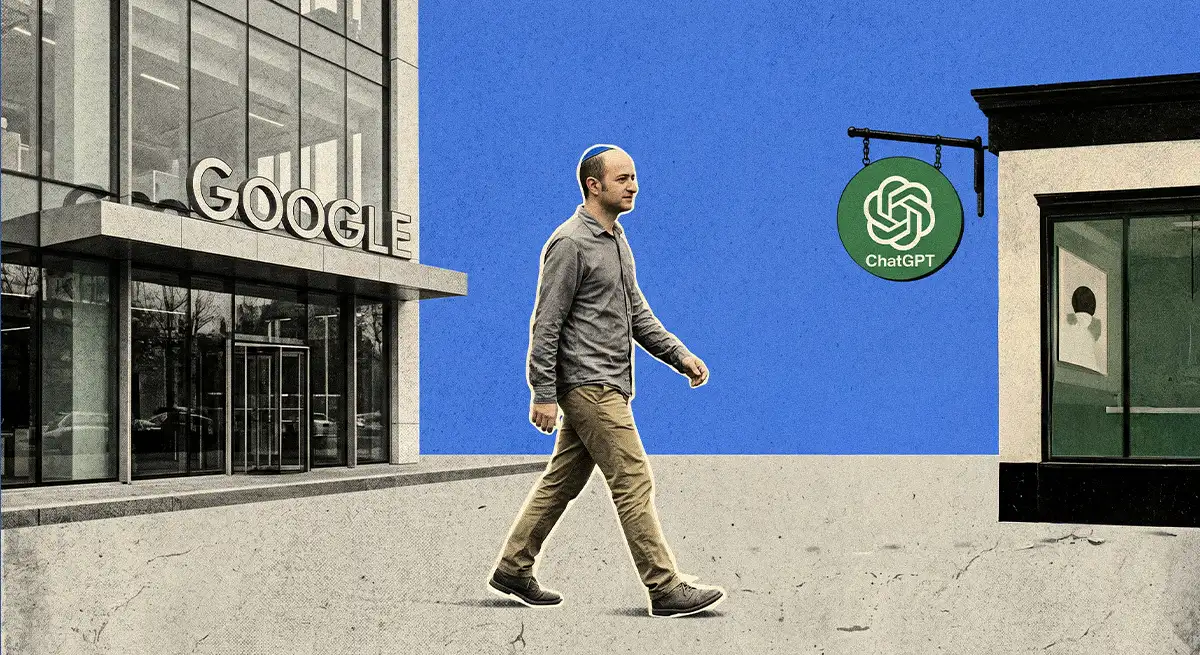
The researcher whose ideas sit behind nearly every large language model in use today is changing teams again. Noam Shazeer, VP of engineering at Google, co-lead of its Gemini models, and a co-author of the 2017 paper that introduced the transformer architecture, announced on June 18 that he is leaving Google to join OpenAI. The move was confirmed by Reuters, The Information, and others, and Shazeer disclosed it himself in a post on X. Bloomberg called it a coup for the startup.
It is the highest-profile defection of the year so far, and a clear win for OpenAI as it heads toward a likely IPO.
A returning star, leaving again
This is the second time Shazeer has walked out of Google's doors. He first joined the company in 2000, where his early work included improvements to the search engine such as the spell checker, as The Decoder recounts. He left in 2021 to co-found the chatbot startup Character.AI, reportedly after Google declined to release his "Meena" conversational model.
Then came the reunion. In 2024, Google brought Shazeer back through a deal valued at roughly $2.7 billion, primarily a licensing arrangement for Character.AI's technology that also returned Shazeer, co-founder Daniel De Freitas, and a slice of the research team to the company. (Some accounts, including a LinkedIn News summary, put the figure closer to $2.5 billion.) The stated goal was to strengthen Google's reasoning models, which had been trailing OpenAI and Anthropic. Once back, Shazeer co-led Gemini development alongside Jeff Dean and Oriol Vinyals.
Now, less than two years after that expensive homecoming, he is leaving for the competition. In his X post, Shazeer described it as a hard call to make and said he was proud of what the Gemini team had built. Google kept its response gracious, telling Reuters it was grateful for his contributions and wishing him well.
What he'll do at OpenAI
According to citybiz, which cited OpenAI Chief Research Officer Mark Chen, Shazeer is joining as Lead for AI Architecture Research, overseeing work on the fundamental design of next-generation models. That is a fitting brief for someone whose name sits on "Attention Is All You Need," the 2017 paper that introduced the transformer, the architecture underpinning everything from OpenAI's GPT line to Google's own Gemini.
OpenAI has effectively hired one of the people who drew the original blueprint to help design what comes after it.
Why the timing matters
The move lands at a charged moment. OpenAI is widely reported to be preparing for a public offering, and a marquee research hire ahead of an IPO sends a strong signal to investors and customers about where momentum sits. It also deals a visible blow to Alphabet, which spent billions to reacquire Shazeer's talent and is now watching it walk to its fiercest rival, a point Seeking Alpha flagged for investors.
The wider context is an escalating, expensive scramble across the frontier for the small number of people who can meaningfully move the needle on model capability.
Anthropic's hiring run
Shazeer's jump does not sit in isolation. The same dynamics have reshaped Anthropic, which has pulled senior people from OpenAI, Google, xAI, and Microsoft throughout 2026.
The clearest parallel came in May, when Anthropic landed Andrej Karpathy, an OpenAI co-founder and former Tesla AI lead, to build a team focused on using Claude to accelerate pretraining research, CNBC reported. As State of Brand noted, Karpathy arrived without the usual gardening-leave cooldown, and his hire came as Anthropic positioned itself to surpass OpenAI's private-market valuation. The same outlet pointed out that Karpathy had publicly rated copywriting as among the most AI-exposed jobs, then joined a company paying up to $400,000 for a head of copy, a tension that reveals how these labs actually value human work.
That detail connects to a broader build-out State of Brand has tracked: a full in-house Creative Studio hiring sprint, with a Head of Copy & Content role listed at $320,000 to $400,000 and a Copy Lead for Enterprise at $255,000 to $320,000. The company's job listings reportedly emphasize craft and making things by hand, using AI selectively, a deliberate posture for a lab valued north of $30 billion and reportedly eyeing its own IPO. As Anthropic president Daniela Amodei has framed it, the qualities that make us human only grow more valuable as the models get more capable.
The takeaway
Read together, the Shazeer and Karpathy hires show the shape of the current race. The frontier labs now compete on compute, benchmarks, and the handful of researchers and leaders who define what gets built next, and they are paying accordingly. OpenAI just took the co-author of the transformer off Google's roster. Anthropic just took an OpenAI co-founder off the open market. Google is short one Gemini co-lead it paid billions to keep.
For Shazeer, it is another chapter in an unusually winding career. For everyone else, it is a reminder that in 2026 the scarcest asset in AI is the person who knows what to build, not the hardware or the model weights.
If this caught your attention, that’s not accidental.

The best editorial systems don’t happen by accident. Outlever builds them.


Get the latest AI insights first.
Sign up for updates, interviews, and fresh analysis on how AI is reshaping business, brands, and technology.