For three years, the AI boom has been told as a story of winners: chipmakers printing money, hyperscalers racing to build data centers, startups raising billions. On Tuesday, the market got a brutal look at the other side of that ledger. IBM shares crashed as much as 26%, the company's worst intraday drop in nearly six decades, and the reason was AI itself.
IBM warned that second-quarter earnings and revenue would land well below Wall Street's expectations, with preliminary revenue of $17.2 billion against estimates of roughly $17.9 billion and adjusted earnings of $2.93 per share versus the $3.01 to $3.02 analysts expected, per FactSet and LSEG data. A 4% miss doesn't normally erase a quarter of a company's market value. What terrified investors was why it happened.
AI spending didn't lift IBM. It drained it.
In a letter to investors, CEO Arvind Krishna described a shift he admitted he never saw coming. In the final weeks of June, enterprise customers abruptly redirected their capital budgets toward servers, storage, and memory, scrambling to lock in supply-constrained AI infrastructure before expected price increases hit. "We did not anticipate the magnitude of the capex reprioritization," Krishna wrote, conceding that the company "faltered."
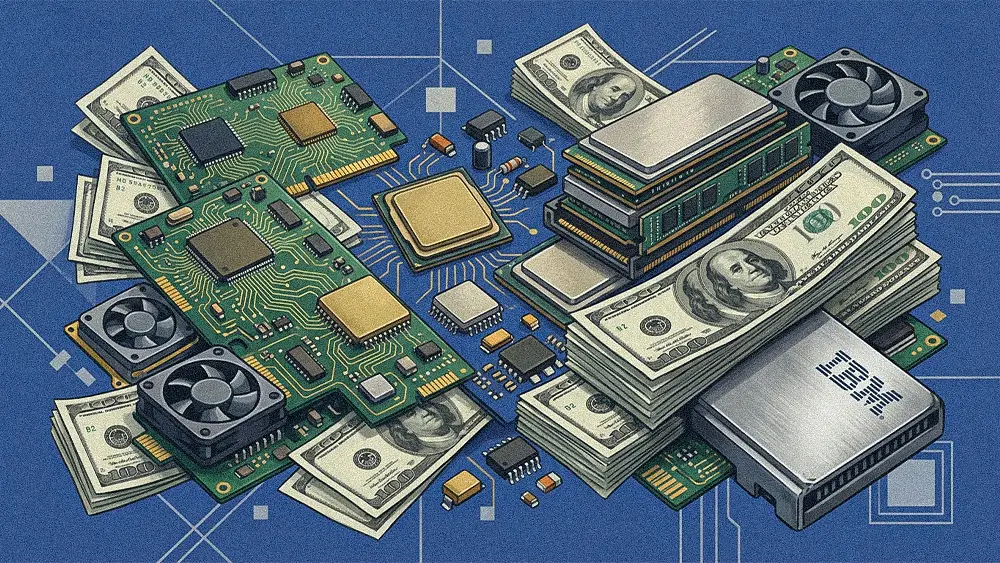
Here is the mechanism in plain terms. The AI buildout has created a global shortage of the raw materials of computing: GPUs, DRAM, high-bandwidth memory, server capacity. Prices are rising, supply is rationed, and enterprise buyers know it. So when June's budget decisions came due, they hoarded AI hardware and deferred everything else. The software renewal could wait. The consulting engagement could wait. The mainframe refresh could definitely wait.
Everything that waited was IBM's business. The Z mainframe line, which Krishna said had just posted the strongest start to a cycle in company history with the z17, fell short and dragged down the software attached to it, particularly transaction processing. Large deals IBM expected to close simply slipped as customers rewrote their priorities mid-quarter to feed the AI machine.
The AI boom is a budget war, and legacy tech is losing
Investors immediately understood that this wasn't an IBM problem. It was a warning shot for every company on the wrong side of the AI budget line. Reuters reported that the warning pressured software stocks broadly, and IBM's peers were already limping into Tuesday: Oracle down 33% year to date, Microsoft roughly 20%, Accenture cut in half.
The pattern is stark. Corporate IT budgets are not infinite, and AI is not expanding them fast enough to pay for everything. Instead, AI is cannibalizing them. Every dollar spent stockpiling GPUs and memory is a dollar pulled from traditional software, services, and legacy infrastructure. The companies selling AI's inputs are riding a historic supply crunch. The companies selling everything else are discovering they were the funding source all along.
The bitter irony: IBM sells AI too
What makes Tuesday sting is that IBM has spent years rebuilding itself as an AI company. Watsonx, the Granite model family, AI-enabled mainframes, a consulting arm retooled around enterprise AI adoption. The whole pitch was that Big Blue would ride this wave, not drown in it. Instead, the AI transition it has been selling to customers moved faster and more violently than IBM itself could adapt to, and the company got run over by the very spending shift it was built to capture.
Full results arrive on July 22, and Krishna's task is to convince investors that June was a timing problem, with deals delayed rather than lost, and not the opening move in a permanent reallocation of enterprise spending toward AI infrastructure. The 26% haircut suggests the market has already picked its answer.
In 1968, IBM's worst days came from a computing revolution it controlled. This one came from a computing revolution it can only chase.