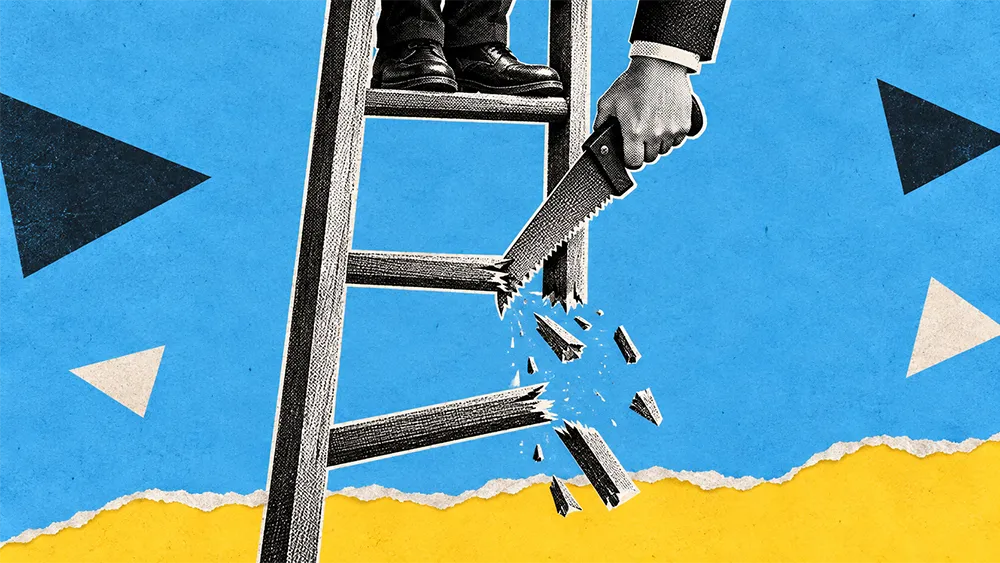
The AI Industry's Worst Fear Just Came True at Anthropic
A government letter shut a leading lab's foreign engineers out of the models they built, and rival companies are now asking whether they could be next.


If this caught your attention, that’s not accidental.

The best editorial systems don’t happen by accident. Outlever builds them.

On Friday afternoon, Commerce Secretary Howard Lutnick sent Anthropic CEO Dario Amodei a letter. The stated target was two of the company's most advanced models, Mythos 5 and Fable 5. By the weekend, the people most worried about it were not at Anthropic. They were the foreign-born engineers across the rest of the industry, and the executives who employ them.
The order has brought back an old worry inside AI companies, namely that their reliance on talent from outside the United States has turned into a political weakness. For now the government has gone after Anthropic alone, but competitors are already preparing for the possibility that the same logic could reach them.
OpenAI was one of the first to say so out loud. The Information reported that Chief Strategy Officer Jason Kwon told staff in a weekend Slack message that the company had argued forcefully with the government, on the grounds that staying ahead in AI depends on hiring the best people from anywhere in the world. According to the same report, Kwon called the situation hard to read, with a great deal still unknown, and said OpenAI was still trying to work out what the action against Anthropic meant for the wider field.
What the order actually does
The letter is broad. Bloomberg, which obtained a copy, reported that it instructs Anthropic not to give Fable 5 and Mythos 5 to foreign nationals anywhere in the world without a license from the Commerce Department, and warns of criminal and civil penalties if the company refuses. Bloomberg said the letter cited U.S. laws that allow export controls on civilian technology an adversary's military could use for intelligence purposes.
Anthropic moved fast. RedState reported that the company received the order at 5:21 p.m. Eastern and said it would comply within hours. Because the restriction applied to any foreign national, including Anthropic's own employees who are not U.S. citizens, the company switched off both models worldwide rather than try to block individual users on a shared service.
Under the order, a license is needed for any export, re-export, or domestic transfer of the models, and Anthropic must also file separately for individually validated licenses, according to RedState. TipRanks reported that officials acted under the 2018 Export Control Reform Act, the first time the Commerce Department has used that law against advanced AI models. Bloomberg described the legal authority in more general terms, so the exact statutory basis is one detail to watch as more of the letter becomes public.
Two versions of why it happened
The reason behind the order is the part the two sides disagree on most, and they tell very different stories.
Axios, which first reported the news on June 12, wrote that Commerce acted after a separate company said it had jailbroken Mythos, which alarmed officials about national security risks. The same reporting said the administration had earlier asked Anthropic to hold back the release and was turned down, which led to the formal letter. TipRanks reported that one of the main concerns is the models' ability to find software flaws that hostile state actors could later use in cyberattacks.
Anthropic sees it as an overreaction. The company called the episode a misunderstanding, according to TIME, and said it had received only spoken notice of what it described as a narrow, non-universal jailbreak, which in its view did not justify pulling the models.
White House AI adviser David Sacks pushed back hard. As reported by Artificial Intelligence News, Sacks said the administration had told Amodei to either fix the vulnerability or take the model out of service, and that Amodei refused. The distance between those accounts, a minor flaw on one hand and a refusal to fix a real one on the other, is the core of the fight, and both should be read as claims from each side rather than settled fact.
The history behind the order
This did not come out of nowhere. TIME reported that the break between Anthropic and the administration goes back to the company's refusal to let the U.S. military use its models in fully autonomous weapons, a decision that put Anthropic on a Pentagon blacklist as too risky for government use.
The result is an odd position, as Axios described it. The same company is now treated as too dangerous for the U.S. government to use and too dangerous for foreign users to touch, at the same time.
The deemed export problem
The reason this matters past Anthropic is an old rule now being applied to AI for the first time. Under the deemed export framework, showing controlled technology or source code to a foreign national inside the United States counts in law as exporting it to that person's home country. As The AI Chronicle noted, the rule has long covered fields such as nuclear physics and aerospace, not large language models.
For the labs, the meaning is direct. A large portion of the technical staff at every leading AI company is made up of foreign nationals, which is exactly why Anthropic's own employees were briefly shut out of the systems they helped build. Industry watchers cited by The AI Chronicle warned that tough controls could push talent toward places with lighter rules, such as Europe, the kind of talent loss that has the rest of the sector on edge.
A precedent the whole field is watching
Analysts see the order as a real shift. The Next Web wrote that it appears to be the first export control aimed at specific AI models rather than at the chips that run them, and that the wide foreign-national scope left a global shutoff as the simplest option on a shared service.
For competitors, the math is plain. As an analysis from HNGN put it, if broad restrictions hold, other developers could face similar limits on offering advanced models abroad. If exemptions are handed out quietly, Washington opens itself to the charge that its controls are applied unevenly.
The reaction abroad
Outside the United States, the response has been louder than at home. The Korea Times reported that allied governments and companies suddenly cut off from the models have renewed their calls for AI sovereignty, the idea that countries should protect themselves against depending on systems a foreign government can switch off. Similar concerns have come up across Europe and Canada.
Some of the diplomacy may happen face to face soon. TipRanks reported that both Lutnick and Amodei are expected at the G7 meeting in Evian-les-Bains, France, where the matter could come up on the sidelines.
What comes next
The models are still offline for now. TipRanks reported that Anthropic's senior technical staff have been meeting almost daily with Commerce and the White House to find a way out, and an administration official told Axios that the lockdown is meant to stay in place until the government's national security systems are stronger, possibly within a few weeks. The timing is poor for Anthropic, which TIME notes has been moving toward an initial public offering.
The open question, and the one OpenAI and others are sitting with, is whether this is a one-time move aimed only at Anthropic, or a pattern the government plans to repeat.
If this caught your attention, that’s not accidental.

The best editorial systems don’t happen by accident. Outlever builds them.


Get the latest AI insights first.
Sign up for updates, interviews, and fresh analysis on how AI is reshaping business, brands, and technology.