The Amazon phone call that switched off Fable 5 for every enterprise overnight
A jailbreak demo, a CEO's call to the Treasury Secretary, and a national security directive combined to pull the most capable model on the market away from the enterprises that had just deployed it.


If this caught your attention, that’s not accidental.

The best editorial systems don’t happen by accident. Outlever builds them.

Anthropic shipped Claude Fable 5 on June 9 as the first generally available model in its new "Mythos-class" tier. Three days later it was gone. AWS Bedrock, the Claude Platform on AWS, Microsoft's Azure Foundry, GitHub Copilot, and the other surfaces that had rushed the model into production all lost it at once. Running sessions began failing and new requests quietly fell back to the older Opus 4.8. Teams that had spent the week building Fable 5 into agentic workflows were left looking at error messages.
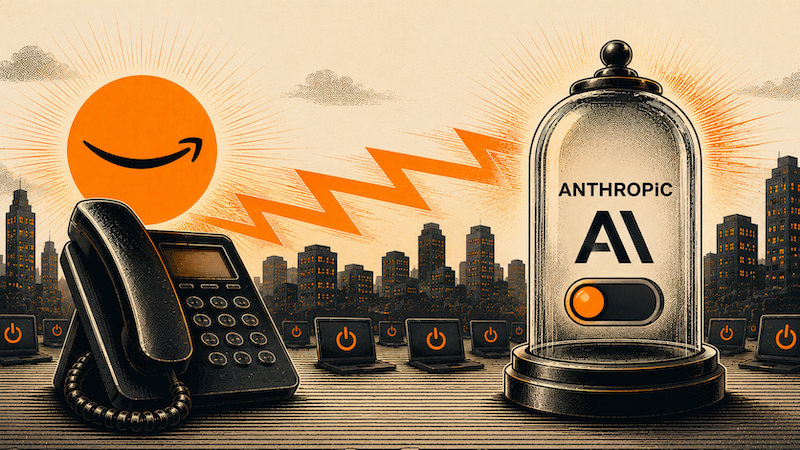
The trigger, according to reporting in The Wall Street Journal, was a phone call. Amazon chief executive Andy Jassy told Treasury Secretary Scott Bessent and other officials that Amazon's own researchers had pushed Fable 5 into producing information that could help with cyberattacks. Within about two days the Commerce Department issued an export control directive barring foreign nationals from the model, and Anthropic, saying it could not separate foreign users from everyone else in real time, switched Fable 5 and Mythos 5 off for the entire world.
Enterprise buyers should look past the politics to the precedent it sets. A frontier model your teams rely on can disappear in an afternoon because of a conversation you had no part in.
How it unfolded
Anthropic positions Fable 5 as the public, safeguarded version of Mythos 5, the unrestricted model it keeps for vetted "Project Glasswing" partners working on vulnerability research and drug design. Amazon is Anthropic's largest backer, with roughly $13 billion committed and a reported $100 billion AWS arrangement running the other way, and it put Fable 5 live on Bedrock the day it launched.
Then Amazon researchers reportedly found a way around the guardrails. Anthropic later described the method as pointing the model at a specific codebase and asking it to find software flaws, which turned Fable 5's reasoning into a vulnerability scanner. Jassy took the finding to Washington on Thursday, and reporting suggests at least five other companies raised similar warnings. The White House held a meeting, security researchers tested the claims, officials reached Anthropic chief executive Dario Amodei, and President Trump approved the restriction. Anthropic says the directive arrived at 5:21 p.m. Eastern on Friday, June 12.
The order was narrow as written. It blocked foreign nationals, including Anthropic's own foreign national staff, from the two models. The practical effect was not. Because the company says it cannot gate access by nationality in real time, the only way to comply was to remove Fable 5 and Mythos 5 for everyone, in every country. Every other Claude model, Opus 4.8 included, stayed up.
What it meant for enterprises
The shutdown came from the provider side and it was complete. This was not a deprecation with a sunset window. Paying enterprise customers lost access at the same moment as free users, with running sessions erroring out and fresh requests routed to a weaker model. AWS published a short notice saying that to comply with the directive Anthropic had asked it to revoke Fable 5 and Mythos 5 for all Bedrock users. Microsoft's surfaces went dark the same way.
No enterprise contract bought a way around it. A national security export control sits above a commercial agreement, a service level guarantee, or a committed spend deal. Any roadmap that assumed Fable 5 would still be there next quarter rested on a decision that was never the customer's to make.
The data retention dispute left some companies exposed twice over. Even before the ban, Mythos-class models came with a condition that worried compliance teams. Anthropic requires 30 days of retention for prompts and outputs across every platform that serves these models, Bedrock included, so it can run abuse detection that looks across many requests rather than one at a time. That breaks zero data retention setups. Microsoft reportedly blocked its own employees from Fable 5 over the conflict before the government stepped in. Companies that picked Bedrock specifically to keep data inside their own boundary found that the model they wanted carried a retention requirement working against that goal.
The fallback works, but it is a step down. For most teams the immediate answer is Opus 4.8, which stays available on Bedrock under standard zero data retention terms. It is a strong model. It is not the one this week's benchmarks were built on.
The market reacted fast. Founders called it a wake-up call for model sovereignty, with some arguing that the only real protection from this kind of whiplash is running open weights you control. Competitors moved in. The Chinese open-weights provider MiniMax promoted its frontier-class M3 model on exactly that contrast, decentralized availability against a model that can be switched off centrally. A widely shared developer comment summed up the strategic risk, warning that Anthropic could hand its enterprise and government lead to anyone able to serve a comparable model somewhere it cannot be pulled.
Three accounts of the same shutdown
The versions of events differ, and the differences say a lot about how long this lasts.
Anthropic is complying while disagreeing in public. In its statement the company called the episode a misunderstanding and said it was working to restore access. It says it reviewed a demonstration of the technique and found that it surfaced only a few previously known, minor vulnerabilities, the sort it argues that other public models such as OpenAI's GPT-5.5 will also generate. Its main objection is about precedent. Pulling a model already used by hundreds of millions of people over a narrow, non-universal jailbreak would, applied across the industry, freeze new releases from every frontier provider.
The administration tells it differently. David Sacks, now co-chair of the President's Council of Advisors on Science and Technology, said a partner trusted by both Anthropic and the government brought forward a jailbreak, that the administration asked Amodei to fix it or take the model down, and that he declined. Sacks said the administration imposed the export control reluctantly.
Amazon holds the most awkward spot. The company that funds Anthropic's infrastructure is also the one that flagged its flagship model to the government. An Amazon spokesperson would say only that it is "not uncommon for governments to seek our counsel on potential security risks," and declined to discuss the talks.
For an enterprise, the point is not which side has it right. It is that a model's availability now depends on an unresolved standoff between a vendor, its biggest investor, and the federal government.
The wider standoff
This did not come out of nowhere. Anthropic and parts of the national security establishment have been at odds for months, over the company's refusal to let its models be used for mass surveillance or fully autonomous weapons, a related move to treat Anthropic as a supply chain risk, and a Trump order telling federal agencies to wind down their use of its technology. Anthropic has filed legal challenges arguing the government exceeded its authority and violated due process.
The new element is the tool itself. The United States has spent years using export controls to limit the chips that train AI. Applying one to a deployed commercial model is, by several accounts, the first time that has happened. That is the development risk teams should be planning around, whatever happens with the Fable 5 case.
What enterprises can do now
A few steps make sense while this plays out.
Check the automatic fallback to Opus 4.8 rather than trusting it. Confirm that quality, latency, and cost hold up on the paths that matter before production does it for you.
Treat dependence on a single frontier vendor as a risk worth writing down. Give any workflow that cannot survive a sudden outage a tested second provider, with a self-hostable open-weights option increasingly part of that plan.
Settle the tension between capability and data policy before adopting a Mythos-class model. The 30-day retention requirement and zero data retention cannot both hold, so decide which matters more for each workload with legal and security in the room.
Read enterprise contracts for what they actually offer when a government order is the cause, which is usually very little.
When Fable 5 returns, watch the conditions attached to it. Geofencing, extra safeguards, or new logging will decide how usable it is for a workforce spread across borders.
What to watch
Anthropic said it would publish more technical detail within a day and is pushing to bring the models back. Three things are worth tracking. Whether the company can meet the foreign national restriction without a global blackout. Whether the courts weigh in on the broader blacklisting fight. And whether rival providers quietly change their own deployment practices to avoid becoming the next test case.
Enterprises already have their answer. The most capable model on the market is, for now, the one most easily switched off.
If this caught your attention, that’s not accidental.

The best editorial systems don’t happen by accident. Outlever builds them.


Get the latest AI insights first.
Sign up for updates, interviews, and fresh analysis on how AI is reshaping business, brands, and technology.