Part 1 of The State of AI's series on AI and the American workforce
The unemployment rate is sitting near historic lows. The economy added 172,000 jobs in May. And yet a Reuters/Ipsos poll released this week found that 53 percent of Americans believe AI could put them, or someone in their household, out of work.
That number deserves a second look, because it represents a majority of the country. What separates this poll from the AI panic surveys of 2023 is who's worried now. The fear cuts almost evenly across age, gender, and education level. AI anxiety used to be a story about factory workers, then a story about copywriters and illustrators. Now it belongs to everyone.
What the numbers actually say
The six-day survey of 4,531 U.S. adults, completed Monday, found 53 percent of respondents worried about AI-driven job loss in their household. Another 37 percent said they weren't worried, and the remaining 10 percent were unsure or declined to answer. The margin of error is two percentage points.
A few fault lines show up under the surface. Democrats are more anxious than Republicans, 61 percent to 47 percent, a gap that likely reflects how differently the two parties' coalitions break down by education. There is also a usage divide: half of college graduates say they use AI regularly, compared to about a third of Americans without a degree. Familiarity with the technology has apparently done little to reassure the people who know it best.
Broader unease is climbing too. Some 73 percent of Americans say they're concerned about increasing AI use, up from 68 percent in a comparable 2023 survey. Three years of living with these tools hasn't normalized them. If anything, the country has grown more nervous.
The fear has receipts
It would be easy to write this off as mood. The layoff data says otherwise. The poll landed after the worst month for tech layoffs in nearly two years: 38,242 announced job cuts in May, according to outplacement firm Challenger, Gray & Christmas. That brings the sector's 2026 total past 123,000, a 66 percent jump over the same period last year. For the third straight month, AI was the single most cited reason employers gave for cutting jobs.
The names attached to those numbers are familiar ones. Meta is working through roughly 8,000 cuts it framed as freeing up money for its AI push. Intuit told staff it would shed 17 percent of its global workforce. Salesforce, which has openly credited AI agents with absorbing thousands of customer support roles, made fresh cuts this week on top of a January round. A pattern emerges quickly: the companies building the AI future are also the ones most aggressively restructuring around it.
The economy refuses to cooperate with the panic
Total U.S. layoff announcements in May reached their highest monthly level since the depths of the pandemic, and the national unemployment rate barely moved. Job growth stayed solid. Outside of technology, layoffs have remained relatively contained.
Even inside tech, the picture is messier than the headlines suggest. The sector announcing the most cuts also has the largest hiring plans of any industry this year. Google, Amazon, Microsoft, and Meta are projected to spend a combined $725 billion on AI infrastructure in 2026. That money builds data centers, but it also funds AI engineering, data, and infrastructure roles, even as recruiting, HR, and legacy software jobs disappear. Andy Challenger, whose firm tracks the layoff data, said AI has not yet produced the "jobpocalypse" some predicted, and that the real question is how fast the workforce changes, not whether it does.
Two truths at once
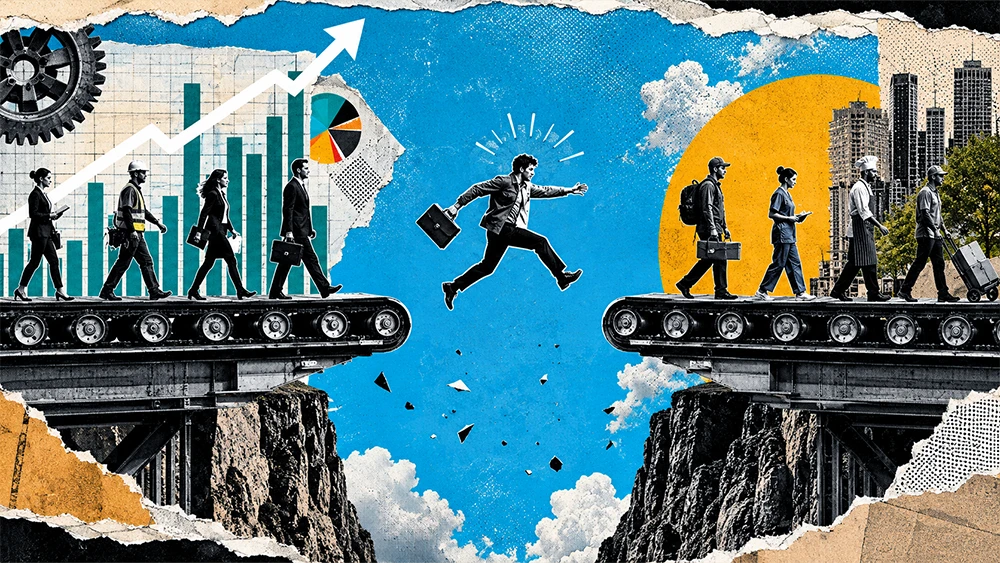
So is this a crisis or just churn? The honest answer is that we are watching a reallocation that feels like a crisis to the people inside it. A 62-year-old freelance writer who loses advocacy work to a chatbot doesn't experience "labor market reshaping." She experiences unemployment. Multiply her by every customer support agent, recruiter, and junior analyst whose role just got automated, and you get a country where the aggregate statistics look fine while the dinner-table conversation does not.
That distance between the macro data and the household-level fear may be the defining economic anxiety of 2026. It explains how 53 percent of Americans can be bracing for impact while economists point to a roughly 4 percent unemployment rate and see little cause for alarm. Both are telling the truth. They are simply measuring different things.
Over the coming weeks we'll be unpacking this divide piece by piece: who is actually losing jobs to AI (and who is quietly gaining them), why the fear splits along political lines, what the $725 billion infrastructure bet means for the next decade of work, and what the people on the wrong side of the transition want the rest of us to understand.